Good Documentation Practices (GDocP) form a fundamental component of pharmaceutical quality systems. They provide a structured approach to creating, managing, and maintaining records that accurately reflect activities performed and decisions made throughout a product’s lifecycle.
Clear, accurate, and verifiable documentation is essential for demonstrating compliance, supporting batch release, enabling effective investigations, and maintaining regulatory confidence. Weak or poorly governed documentation is no longer an administrative issue. It affects traceability, complicates decision-making, and can undermine the reliability of the quality system.
In recent years, expectations have evolved beyond basic recording rules. Concepts such as ALCOA++ place greater emphasis on data integrity, long-term availability, traceability of changes, record security, and preservation of context. This reflects a shift from simply documenting activities to ensuring that recorded information can be trusted, reconstructed, and defended as needed.
This article provides a structured overview of Good Documentation Practices, their regulatory basis, practical application, common weaknesses observed in inspections, and considerations for implementing and sustaining GDocP within daily operations.
What Is Good Documentation Practice (GDocP)?
Good Documentation Practice (GDocP) refers to the principles and controls governing the creation, recording, review, correction, handling, storage, and retention of documents and records in pharmaceutical operations.
Its primary purpose is to ensure that documentation accurately reflects the activities performed and provides reliable evidence to support regulatory compliance, product quality, and quality system decision-making.

GDocP applies to all documentation generated throughout the product lifecycle, including:
- Manufacturing and in-process records
- Laboratory and analytical data
- Batch manufacturing and packaging documentation
- Validation and qualification records
- Equipment, facility, and utility logbooks
- Maintenance and calibration documentation
- Training and personnel records
- Deviation, CAPA, complaint, and QMS records
- Electronic records and data generated through computerized systems
The same expectations apply to both paper-based and electronic systems.
SEE ALSO: Different Types of GMP Documentation Used In Pharma Industry
Good Documentation Practice ensures that records are:
- Accurate and representative of actual activities
- Complete and free from unexplained gaps
- Legible, clear, and understandable
- Recorded contemporaneously
- Secure and protected against loss or manipulation
- Available and retrievable throughout the defined retention period
GDocP is closely linked to data integrity expectations and is reinforced through ALCOA++ principles, which emphasize records that are attributable, legible, contemporaneous, original, accurate, complete, consistent, enduring, available, traceable, contextualized, and reliable.
The Importance of Good Documentation Practice
Good Documentation Practice is critical because pharmaceutical systems rely on documented evidence to demonstrate compliance, justify actions, and support product quality decisions. Records are not optional administrative outputs. They are an integral part of the quality system.
A key reason for GDocP’s importance is the protection of data integrity. Records must accurately represent the activities, observations, and results they describe.
GDocP is also fundamental to regulatory compliance. Authorities such as the FDA, EMA, MHRA, TGA, WHO, and PIC/S place strong emphasis on documentation standards. Inadequate documentation is one of the most frequent causes of inspection findings. In severe cases, poor documentation can contribute to enforcement actions, operational restrictions, or product recalls.
Below are the key functional reasons GDocP is essential to daily operations.
Traceability and Accountability
Accurate, comprehensive documentation enables full traceability of operations and provides a complete historical record of activities. This supports:
- Identification of what was done, when, how, and by whom
- Reconstruction of events in case of deviations or failures
- Clear attribution of responsibilities and actions
Traceability and accountability are essential for effective investigations, root cause analysis, and CAPA execution.
Supporting the Quality Management System (QMS)
Documentation is a fundamental element of the Pharmaceutical Quality Management System. Strong GDocP supports:
- Demonstration that processes operate as approved and as validated
- Monitoring of process performance and product quality
- Consistency of operations and prevention of uncontrolled practices
- Reliable measurement and review of quality performance
Good documentation strengthens overall system robustness and supports continuous improvement.
Facilitating Regulatory Compliance
During inspections and audits, documentation serves as primary evidence that products are manufactured, tested, stored, and distributed in compliance with GMP requirements. Non-conformance in documentation can lead to:
- Regulatory observations and citations
- Increased inspection frequency or follow-up actions
- Operational and business impact
- Loss of regulatory confidence
Strong GDocP supports both routine compliance and ongoing regulatory trust.
SEE ALSO: 10 Tips on How to Prepare for a GMP Inspection
Enhancing Transparency in Decision Making
Quality decisions in pharmaceutical environments must be based on reliable data. Comprehensive documentation:
- Supports QA review and approval processes
- Justifies batch release decisions
- Strengthens investigation outcomes
- Supports risk-based assessments
Good documentation ensures that decisions are transparent, traceable, and defensible.
Mitigating Risks and Protecting Product Integrity
Failures in documentation create uncertainty and risk. Effective GDocP helps prevent data gaps, recording errors, and uncontrolled practices. This contributes to:
- Early detection and management of issues
- Reliable deviation handling
- Appropriate CAPA implementation
- Protection of product quality and patient safety
Enabling Continuous Improvement
Historical documentation provides valuable insight into performance trends and recurring challenges. Reliable records enable organizations to:
- Identify process variability or recurring deviations
- Strengthen controls
- Improve operational efficiency
- Support strategic quality improvements
Good Documentation Practice, therefore, supports both compliance and long-term quality maturity.
ALCOA and the Evolution to ALCOA++
ALCOA and its expanded forms define what constitutes “good quality data” in pharmaceutical operations. These concepts underpin Good Documentation Practice and data integrity expectations across international regulatory frameworks.
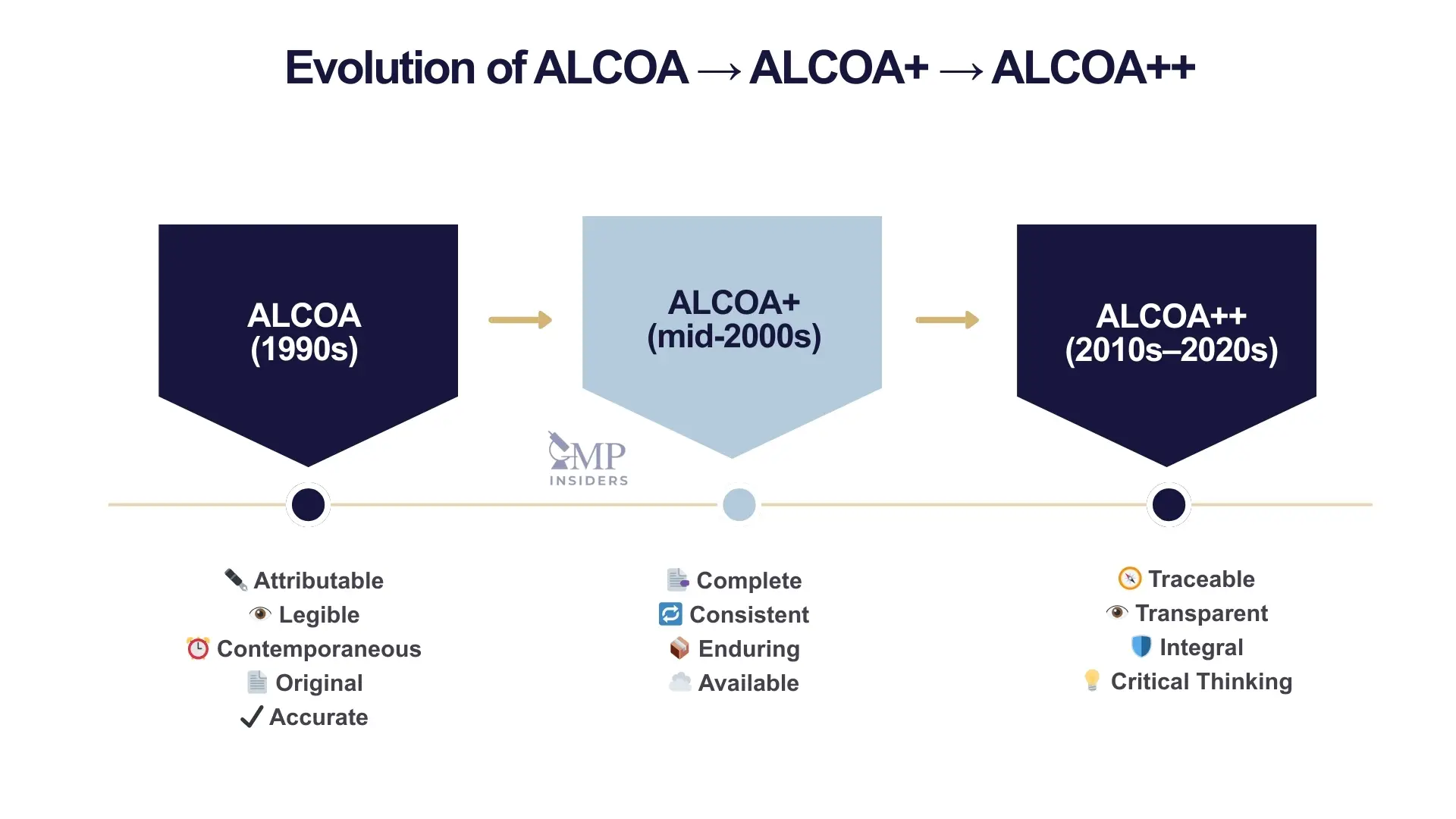
Initially introduced by the FDA and later reinforced by the EMA, MHRA, WHO, and PIC/S, ALCOA provides a structured framework for evaluating whether records can be trusted, used for decision-making, and relied upon during inspections.
ALCOA Principles
ALCOA refers to five essential attributes that every record must demonstrate:
Attributable
It must always be clear who performed an action, who made an entry, and when it was performed. Records must identify the responsible person through signatures, initials, or secure electronic user identification.
Legible
Records must be readable, understandable, and permanent throughout the retention period. Information must remain interpretable even years later during inspections, audits, or investigations.
Contemporaneous
Entries must be recorded at the time the activity takes place. Delayed or retrospective recording introduces risk of inaccuracy and weakens data credibility.
Original
Records must be the first capture of data or a verified true copy that preserves all essential information, including metadata where applicable.
Accurate
Data must correctly represent the activity, measurement, or observation. Records must be free from undocumented changes, manipulations, or transcription errors.
ALCOA+ Enhancements
Over time, regulators recognized that ALCOA alone did not fully address the growing complexity of documentation, particularly in electronic environments. As a result, ALCOA+ was introduced, expanding expectations to include additional attributes.
ALCOA+ principles emphasize that records must be:
- Complete: All data, including repeat measurements, aborted runs, deviations, and supporting information, must be included.
- Consistent: Records must follow a logical sequence, with aligned timestamps and documented process flow.
- Enduring: Records must be durable and maintained in validated, secure systems or controlled physical formats to prevent loss or deterioration.
- Available: Records must be readily retrievable for review, audits, and inspections throughout their retention period.
These expectations reinforce the need for strong control over documentation systems, both paper-based and electronic.
Transition to ALCOA++
With advances in digitalization, increased reliance on computerized systems, cloud environments, and outsourced data handling, regulatory expectations have evolved further. ALCOA++ extends the framework beyond record attributes to encompass broader data governance, system reliability, context preservation, and lifecycle control.
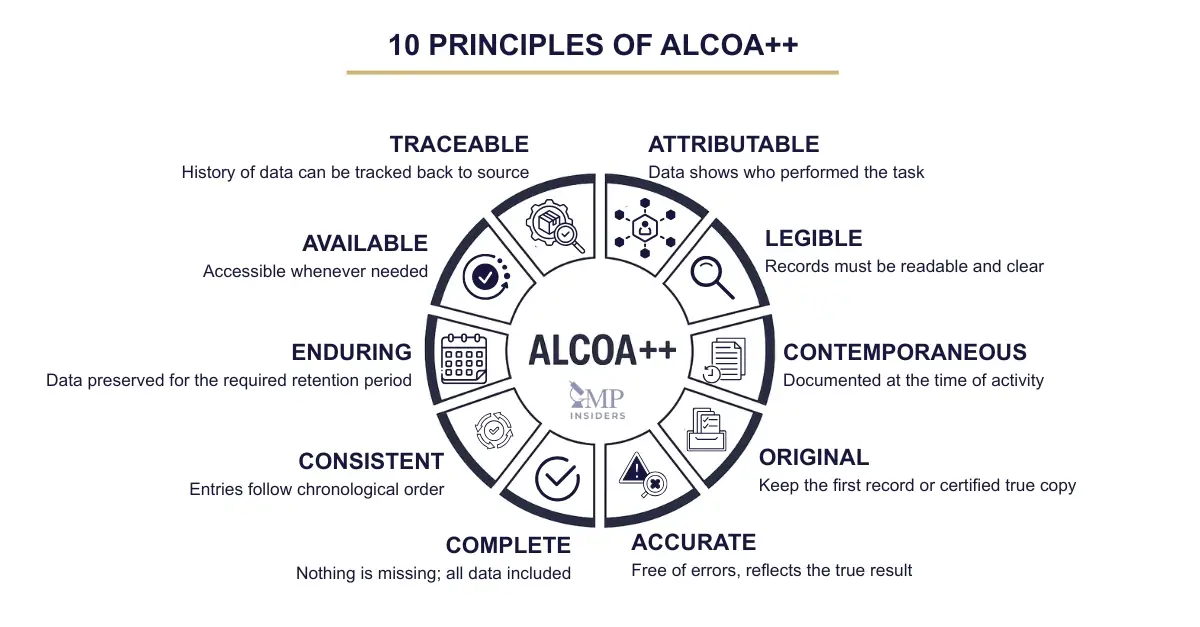
ALCOA++ places greater emphasis on:
- Traceability: The ability to track every change, identify all modifications, and reconstruct who did what, when, and why.
- Transparency: No hidden data, uncontrolled workarounds, undocumented edits, or shadow records. All relevant data must be visible and governed.
- Reliability: Records and systems must consistently function as intended, supported by validation, secure design, and controlled processes.
- Integrity Assurance: Data must be protected against intentional manipulation, unauthorized access, accidental loss, and cybersecurity threats.
- Context Preservation: Metadata, audit trails, and supporting information must be retained to ensure that records are not only present, but also meaningful and interpretable.
Core Elements of Good Documentation Practice in Daily Operations
Good Documentation Practice is applied through disciplined daily execution. Beyond high-level principles, organizations must ensure that documentation is completed correctly, in real time, and in accordance with approved procedures. The following elements represent the fundamental operational expectations consistently emphasized by regulatory authorities.

Recording Rules and Documentation Conduct
Documentation must be completed in a controlled, consistent, and transparent manner. In practice, this means:
- Records must be completed at the time the activity is performed
- Entries must be permanent and made using approved writing tools or validated electronic systems
- Information must be clear, unambiguous, and easy to interpret
- Each entry must be attributable to the person who performed the activity
- Only authorized personnel may complete or modify GMP records
Prohibited practices include:
- Retrospective data entry without approved justification
- Use of correction fluid, erasing, overwriting, or obscuring data
- Unapproved alterations or undocumented changes
- Draft documentation used as official records without control
These controls support transparency and reduce the risk of undocumented manipulation.
Corrections and Error Handling
Errors should never be concealed. Regulatory expectations require transparency in how corrections are handled.
Acceptable correction practice typically includes:
- Drawing a single line through incorrect data, ensuring it remains readable
- Providing the correct entry nearby
- Including initials, date, and justification where appropriate
- Maintaining traceability of changes in both paper and electronic systems
For electronic systems, corrections must be recorded in controlled audit trails that capture user identity, timestamp, original entry, new entry, and, where applicable, the reason.
Time, Date, and Signature Requirements
Time stamping, dating, and signing records are essential to demonstrate accountability and contemporaneous documentation.
Key expectations include:
- Entries must be dated at the time they are made
- Times must be recorded where relevant to process integrity or sequence control
- Wet signatures or secure electronic signatures must be applied where required
- Electronic signatures must comply with Part 11 and Annex 11 expectations, including user authentication and link to the record
- Initials used must be identifiable through signature logs or equivalent control
These requirements support verification of when and by whom activities were performed.
Document Clarity, Structure, and Completeness
Documents must be structured to support correct use and reliable data capture. This generally includes:
- Clear titles, unique document identifiers, and version control
- Pagination (for example, page X of Y)
- Consistent format and standardized fields
- Clear instructions for completion
- Defined spaces for signatures, dates, and approvals
Blank spaces and ambiguous fields represent compliance risk. Therefore:
- Unused fields must be appropriately invalidated or marked “Not Applicable”, as per procedure
- Only approved document versions may be used
- Obsolete documents must be removed from routine use or clearly controlled
Handling of Blanks, Copies, and Transcription
Uncontrolled documentation practices are a frequent cause of inspection findings. To mitigate these risks:
- Blank forms must be controlled to prevent unauthorized use
- Photocopies should not substitute controlled originals unless defined and justified
- Transcription should be avoided where possible; where unavoidable, controls must exist to verify accuracy
- Raw data must always be retained and protected
For electronic systems, data must be captured and stored in validated environments, not transcribed into unofficial formats.
Security, Protection, and Retention of Records
Records must remain complete, readable, and protected for as long as they are required.
Organizations must ensure:
- Secure storage of paper records to prevent loss, damage, or unauthorized access
- Controlled access to electronic systems with defined user roles
- Validated backup and recovery mechanisms
- Protection of metadata and audit trails
- Compliance with defined retention periods
Systems must ensure sustained data reliability and accessibility, consistent with GMP and Annex 11 expectations, including those highlighted in the draft revision.
Controlled Document Lifecycle
Good Documentation Practice is not limited to how entries are written. It also extends to how documents and records are created, approved, issued, used, revised, archived, and retained.
A controlled document lifecycle ensures that only valid, approved information is used and that historical versions are preserved when required. That documentation remains reliable and available throughout its defined retention period.

Document Creation and Approval
Documents must be developed in a structured and controlled manner.
Key expectations include:
- Documents must be written clearly, accurately, and in alignment with applicable regulations and internal procedures
- Each document must have a defined owner responsible for its content and maintenance
- Drafts must be controlled and must not be used in operations
- Documents must undergo formal review to verify technical accuracy, clarity, and suitability for use
- Approval must be granted by authorized personnel, typically including Quality Assurance, where applicable
Approved documents must include:
- A unique document identifier
- Version or revision number
- Effective date
- Approval signatures and dates
- Defined status (e.g., effective, obsolete, superseded)
This ensures clarity on which document version is valid for use.
Document Issuance and Availability
Once approved, documents must be issued in a controlled manner to prevent unauthorized use or duplication.
Organizations should ensure:
- Only the current approved version is available at the point of use
- Obsolete documents are removed from operational areas or clearly marked to prevent accidental use
- Distribution of controlled documents (paper or electronic) is traceable
- Employees have access to the latest approved procedures and records required for their work
For electronic systems, user access rights must be clearly defined, controlled, and aligned with job responsibilities.
Use of Controlled Documents in Operations
During execution, documents must support consistent and correct performance of activities.
This means:
- Procedures must be practical, clear, and aligned with current practice
- Operators must use controlled documents during task execution
- Deviations from documents must be recorded and investigated
- Work must never rely on uncontrolled instructions or informal notes
Inspectors frequently assess whether actual practice aligns with documented procedures. Misalignment is a common source of regulatory findings.
Revisions and Change Control
Documents must be revised when processes change or when improvements are identified. Uncontrolled changes introduce risk and undermine data integrity.
Expectations include:
- The rationale for change must be documented and justified
- Impact assessment must consider training needs, validation requirements, and related documentation
- Revised documents must undergo review and approval before implementation
- Historical versions must be preserved as records
This ensures transparency and full traceability of procedural evolution.
Archiving, Retention, and Retrieval
Records must be retained for defined periods and must remain readable and accessible throughout their lifecycle.
Organizations must ensure:
- Archiving systems are secure, controlled, and protected against loss or deterioration
- Retention periods comply with regulatory and internal requirements
- Records are indexed or organized to enable timely retrieval
- Stored documentation remains legible, intact, and traceable to its origin
For electronic systems, retention must include preservation of metadata and audit trail information, consistent with Annex 11 and data integrity expectations, including those emphasized in the draft revision.
Protection of Records and Long-Term Control
Throughout their lifecycle, documents and records must be safeguarded against unauthorized access, manipulation, or accidental loss.
Key controls typically include:
- Defined user access levels
- Secure physical storage conditions
- Validated electronic systems with backup and a disaster recovery mechanism
- Periodic review of system integrity and documentation controls
- Protection of audit trails and metadata
These controls ensure the long-term reliability and availability of records necessary for compliance and decision-making.
Good Documentation Practice in a Digital Environment
Good Documentation Practice applies equally to paper-based and electronic records. However, electronic systems introduce additional requirements for data governance, data validation, metadata management, cybersecurity, and lifecycle control.
Regulatory authorities expect electronic data to provide at least the same level of reliability and traceability as paper records, with increasing emphasis on enhanced system and data integrity controls.
Computerized Systems and Regulatory Expectations
Computerized systems used for GMP activities must be:
- Validated for their intended use
- Controlled under defined procedures and governance structures
- Documented in terms of scope, configuration, and intended functionality
- Periodically reviewed to confirm continued suitability and compliance
Roles and responsibilities must be clearly defined between system owners, Quality Assurance, IT, and service providers.
Practical Tips
- Maintain a clear system inventory with defined criticality assessments
- Ensure validation documentation is complete, current, and reviewable
- Periodically verify that practice aligns with approved system procedures
- Define responsibilities in procedures (system ownership, QA oversight, IT support)
Metadata and Context Preservation
Metadata is part of the record in electronic systems. It provides essential context that allows understanding of when, how, and under what conditions data was generated.
Metadata typically includes:
- User identification
- Date and time information
- Instrument or system parameters
- Record status and version history
Metadata must be retained, protected, and reviewable. Records must not lose metadata through export or uncontrolled transfer.
Practical Tips
- Avoid relying on uncontrolled spreadsheets or local downloads
- Ensure exported reports do not strip metadata or audit trail information
- Clarify in SOPs what constitutes the “true record” for each system
Audit Trails
Audit trails are essential for demonstrating the transparency and trustworthiness of electronic data.
Regulatory expectations include:
- Automatic capture of data creation, modification, and deletion
- Capture of user identity, timestamps, old value, and new value
- Protection against alteration
- Routine review of audit trails, where appropriate
- Retention aligned with record retention requirements
Practical Tips
- Define when and how audit trails must be reviewed (routine and event-driven)
- Ensure reviewers are trained to interpret audit trails
- Confirm that audit trail configuration is validated and documented
Electronic Signatures
Where electronic signatures replace handwritten signatures, they must:
- Be uniquely linked to an individual
- Require secure authentication
- Be legally and procedurally equivalent to handwritten signatures
- Be permanently associated with the record
Practical Tips
- Avoid shared user accounts under any circumstances
- Maintain signature and authorization registers
- Ensure password policies are robust and enforced
System Security, Access Control, and Cybersecurity
Data integrity relies heavily on system security and user governance.
Organizations must ensure:
- Clearly defined user access roles
- Segregation of duties where appropriate
- Controlled authorization and timely removal of access
- Protection against unauthorized modification
- Cybersecurity measures to preserve continuity and integrity
The Draft Annex 11 places increased emphasis on resilience and cybersecurity.
Practical Tips
- Periodically review user access lists
- Remove access promptly when roles change
- Ensure administrative rights are justified and controlled
Backup, Recovery, and Business Continuity
Data must remain available and intact for the full retention period.
Requirements include:
- Regular, verified backups
- Validated backup and recovery procedures
- Recovery testing to confirm data integrity
- Preservation of metadata and audit trails during restoration
Practical Tips
- Test recovery scenarios, not just backup creation
- Document evidence of successful restore testing
- Include metadata and audit trail verification in recovery checks
Paper vs Electronic Records: Key Considerations
Both environments must meet GDocP expectations.
Paper environments require:
- Controlled forms
- Secure storage
- Clear correction and legibility standards
Electronic environments require:
- System validation
- Metadata and audit trail control
- Cybersecurity and access governance
No reduced expectations exist for electronic systems.
Practical Tips
- Avoid hybrid systems without a clear definition of the primary record
- Ensure alignment between SOPs, practice, and regulatory expectations
Implementing and Sustaining Good Documentation Practice
Establishing Good Documentation Practice requires more than issuing a policy or conducting a one-time training session. It involves structured governance, integration into the Quality Management System, alignment with operational reality, and continuous reinforcement through oversight and monitoring.
Implementation should address people, processes, systems, and culture.

Governance and Quality System Integration
GDocP must be clearly defined, formally documented, and integrated into the Quality Management System.
Key expectations include:
- A documented GDocP policy and supporting procedures
- Clear definition of documentation standards and responsibilities
- Alignment between procedures, actual practice, and training
- Defined ownership for documentation governance (often QA)
- Integration with other QMS elements (deviations, CAPA, training, validation, etc.)
Procedures should clearly specify:
- How documents and records are created, completed, and corrected
- Rules for signatures, dates, audit trails, and accountability
- How blank fields, copies, and templates are managed
- How documentation is reviewed, approved, archived, and retained
Practical Tips
- Avoid overly generic procedures. Tailor expectations to your actual operations
- Ensure procedures reflect both paper-based and electronic environments where applicable
- Link GDocP governance with data integrity governance to ensure consistency
Training and Competence
Personnel must understand not only what to document, but why it matters and how to do it correctly.
Effective training programs should include:
- Initial GDocP training for new employees
- Role-specific documentation training (manufacturing, QC, QA, engineering, IT, etc.)
- Periodic refresher training, especially following incidents or inspection trends
- Practical examples and case-based learning rather than only theory
Training must also address:
- Consequences of poor documentation
- Expectations for contemporaneous recording
- Corrective practices for errors and late entries
- Responsibilities when working with electronic systems
Practical Tips
- Evaluate training effectiveness, not just attendance
- Use real examples from internal audits or regulatory findings
- Focus on behavior and discipline, not only policy memorization
QA Oversight and Review Discipline
Quality Assurance plays a critical role in sustaining GDocP through structured oversight.
This typically includes:
- Formal review of records for accuracy, completeness, and compliance
- Defined review criteria and documented review outcomes
- Escalation of repeated or serious documentation deficiencies
- Participation in the investigation of documentation-related deviations
- Oversight of computerized system documentation controls
Good review practices prevent errors from becoming systemic weaknesses.
Practical Tips
- Use structured review checklists
- Ensure reviewers are trained to identify subtle documentation issues
- Treat recurring documentation weaknesses as quality system failures, not isolated mistakes
Monitoring, Trending, and Continuous Improvement
GDocP compliance should be monitored systematically rather than relying on individual observations.
Organizations should consider:
- Trending documentation-related deviations and audit findings
- Monitoring error types, frequencies, and responsible areas
- Identifying systemic contributors such as workload, poor document design, or unclear procedures
- Using CAPA to address recurring weaknesses
Data-driven monitoring strengthens governance and demonstrates a proactive approach.
Practical Tips
- Include documentation metrics as part of quality performance reporting
- Use periodic self-inspections to evaluate documentation quality
- Link documentation deficiencies to retraining, process changes, or system improvements where justified
Culture and Behavioral Expectations
Good Documentation Practice is ultimately sustained through culture and behavior. Regulators frequently emphasize that documentation integrity must be part of how the organization operates, not something practiced only during inspections.
Organizations should promote a culture where:
- Documentation is viewed as an essential part of the job
- Personnel feel responsible for accuracy and completeness
- Late entries and undocumented practices are not tolerated
- Transparency is valued more than convenience
- Leadership consistently reinforces expectations
Culture is demonstrated through daily behavior, not slogans.
Practical Tips
- Reinforce documentation expectations during routine management communication
- Recognize disciplined documentation behavior
- Address shortcuts and informal practices immediately
Regulatory Foundations of Good Documentation Practice
Good Documentation Practice is not an isolated concept. It is embedded throughout international GMP and quality regulations. Multiple regulatory authorities and harmonization bodies clearly define expectations for how records must be created, controlled, and maintained to support product quality and data integrity.
The principles of GDocP are reflected in the following key regulatory frameworks:
FDA Requirements
The United States Food and Drug Administration establishes documentation expectations primarily through:
- 21 CFR Part 211 (Current Good Manufacturing Practice for Finished Pharmaceuticals) – Relevant provisions include requirements for accurate records, retention, review, documentation of manufacturing and control activities, deviations, laboratory records, and batch records.
- 21 CFR Part 11 (Electronic Records, Electronic Signatures) – Defines requirements for electronic record credibility, system validation, audit trails, security, user access, and electronic signatures to ensure electronic data is equivalent to paper records.
FDA inspection findings consistently show that documentation deficiencies are among the most frequent causes of non-compliance observations, particularly incomplete records, retrospective entries, lack of control, and inadequate data integrity.
EU GMP Requirements
Within the European Union, documentation expectations are outlined in:
- EU GMP Volume 4, Part I and II: Specifies that documentation must be clear, accurate, contemporaneous, traceable, retained, and properly controlled throughout its lifecycle.
- EU GMP Annex 11: Computerised Systems (Current Version): Establishes expectations for validation, data integrity, system control, security, audit trails, backup, and recovery. Emphasizes that computerized records must be subject to the same documentation standards as paper.
Draft Revision of Annex 11 (Annex 11 – Draft)
The European Medicines Agency is advancing a revised Annex 11, which places an even stronger emphasis on:
- Data integrity as a core outcome of computerized system governance
- Lifecycle management of computerized systems, including validation and periodic review
- Strengthened expectations for audit trails and metadata integrity
- Clear responsibilities between system owners, QA, and suppliers
- Supplier and service provider management, particularly for cloud-based and outsourced solutions
- Cybersecurity, system availability, and resilience to protect business continuity and data trustworthiness
The draft revision reinforces the direction of ALCOA++ principles by focusing not only on record quality, but also on governance, reliability, and sustained control of digital data.
Related Article: Comparison Between Annex 11 and 21 CFR Part 11
MHRA, PIC/S and Other Authorities
Additional key guidance sources include:
- MHRA GxP Data Integrity Guidance and Definitions: Strongly emphasizes ALCOA+, control of raw data, audit trails, metadata, validation, and documentation discipline.
- PIC/S Guidance (e.g., PI-041 and related papers): Aligns international expectations for data integrity, documentation control, electronic systems reliability, and inspectorate interpretation.
These documents collectively reinforce that documentation must be accurate, attributable, contemporaneous, original, complete, consistent, enduring, available, traceable, and secure.
ISO Standards
Relevant ISO frameworks, particularly for pharmaceutical manufacturers, medical device organizations, and quality-driven industries, further support documentation governance:
- ISO 9001 (Quality Management Systems): Establishes requirements for documented information, record control, and structured process governance.
- ISO 13485 (Medical Devices): Sets stricter documentation control requirements for traceability, risk management, and lifecycle documentation.
These standards align closely with GMP expectations and reinforce systematic documentation control.