Change control procedures are considered a fundamental element of pharmaceutical manufacturing and quality management. It provides a structured and documented approach to evaluating, approving, and implementing changes that may affect product quality, process performance, or the validated state of systems and equipment.
A well-established change control system ensures that no modification to materials, processes, facilities, computerized systems, documentation, or suppliers is introduced without prior assessment and justification. Its purpose is to maintain consistency, prevent unintended consequences, and preserve product integrity throughout the lifecycle.
This article explains the principles of GMP-compliant change control, covering its objectives, classification of changes, step-by-step process, impact and risk assessment activities, and its role in maintaining product quality, operational continuity, and inspection readiness.
What Is Change Control in Pharma?
Change control is a formal, documented system used to manage any planned or unplanned modification that could directly or indirectly affect product quality, patient safety, or the validated state of a process, facility, utility, equipment, or computerized system.
Its objective is to ensure that no change is introduced without:
- Justification,
- Risk assessment,
- Formal approval by designated functions, and
- Documentation of implementation and effectiveness.
Purpose of Change Control

A change control system exists to:
- Preserve consistency in manufacturing and testing processes.
- Maintain the validated state throughout the product lifecycle.
- Prevent uncontrolled changes that may cause deviations, OOS/OOT results, or regulatory non-compliance.
- Provide traceability — documenting why the change was made, who approved it, how it was implemented, and whether it was effective.
Types and Classification of Changes
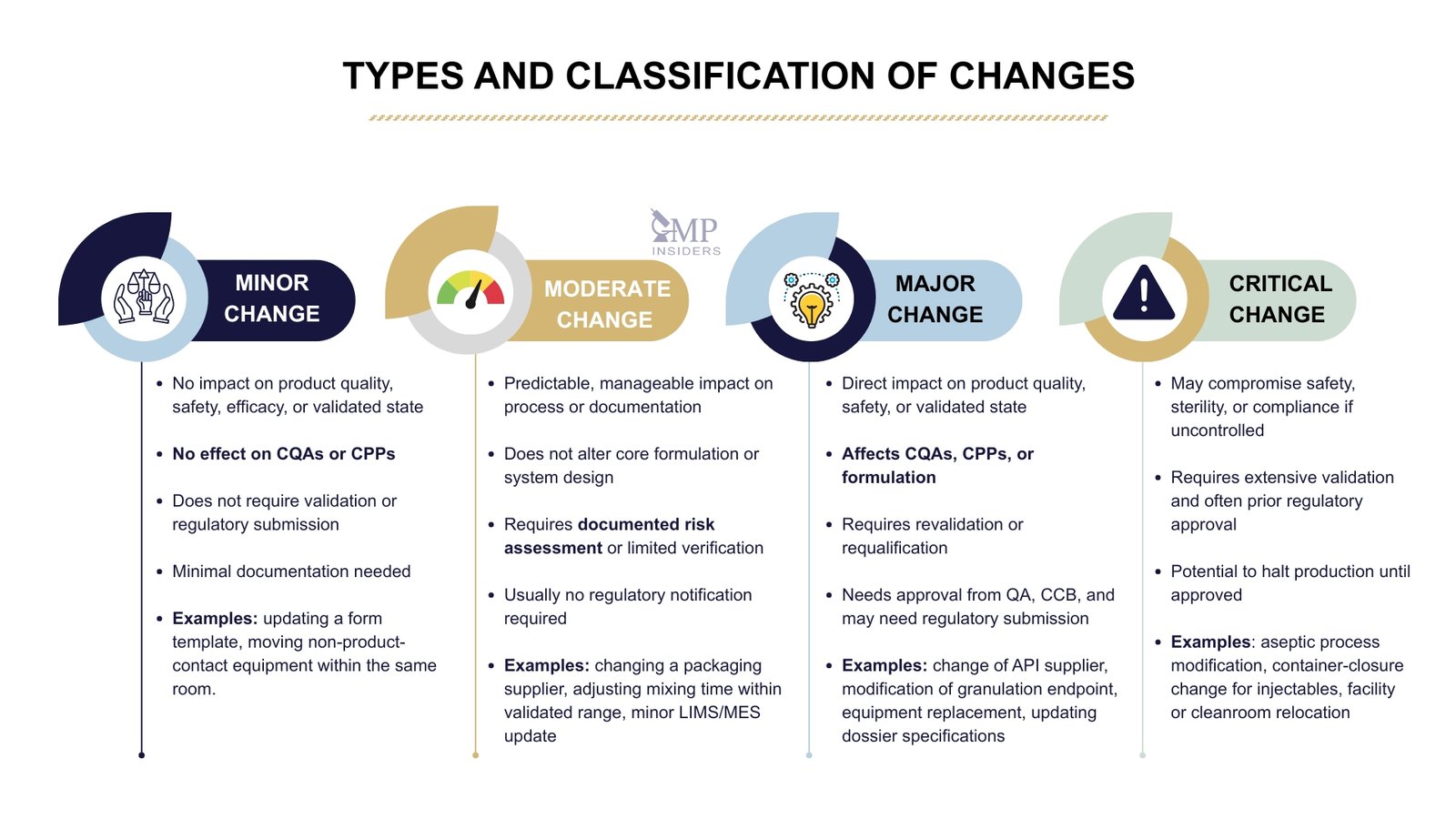
In pharmaceutical manufacturing, not all changes carry the same level of risk. A compliant change control system must therefore categorise changes to ensure that the level of assessment, documentation, validation, and regulatory involvement reflects the potential impact on product quality and patient safety.
Classification of Changes Based on Risk
Once the type of change is identified, the next step is to determine its criticality. Classification ensures that the level of documentation, testing, validation, and regulatory involvement is appropriate to the risk posed by the change.
Change classification typically considers:
- Impact on product quality, safety, or efficacy
- Effect on validated processes and equipment
- Need for requalification or revalidation
- Potential impact on regulatory filings or marketing authorisations
- Consequences for patient safety or supply continuity
Minor Change
Minor changes are low-risk modifications that do not impact product quality, safety, efficacy, process performance, or the validated state of equipment or systems. These changes can be implemented with minimal documentation and do not require validation or regulatory submission.
Typical attributes of a minor change:
- No effect on CQAs (Critical Quality Attributes) or CPPs (Critical Process Parameters)
- No impact on validation, cleaning procedures, or regulatory filings
- Only affects format, layout, or non-critical elements
Examples:
- Updating a form template without changing the procedure
- Moving non-product-contact equipment within the same room
Moderate Change
Moderate (or medium-risk) changes may affect the product or process. Still, the impact is predictable, manageable, and can be controlled through risk assessment, testing, or limited validation activities.
Typical attributes of a moderate change:
- May influence process or documentation, but not CQAs directly
- Does not alter the core formulation or validated system design
- Can be managed with documented impact assessment and limited verification activities
- Does not require regulatory notification in most cases
Examples:
- Changing a secondary packaging supplier
- Adjusting mixing time or speed within already validated ranges
- Updating LIMS or MES configuration (without software redesign)
- Revising sampling frequency or IPC test intervals
Major Change
A major change has a direct impact on product quality, safety, validated state, or regulatory documentation, and therefore requires a comprehensive evaluation, revalidation/requalification, or prior regulatory approval.
Typical attributes of a major change:
- Affects CQAs, CPPs, or product formulation
- Requires process validation, equipment qualification, or stability study updates
- Impacts marketing authorisation (MA) or regulatory commitments
- Requires approval from QA, CCB, and possibly regulatory authorities before implementation
Examples:
- Change of API supplier or manufacturing site
- Modification of the granulation endpoint or binder type in the formulation
- Replacement of a major process equipment (e.g., tablet press, granulator)
- Updating specifications in a regulatory dossier
Critical Change
A critical change is a high-risk modification that may compromise patient safety, product quality, regulatory compliance, or business continuity if not controlled. It requires prior approval, significant validation, and often pre-approval from regulatory authorities.
Typical attributes of a critical change:
- Directly impacts product safety, sterility, potency, or bioavailability
- Poses a potential risk of product recall or regulatory non-compliance
- Necessitates extensive validation, stability commitment, or market variation filing
- May involve halting production until approved
Examples:
- Sterile manufacturing process modification (e.g., change in aseptic filling line)
- Change in container-closure system for parenteral products
- Switching from terminal sterilization to aseptic processing
- Relocation of an entire manufacturing facility or cleanroom suite
How to Determine the Classification — Key Questions
A change is classified by answering structured impact questions:
- Does it affect product quality, safety, or efficacy?
- Does it impact a Critical Quality Attribute (CQA) or Critical Process Parameter (CPP)?
- Does it require revalidation or requalification?
- Will it change the approved marketing authorisation/dossier (CMC data)?
- Does it impact ongoing commercial batches or clinical trials?
- Could it affect data integrity or computerized system control?
If yes to one or more of the above → the change is likely major or critical.
Regulatory Impact of Change Types
Not every change requires submission to regulatory authorities, but changes that affect a product’s registered details, manufacturing process, equipment, or quality controls may require formal notification or approval.
The extent of regulatory involvement depends on the impact level of the change and whether it affects the Marketing Authorisation (MA), Common Technical Document (CTD), or validated state of a process or system.
To determine whether a regulatory submission is necessary, companies should consider:
- Does the change affect product quality, safety, or efficacy?
- Does it alter what has been filed in Module 3 (CMC) of the dossier?
- Will the change require updated validation, stability data, or comparability studies?
- Does it impact the manufacturing site, process, specifications, container-closure system, or control strategy?
Based on these criteria, changes are typically categorised as internal-only or requiring regulatory notification or approval.
Temporary Changes (Planned, Short-Term Change Control)
Not all changes in the pharmaceutical industry are permanent. In some situations, companies may implement a temporary change: a planned, time-limited modification introduced for a specific purpose that must be reversed or formally evaluated before it becomes permanent.
These changes still fall under the change control system, as they have the potential to affect product quality, process performance, or compliance if not adequately controlled.
Temporary changes must include:
- Clear justification – why the change is needed and why it cannot follow the standard method.
- Defined duration or batch applicability – how long the change will remain in effect, or for which batches it applies.
- Risk assessment and impact evaluation – ensuring the change does not compromise critical quality attributes (CQAs), critical process parameters (CPPs), or validated conditions.
- Approval before implementation – authorised by QA and relevant departments.
- Reversal or formalization – once the temporary period ends, the process must either be restored to its original state or submitted as a permanent change with full validation and documentation.
Example: using an alternative, calibrated balance for weighing until the primary balance is repaired, temporarily adjusting a process parameter due to equipment malfunction, or using an alternative raw material batch under controlled conditions while awaiting supplier qualification.
Temporary changes must never bypass formal change control procedures, be left open-ended, or continue indefinitely without re-evaluation. Otherwise, they become undocumented permanent changes and a common source of GMP non-compliance.
Change Control Process Workflow
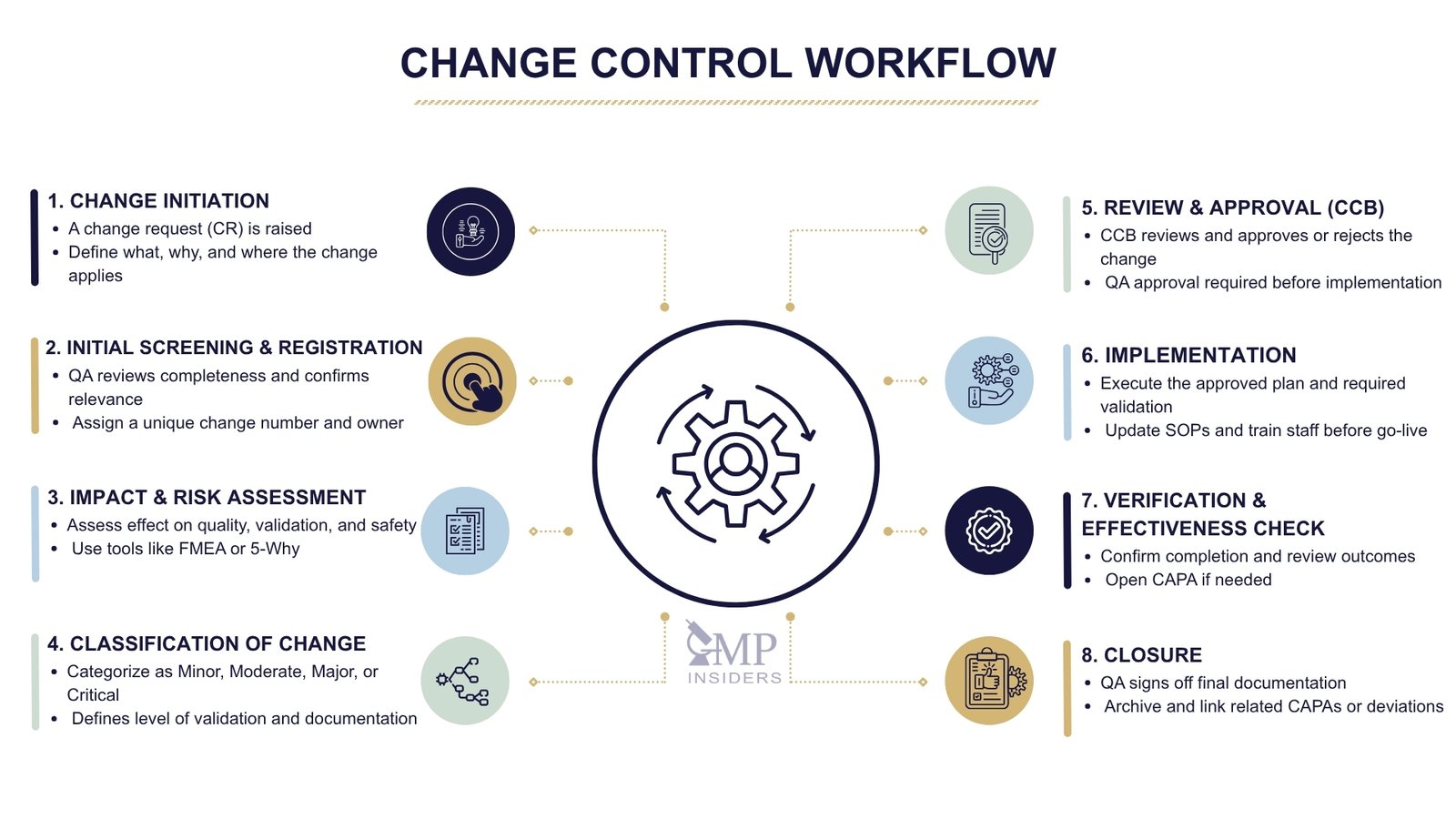
A GMP change control system follows a defined sequence of steps that describes the process flow. Each step is connected to the next, but within each step, bullet points make it easy to apply in real procedures, SOPs, and training.
Change Initiation – When a Change Is First Proposed
Every change starts with a recognised need, from production, QC, engineering, validation, or regulatory departments. At this stage, no modification is made; it is only formally proposed.
Key actions:
- A Change Request (CR) is raised.
- The initiator describes:
- What is changing
- Why the change is needed (justification)
- Which process, system, product, or document is affected
- The request is submitted to the change control system.
Initial Screening and Registration
Before evaluation begins, the request must be checked and accepted into the system.
QA or Change Coordinator:
- Reviews the request for completeness and relevance
- Confirms it belongs under the change control system (not just document correction or maintenance)
- Assigns a unique change control number
- Appoints a Change Owner / Responsible Person
Impact Assessment and Risk Evaluation
Only after registration is the change evaluated. This is the most critical step — it determines whether the change is safe, compliant, and feasible.
Impact must be assessed on:
- Product quality and patient safety (CQA impact?)
- Process performance (CPPs, IPCs, batch reproducibility)
- Validated state (need for IQ/OQ/PQ, PPQ, CPV updates?)
- Equipment, utilities, and cleaning procedures
- Computerised systems/data integrity (Annex 11, GAMP 5 considerations)
- Regulatory filings, dossier commitments, stability studies
- Supply chain continuity and documentation updates
Risk assessment tools may include:
- FMEA (Failure Modes and Effects Analysis)
- Ishikawa (Fishbone) diagrams
- 5-Why analysis
- Risk Priority Number (RPN) ranking
- Impact vs probability matrix
Change Classification
The results of the impact assessment determine the classification. This step links the change to the required level of control.
Review and Approval – Change Control Board (CCB)
A change cannot move forward without formal approval. This decision is made collectively.
The CCB may include representatives from:
- QA (mandatory)
- QC, Production, Engineering
- Validation, Regulatory Affairs
- CSV/IT, Microbiology (as needed)
The CCB is responsible for:
- Reviewing the impact assessment and classification
- Approving, rejecting, or requesting additional information
- Defining actions, responsibilities, and timelines
- Confirming whether a validation or regulatory submission is required
Implementation of the Change
Once approved, the change is carried out in a controlled manner according to the implementation plan.
Implementation activities can include:
- Equipment modification, process update, software change, or supplier onboarding
- Execution of validation/requalification (IQ/OQ/PQ, PPQ) if triggered
- Updating documents: SOPs, BMR/BPR, cleaning procedures, drawings
- Training relevant personnel before go-live
- Recording any deviations encountered during execution
Verification and Effectiveness Check
Changes must not only be implemented but also verified to work as intended.
Verification tasks include:
- Confirming all actions in the change plan were completed
- Reviewing validation results, batch data, or stability studies
- Checking whether the change caused unintended deviations or trends
- Opening CAPA if results are unsatisfactory
Formal Closure and Documentation
Only after effectiveness is confirmed can the change be closed.
Closure requires:
- Final QA review and approval
- Documentation of all assessments, actions, training, and verification
- Archiving in accordance with data integrity (ALCOA++) principles
- Linking to related CAPAs, deviations, or regulatory submissions
Impact on Validation and the Validated State
Every change control procedure is directly connected to equipment, process, analytical, and cleaning validation activities. Any approved change must be evaluated for its impact on the validated state. If not properly managed, even a minor modification can unintentionally invalidate previously approved processes, methods, or systems.
Why Validation is Affected by Change Control
A process, system, or equipment remains in a validated state only as long as it operates within approved parameters, materials, and procedures. Once a change is introduced, this state can be compromised unless:
- The change is risk-assessed
- Validation impact is identified
- Requalification/revalidation is performed where necessary
See Also: Qualification vs Validation in GMP
Types of Validation Impacted by Change Control
When a change is introduced, one of the first questions to answer is whether it affects the validated state of equipment, processes, analytical methods, or supporting systems. If the change has the potential to alter a previously approved or qualified condition, requalification or revalidation is required.
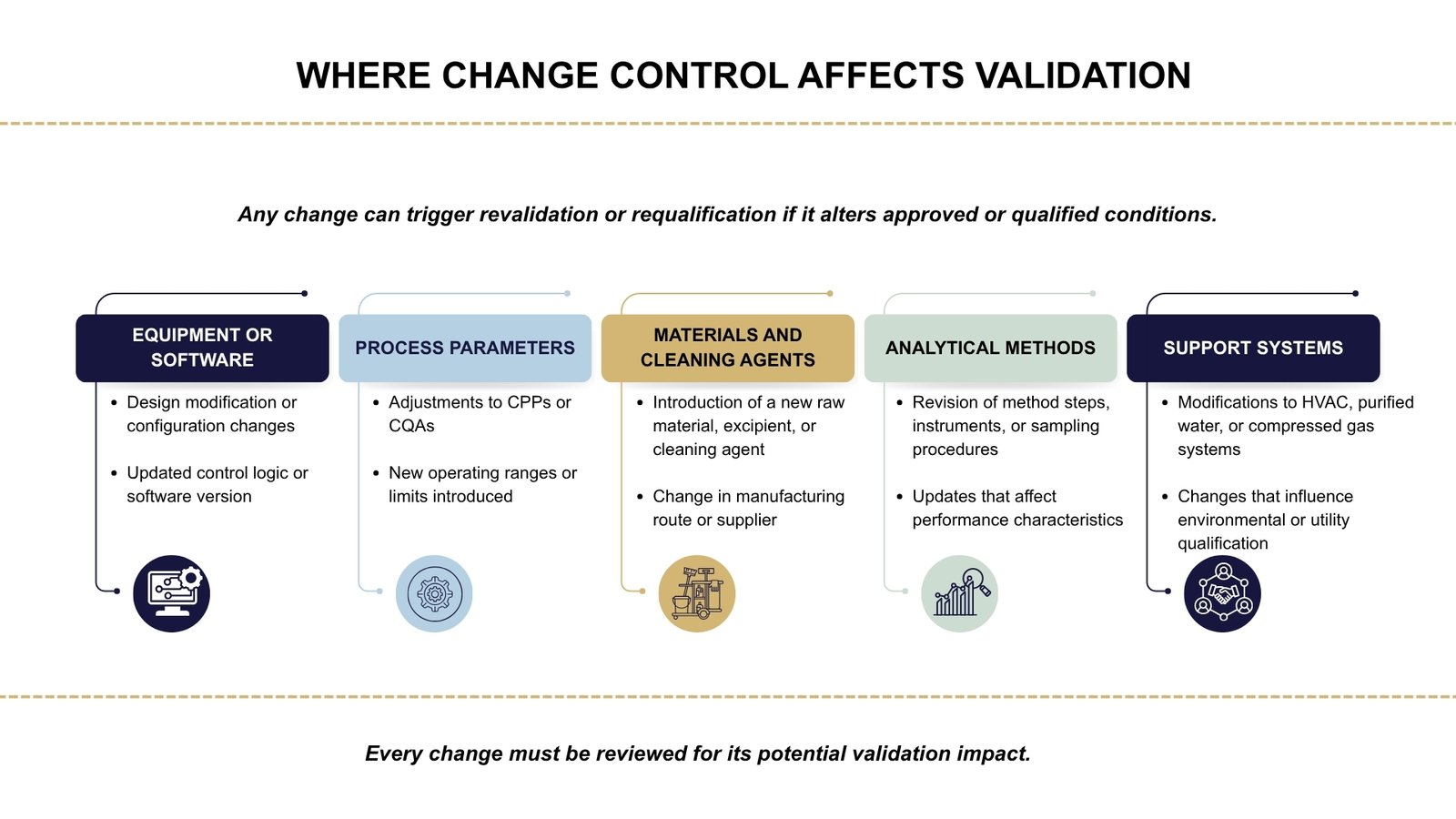
This impact is commonly seen in the following areas:
A change may trigger validation activities if it:
- Alters a Critical Process Parameter (CPP) or Critical Quality Attribute (CQA)
- Modifies equipment design, software, or operating controls
- Introduces a new material, cleaning agent, or manufacturing route
- Affects previously approved analytical methods or sampling procedures
- Impacts systems essential to product quality, such as HVAC, water systems, or compressed gases
Key Questions to Determine Validation Impact
During change control assessment, QA/Validation should determine:
- Does the change impact Critical Process Parameters (CPPs) or Critical Quality Attributes (CQAs)?
- Does the change affect qualified equipment, utilities, or software?
- Will it require IQ/OQ/PQ or full/partial revalidation?
- Does it impact process validation (PPQ/CPV) or analytical method performance?
- Is comparative data or equivalence testing required?
- Does it affect cleaning validation limits or worst-case product selection?
- Does the change need regulatory submission or prior approval from authorities? (e.g. Type II Variation, PAS)
Linking Change Control to the Validation Lifecycle
Any approved change must be evaluated not only for its risk but also for its impact on the validation lifecycle. A modification can affect different stages of equipment, process, or system validation. If not managed correctly, it may result in loss of validated state or non-compliance with Annex 15 and ICH Q10 requirements.
To maintain control, change control and validation must work together. This means that:
- No change is implemented without assessing its impact on qualification or validation.
- Each stage of validation, from design to continued process verification, may need to be updated depending on the scope of change.
- Revalidation or requalification is required when approved parameters, materials, or system functionality are altered.
When Are Change Control Procedures Required
Not every update in pharmaceutical manufacturing requires a formal initiation of a change control procedure. However, distinguishing between changes that need structured evaluation and those that do not is essential for maintaining compliance without overloading the system with unnecessary documentation.
A change should undergo the change control process when it has the potential to impact product quality, patient safety, data integrity, or the validated state of equipment, processes, or systems. Conversely, routine actions that do not affect these elements may be managed through maintenance records, document revisions, or administrative updates.
Changes That Require Change Control
Changes must be formally evaluated and approved when they introduce a potential risk to manufacturing consistency or regulatory compliance. Typical examples that necessitate change control include modifications to materials, processes, equipment, or quality documentation.
Examples when change control is required:
- The modification affects materials or suppliers
- Manufacturing parameters or validated processes are adjusted
- New equipment is introduced or existing equipment is modified
- Cleanroom classification, layout, or environmental controls are altered
- Computerized systems (LIMS, MES, eQMS, PLC) are upgraded or reconfigured
- Specifications, sampling plans, or analytical methods are changed
- The change impacts the marketing authorization or regulatory dossier