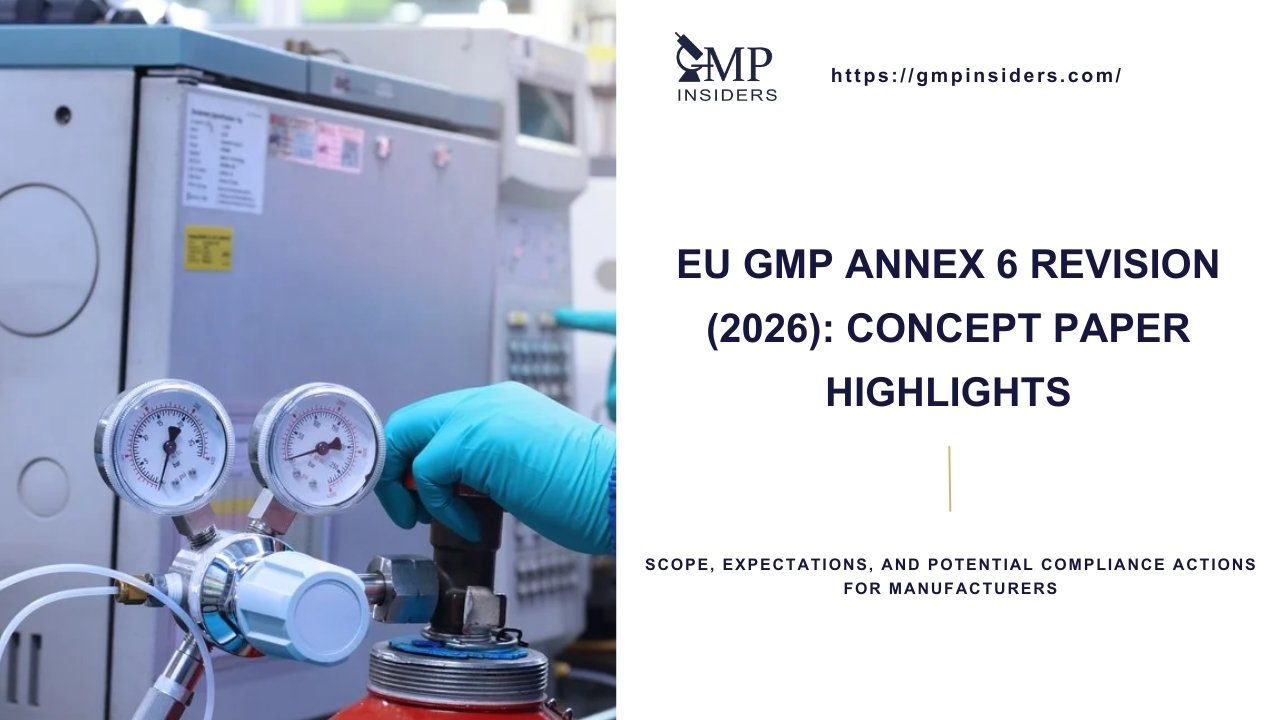
The EMA GMP/GDP Inspectors Working Group (GMP/GDP IWG), together with PIC/S, has opened a public consultation on a concept paper proposing a targeted revision of EU GMP Annex 6 (Manufacture of Medicinal Gases). Annex 6 is a shared expectation across EU/EEA inspectorates and PIC/S participating authorities, so the direction set in this concept paper matters beyond a single region.
The concept paper was approved by the EMA GMP/GDP IWG on 26 November 2025 andby PIC/S on 14 January 2026, with the consultation period running from 11 February 2026 to 11 April 2026 (deadline for comments). In other words, this is the formal window for industry, authorities, and interested groups to submit practical feedback before the drafting of the updated guideline accelerates.
The revised guideline is intended to replace the current EudraLex Volume 4 Annex 6. The concept paper frames the update as a limited review to reflect current practice, new technologies, and the wider use of computerised systems, whilealso taking into account stakeholder recommendations highlighted after the COVID-19 period.
30 Seconds Takeaway
What Is Proposed to Change
The drafting group proposes a limited review with targeted updates. The concept paper lists the following focus areas for revision.
| Focus area | What’s being revisited | What inspectors may probe harder |
|---|---|---|
| Premises | How far should “general GMP premises rules” apply for a closed, positively pressurised medicinal gas process? | Your premises and contamination control logic for this process model (and where it’s justified). |
| Containers & valves | Gas-specific couplings, container and valve technology, and clearer rules for valve checks and residual gas handling before refilling. | Connection integrity and contamination prevention by design, plus defensible refill steps. |
| Integrated regulator/flowmeter valves | Whether pre- and post-fill checks need updating for cylinders with integrated regulator and flowmeter valves. | Checks that match the valve design and are consistent and evidenced. |
| Flow checks | Setting expectations for flow-check frequency (cylinders and cryogenic containers). | A justified frequency, trending, and action when performance drifts. |
| Hospital liquid oxygen documentation | Stronger documentation and QA for liquid oxygen supply to hospitals, including filling hospital evaporation units. | Traceability, responsibilities, record completeness, deviation handling, and QA oversight. |
| Batch release (Annex 16 interface) | Whether batch release needs medicinal-gas specifics (including feasibility of the QP role; potential remote or retrospective concepts). | How release is organised under real supply constraints, without losing control or evidence. |
| Qualification scope | Better coverage for qualification of facilities, mobile and stationary tanks, reusable containers. | A consistent, risk-based qualification lifecycle for key assets. |
Premises: How “General GMP” Applies to a Closed, Positively Pressurised Process
The concept paper flags a core ambiguity in today’s Annex 6: how far “general EU GMP manufacturing-environment requirements” should be applied when the process is closed and both the manufacturing process and containers operate under positive pressurisation. The revision is expected to explicitly assess this extent in the context of medicinal gases.
What this means in practice is less about adding “cleanroom-like” expectations and more about making the premises rationale defensible: what contamination risks are credible for a closed process, where they can still enter (interfaces, connections, maintenance, cylinder handling), and which premises controls are therefore justified.
Practical inspection angle: how your contamination control logic for premises is justified (risk-based, process-based) and how it aligns with the closed-system reality.
Technology Controls: Couplings, Residual Pressure Valves, and Refill Practices
The concept paper explicitly highlights technological advances that reduce risk: the exclusive use of gas-specific couplings and the elimination of containers with residual-pressure valves. It also states that requirements for valve checks and the removal of residual gases before refilling containers with residual-pressure valves will be evaluated.
This is a strong signal that Annex 6 will lean more on engineering controls (design-based prevention), as this is where misconnection and contamination risk are reduced most reliably.
Practical inspection angle: whether your container management system reduces misconnection/contamination risk by design, not only by operator controls.
Modern Cylinder Valve Assemblies: What “Pre-/Post-Fill Checks” Should Look Like
For cylinders fitted with valves that include an integrated pressure regulator and flowmeter, the concept paper states that the inspection requirements before and after refilling should be reviewed to determine whether they need adjustment.
This is important because “standard” cylinder checks don’t always translate cleanly when the valve assembly has functional components that directly influence delivery and performance at the point of use.
Practical inspection angle: do your checks match the technology configuration, and are they defined in a way that can be executed consistently and evidenced?
Flow Checks: Defining Frequency for Cylinders and Cryogenic Containers
The revision will establish requirements for determining the frequency of flow checks for the integrated flowmeter, covering cylinders and cryogenic containers.
From an inspection perspective, this moves sites away from “we do it annually because we always have” and toward a documented, data-supported justification for frequency.
Practical inspection angle: documented rationale for frequency + results trending + action on drift.
Documentation and QA Oversight for Liquid Oxygen Supplied to Hospitals
Liquid oxygen is supplied to hospitals, and refilling hospital tank evaporation units is a critical part of the supply chain. It explicitly states that documentation and quality assurance requirements in this area are to be supplemented.
This is a classic “inspection hotspot” because the activity sits at the boundary between manufacturing control and real-world distribution/service execution.
Practical inspection angle: traceability, responsibilities, record completeness, deviation handling, and release linkage for these high-criticality deliveries.
Batch Release: Specific Considerations for Medicinal Gases (Annex 16 Interface)
The concept paper states that industry has raised a practicality concern: the release of medicinal liquid oxygen to hospitals should be regulated more effectively, taking into account procedures, process risks, and QP availability. The revision will consider whether medicinal-gas-specific considerations apply to batch release, as described in Annex 16, including remote and/or retrospective certification.
This signals that Annex 6 may start to describe a more realistic “how release works” model for oxygen supply, while still demanding documented control and review.
Practical inspection angle: how the QP function is enabled to remain compliant without breaking the operational reality of oxygen supply, while maintaining documented control.
Qualification: Facilities, Tanks, and Reusable Containers
Certain aspects of modern medicinal gas production may not be adequately addressed today, specifically the qualification of manufacturing facilities, mobile and stationary storage tanks, and reusable containers.
This is a meaningful shift: it places assets that are sometimes treated as “infrastructure” within a clearer GMP qualification framework, particularly when they directly affect product quality and supply assurance.
Practical inspection angle: qualification strategy that is consistent across fixed and mobile assets, and proportionate to risk.
Timeline: What to Expect Through 2027
The concept paper provides a proposed timetable:
- Jan 2025: Preparation of draft concept paper
- Nov 2025: Approval of draft concept paper by EMA GMP/GDP IWG
- Feb 2026: Release for consultation of draft concept paper (2 months)
- Apr 2026: Deadline for comments on concept paper
- From Apr 2026: Discussion in EMA/PIC/S drafting group
- Nov 2026: Proposed release for consultation of draft guideline (3 months)
- Feb 2027: Deadline for comments on guideline
- Sep 2027: Endorsement by EMA GMP/GDP IWG
- Nov 2027: Publication by European Commission
- Dec 2027: Adoption by PIC/S Sub-committee on GMDP Harmonisation
Final Thoughts
This concept paper signals a pragmatic, inspection-relevant update of EU GMP Annex 6: the goal is not to “rewrite medicinal gases GMP,” but to remove recurring grey zones by aligning the guideline with how medicinal gas operations are actually run today.
In practice, the revision is expected to sharpen expectations in the areas that most often generate inconsistent interpretations across sites and inspectorates, premises logic for closed/positively pressurised processes, container/valve technology controls, verification check design (including flow checks), hospital supply-chain documentation for liquid oxygen, batch release practicality under Annex 16, and clearer qualification scope for facilities, tanks, and reusable containers.
The consultation is open until 11 April 2026, which is a meaningful window to submit comments that help keep the final text feasible, clear, and genuinely risk-based. If you manufacture, distribute, or audit medicinal gases, this is the moment to flag where guidance needs better wording, where it should explicitly allow justified approaches, and where it should avoid drifting into rigid “one-size-fits-all” requirements that don’t match the operational reality of supply, especially for liquid oxygen to hospitals.