Complaint management is a core element of the Pharmaceutical Quality System (PQS) and a direct indicator of how effectively an organisation controls its processes, understands its products, and protects patients.
Regulatory authorities consistently regard complaint handling as evidence of quality system maturity because it demonstrates whether a manufacturer can identify quality signals, assess risks objectively, investigate in technical depth, and implement sustainable corrective and preventive actions.
A complaint is a post-market quality signal that must be evaluated within a structured, documented, and scientifically justified framework. Complaint information must be linked to deviations, nonconformances, CAPAs, change control, product quality reviews, recall systems, and pharmacovigilance or vigilance processes, where applicable. The expectation is not simply to respond, but to demonstrate control, traceability, and evidence-based, risk-informed decision-making.
This article provides a structured, practice-oriented interpretation of complaint handling aligned with GMP expectations. It addresses foundational definitions and classifications; risk-based complaint triage; investigation principles; documentation quality; regulatory focus areas; governance; integration with the quality management system; and trend and metric analysis.
Definitions and Scope of Complaints
For an effective complaint management system, terminology must be precise, unambiguous, and consistently applied across the organisation. Misinterpretation of what constitutes a complaint is one of the most common weaknesses observed in practice and a frequent root cause of delayed assessment, poor trending, and missed quality signals.
A complaint is any written, verbal, electronic, or otherwise communicated allegation that a medicinal product, batch, or associated quality element may not meet the required quality, safety, identity, strength, purity, performance, packaging, labelling, usability, integrity, or expected functionality.
It may originate from healthcare professionals, distributors, pharmacies, internal personnel, regulatory agencies, patients, or other stakeholders. The format, tone, or completeness of the information provided does not change its status as a complaint.
A distinction must be made between quality-related complaints, medical/safety complaints, and non-quality communications:
- Quality complaints relate to product quality attributes, visual appearance, contamination, particulate matter, degradation, incorrect strength, breakage, leakage, packaging defects, labelling errors, product mix-ups, stability concerns, temperature excursion impact, sterility assurance concerns, or any indicator that the product may not comply with its approved specifications or quality standards.
- Performance or efficacy-related complaints concern perceived lack of effect or reduced performance. These require careful assessment and, where applicable, structured linkage to pharmacovigilance or vigilance activities.
- Safety-related complaints refer to adverse reactions or events. These are not handled solely as complaints; they require well-defined interfaces between complaint handling and pharmacovigilance or vigilance systems to ensure accurate data capture, triage, reporting, and follow-up.
- Distribution-related complaints may arise from storage, handling, transport, temperature excursions, damaged shipments, or suspected GDP failures. These may still represent quality risk and must not be dismissed solely as logistics issues.
- Non-quality communications such as general enquiries, product information requests, ordering issues, price concerns, or commercial matters are not complaints. However, systems must prevent inappropriate exclusion of legitimate quality concerns under the justification of “customer service” or “information only”.
Additionally, complaint systems must recognise reports of suspected counterfeit or tampered products, suspected falsified products, and suspected product-integrity breaches as complaints with elevated risk relevance and structured escalation pathways.
SEE ALSO: Contamination, Cross-Contamination, and Mix-Ups in GMP
Finally, it is essential to differentiate between:
- a complaint (external signal),
- a deviation or non-conformance (internal event),
- and a return or recall action (consequence of risk decision).
A complaint may trigger internal investigations, deviations, CAPAs, recalls, or further regulatory actions. Still, it remains a distinct post-market quality signal that must be recorded, assessed, trended, and managed within a defined complaint handling system.
Classification of Complaints
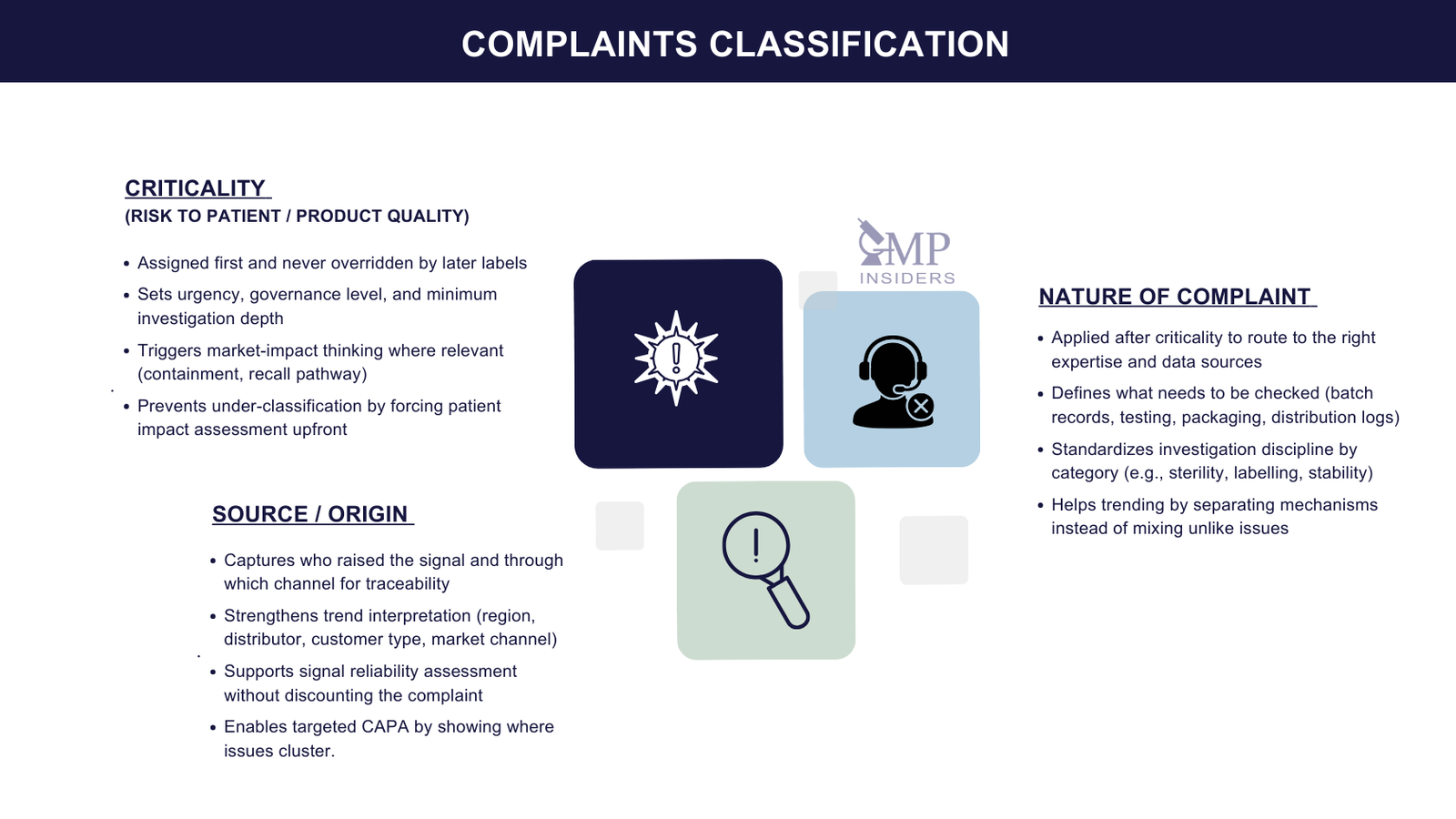
Complaint classification must be driven primarily by risk and patient impact, not administrative convenience or descriptive labels. The classification framework must enable rapid identification of high-risk cases, consistent decision-making, clear escalation criteria, and proportional investigation depth. Poorly designed classification systems typically under-classify risk, delay escalation, and weaken regulatory confidence.
A practical and inspection-defensible classification system considers three pillars:
- Criticality (Risk to Patient / Product Quality) – Primary Determinant
- Nature of Complaint – Supports Technical Routing
- Source / Origin – Supports traceability and trending
Criticality must always take precedence.
Classification by Criticality (Primary Control)
This classification determines urgency, governance level, investigation depth, and recall considerations. Terms may vary between companies, but the logic must be consistent and justified.
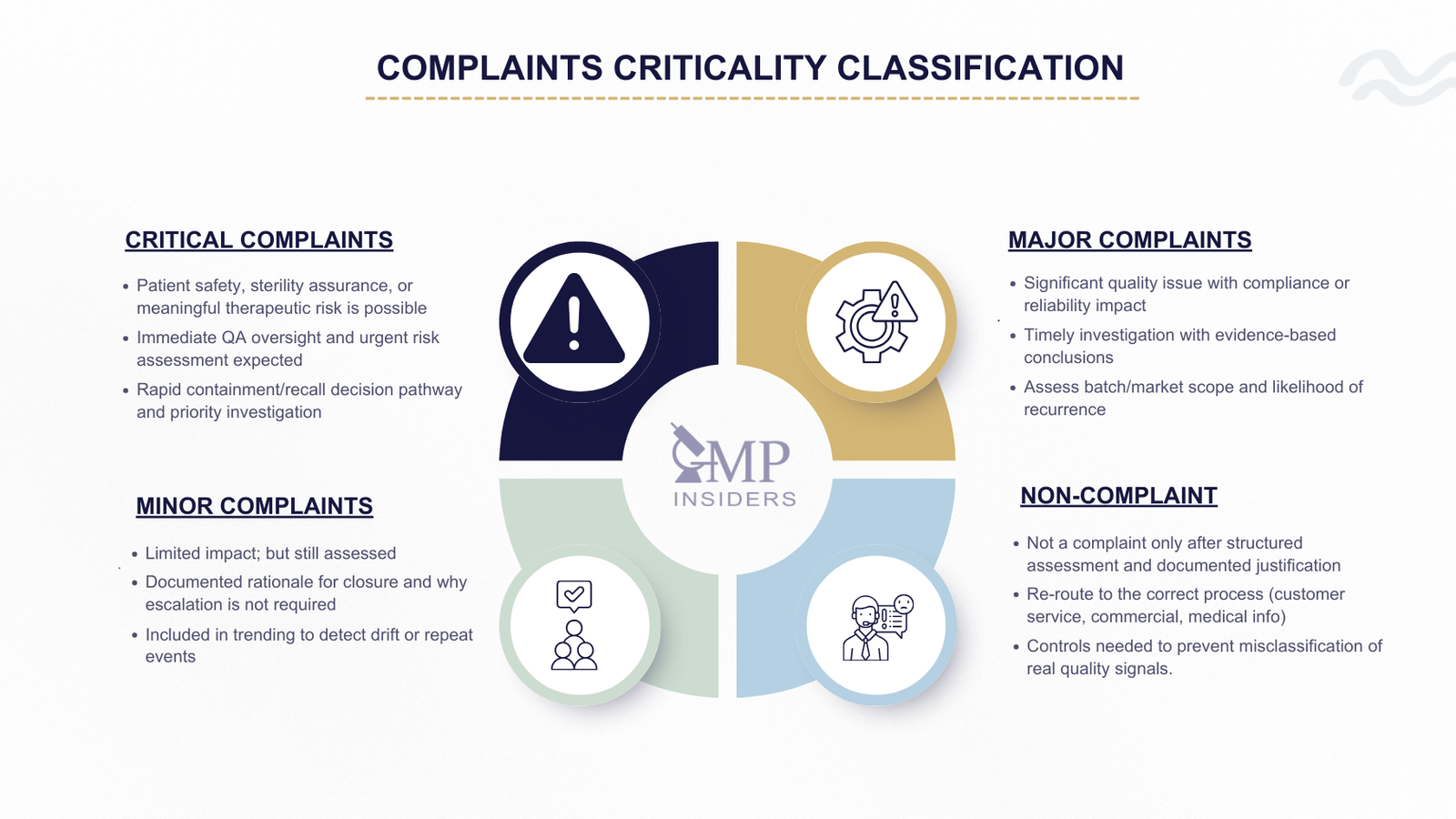
Critical Complaints
Complaints indicating a potential or confirmed risk to patient safety, sterility assurance, or therapeutic performance. Typically include:
- Incorrect strength / incorrect product
- Microbial contamination or sterility assurance failure risk
- Cross-contamination indicators
- Significant label or leaflet errors affecting safe use
- Compromised container closure integrity
- Confirmed or suspected falsified product
- Any defect where use may cause harm
Expected behaviour:
- Immediate QA oversight
- Urgent risk assessment
- Rapid decision on market containment/recall
- Priority investigation
- Senior management involvement
Failure to treat these with urgency is one of the most serious inspection findings.
Major Complaints
Complaints indicating a significant quality issue that may not present immediate patient risk but could compromise compliance, product quality, or reliability. Examples:
- Significant packaging defects
- Repeated manufacturing inconsistencies
- Stability concerns without confirmed failure
- Failures likely to impact product acceptance or compliance
Expected behaviour:
- Timely investigation
- Data-driven justification
- Assessment of potential batch or market impact
- Linkage to CAPA if systemic factors are identified
Minor Complaints
Complaints with limited impact on quality or safety, often cosmetic or perception-based, but still requiring assessment and trending. Examples:
- Minor cosmetic packaging defects
- Isolated handling-related damage
- Non-critical usability concerns
Expected behaviour:
- Documented assessment
- Justified conclusion
- Contribution to trend analysis
Non-Complaint
Cases that, after structured assessment, do not constitute a quality complaint. This requires explicit justification, not informal dismissal.
Examples:
- Enquiries
- Commercial communications
- Misinformation clearly unrelated to product performance
- Handling misused evidence
Improperly rejecting legitimate complaints is a serious regulatory weakness.
Nature of Complaint
Once criticality is established, complaints may be categorised by technical nature to support routing, investigation discipline, and specialist involvement.
Typical categories include:
- Quality attributes and defects (appearance, contamination, particulate, integrity)
- Performance/lack of effect
- Labelling/packaging
- Sterility assurance
- Stability-related concerns
- Logistics/temperature excursion
- Counterfeit / tampering suspicion
- Safety-linked complaints (requiring PV interface)
This classification supports who investigates, not how urgently.
Origin of Complaint
The source of the complaint provides context and trend value:
- Healthcare professionals
- Patients
- Pharmacies/hospitals
- Wholesalers/distributors
- Regulatory authorities
- Internal personnel
This supports signal detection, recurring market themes, regional trends, or reporting reliability assessment.
Complaint Management Lifecycle
An effective complaint management system must operate as a controlled, repeatable, and risk-driven process. Authorities consistently expect manufacturers to demonstrate that every complaint is captured, assessed, investigated proportionately, documented objectively, and used for ongoing quality surveillance. The lifecycle must therefore be clearly defined, consistently applied, and under Quality oversight.
The lifecycle below reflects good practice observed in competent organisations and aligns with regulatory expectations.
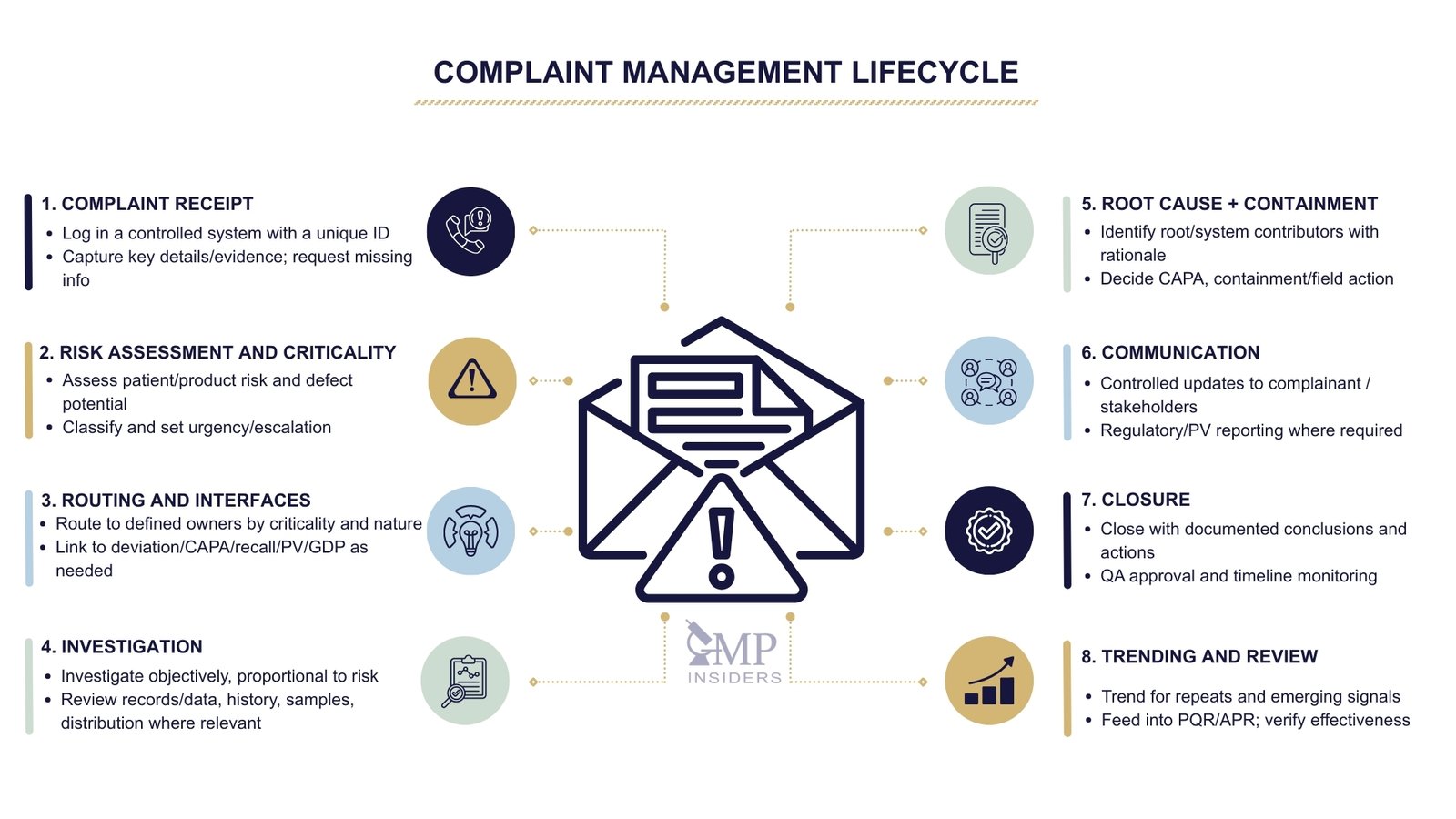
1. Receipt, Registration, and Completeness Check
Every complaint received must be:
- Acknowledged
- Formally recorded
- Uniquely identified
- Handled under a controlled system
Registration must include:
- Product and batch identification (where available)
- Complainant details
- Description of concern in the complainant’s words
- Date received and person recording
- Any accompanying evidence (sample, images, documentation)
The system must not allow informal handling, selective recording, or discretionary screening outside of a defined process.
Before risk assessment, the information must be made usable and evaluated:
- Whether sufficient information exists to support the assessment
- Whether additional data is required
- Whether a sample retrieval is possible or necessary
- Whether supporting documentation should be requested
Where information is incomplete, structured follow-up is expected. However, lack of complete information does not automatically invalidate a complaint; it must still undergo risk evaluation to the extent possible.
2. Risk Assessment and Criticality Classification
Every complaint must undergo a documented risk assessment to determine:
- Whether the case represents a potential patient risk
- Whether it may indicate a quality defect
- Whether immediate containment or escalation is required
- Whether further distribution should be restricted
- Whether recall consideration is necessary
Classification into Critical/Major/Minor/Non-Complaint must occur here using predefined criteria, not subjective judgment. This determines:
- Urgency of actions
- Level of QA oversight required
- Scope and depth of investigation
- Escalation to senior management
Weak systems either delay this assessment or under-classify risk, both of which are unacceptable from a regulatory standpoint.
3. Routing and System Interfaces
Based on classification and complaint nature, cases must be routed correctly. Typical interfaces include:
- Deviation/non-conformance systems
- CAPA system
- Product Quality Defect/Recall System
- Pharmacovigilance/vigilance systems
- GDP/distribution quality systems
- Change control
- Stability monitoring
- Manufacturing and QC systems
This routing must be defined, not improvised. Authorities frequently criticise systems in which complaints remain isolated and not properly integrated.
4. Investigation
If investigation is warranted, it must be:
- objective
- evidence-based
- proportionate to risk
- scientifically justified
- documented in a structured manner
Expectations include:
- Review of batch manufacturing and packaging records
- Evaluation of test results and batch release data
- Review of deviations, change history, and CAPA related to the product
- Assessment of stability and historical complaint data
- Comparison with retained samples and in-house control samples, where appropriate
- Laboratory investigation where relevant
- Evaluation of distribution and storage history
Regulators commonly reject superficial investigations, unjustified conclusions, or “no manufacturing defect found” statements that lack supporting data.
5. Root Cause Determination and CAPA/Containment Decisions
Where a defect or failure is confirmed or probable, root cause analysis must distinguish between:
- causal factor
- root cause
- systemic contributing factors
Human error cannot be treated as a final explanation without demonstrating why the system allowed it to occur. Tools such as 5-Why, Ishikawa, fault tree, and structured problem-solving methodologies should be applied where appropriate.
Where no root cause can be definitively proven, the rationale must still be scientifically defensible.
SEE ALSO: 6 Steps on How to Perform Root Cause Analysis (RCA)
Based on investigation outcomes, the organisation must determine:
- Whether the complaint is justified
- Whether product quality is compromised
- Whether other batches are at risk
- Whether the product on the market requires a recall or other field action
- Whether CAPA is required
- Whether risk communication is necessary internally or externally
Decisions must be traceable, justified, and aligned with defined governance. Senior QA or executive involvement is expected for higher-risk scenarios.
6. Communication
Communication must be controlled and consistent:
- Response to the complainant, where applicable
- Communication with distributors, partners, or MAH where relevant
- Reporting to regulatory authorities where required
- Alignment with PV/vigilance reporting obligations, where applicable
Inspectors frequently criticise inconsistent or delayed communication.
7. Closure
A complaint can only be closed when:
- Investigation is complete
- Justification is documented
- Decisions and actions are recorded
- CAPA (if applicable) is initiated and assigned
- Risk has been adequately assessed
- QA has reviewed and approved
Closure timing must be monitored. Long-open complaints are interpreted as poor control unless justified.
8. Trending and Periodic Review
Complaint systems must not operate only on a case-by-case basis. Authorities expect:
- Complaint trending
- Identification of recurring themes
- Statistical evaluation where applicable
- Linkage to Product Quality Review / Annual Product Review
- Escalation of emerging signals
Failure to trend complaints is a frequent regulatory criticism.
Governance, Responsibilities, and Quality System Integration
Complaint handling is not an isolated administrative function. It is a core quality system activity that requires defined ownership, disciplined governance, and integration with other QMS elements.
Regulators consistently assess who controls the process, how decisions are made, whether senior management is involved when appropriate, and whether the complaint system actually drives quality improvement rather than simply documenting events.
Ownership and Quality Oversight
Complaint handling must operate under Quality/QA authority. This is not optional. While operational functions may contribute data or perform technical activities, QA must retain oversight and decision power.
A compliant governance model includes:
- Clearly defined process ownership under QA
- Written and approved procedures defining responsibilities
- QA review of each complaint and investigation
- QA approval of conclusions, risk decisions, and closure
- Clear definition of when senior management must be notified or involved
Where complaint processes are owned by commercial, customer service, or supply chain functions without QA control, regulatory confidence is extremely low.
Role Clarity and Functional Participation
Multiple functions contribute to complaint assessment. However, roles must be explicit and standardised, not improvised on a case-by-case basis.
Typical contributors include:
- QA – overall control, decision authority, approval
- Manufacturing / Packaging – process and batch record evaluation
- QC – analytical and laboratory assessment
- Technical / Engineering – technical assessments and equipment-related evaluations
- Stability function – assessment of potential product degradation relevance
- Supply Chain / GDP – assessment of transport, storage, and handling aspects
- Pharmacovigilance / Vigilance – safety signal assessment where applicable
- Regulatory Affairs – regulatory communication where required
Confusion, overlaps, informal delegation, or unclear accountability frequently result in delayed actions, inconsistent conclusions, and inspection deficiencies.
Escalation and Decision-Making Framework
Complaint systems must contain predefined escalation criteria. Decisions such as classifying an issue as critical, initiating a recall evaluation, initiating a field safety corrective action, escalating to executive management, or notifying regulatory authorities must not depend on informal judgement.
Authorities expect:
- Written escalation rules
- Defined governance pathways
- Documented decision-making steps
- Involvement of senior QA and executive management for high-risk cases
- Traceable justification of outcomes
A system without structured escalation is interpreted as uncontrolled.
Trending, Metrics, and Quality Intelligence
Complaint handling is not limited to managing individual cases. Regulators expect manufacturers to demonstrate that complaint data are used to monitor product performance, detect emerging risks, and support ongoing quality oversight. A system that closes complaints one by one without structured trend analysis is considered reactive and immature.
Trending must be intentional, methodologically sound, risk-oriented, and integrated into broader quality governance.
Purpose of Complaint Trending
Complaint trending must enable:
- Identification of recurring or emerging defect patterns
- Timely recognition of risk signals
- Evaluation of process and product performance in real use
- Monitoring of CAPA effectiveness
- Evaluation of supplier, manufacturing site, and distribution performance
- Contribution to lifecycle knowledge and continual improvement
Trending is not a statistical exercise for reporting. It is a decision-support tool.
What Should Be Trended
Typical trending parameters include:
By criticality
- Number and proportion of Critical, Major, and Minor complaints
- Changes in the severity profile over time
By product and batch
- Complaint rate per product
- Complaint rate normalised to market volume
- Batch-specific spikes or recurring issues
By defect type
- Particulate/contamination-related
- Labelling/packaging
- Stability-related
- Dosing/strength concerns
- Integrity and sterility-related issues
- GDP / transport-related complaints
By geography or market
- Region-specific complaint concentrations
- Country-specific recurring patterns
By source
- Healthcare professionals
- Pharmacies
- Patients
- Regulators
- Distribution partners
Each category supports different insights. A mature organisation uses multiple perspectives rather than relying on a single metric.
Detection of Trends and Signals
A competent complaint system defines how a “trend” is detected, not just that trending exists. Expectations include:
- Predefined alert levels or thresholds
- Rules for repeated similar complaints
- Statistical approaches, where appropriate
- Justification when trends are not acted upon
A signal ignored or recognised only retrospectively reflects poorly on governance.
Performance Monitoring, KPIs, and Compliance Expectations
Complaint handling performance must be measurable. Regulators expect manufacturers to monitor the effectiveness of their complaint system using defined indicators, rather than relying on informal judgment or retrospective review. Performance metrics are not a reporting formality; they are evidence of operational control, capacity, and quality system maturity.
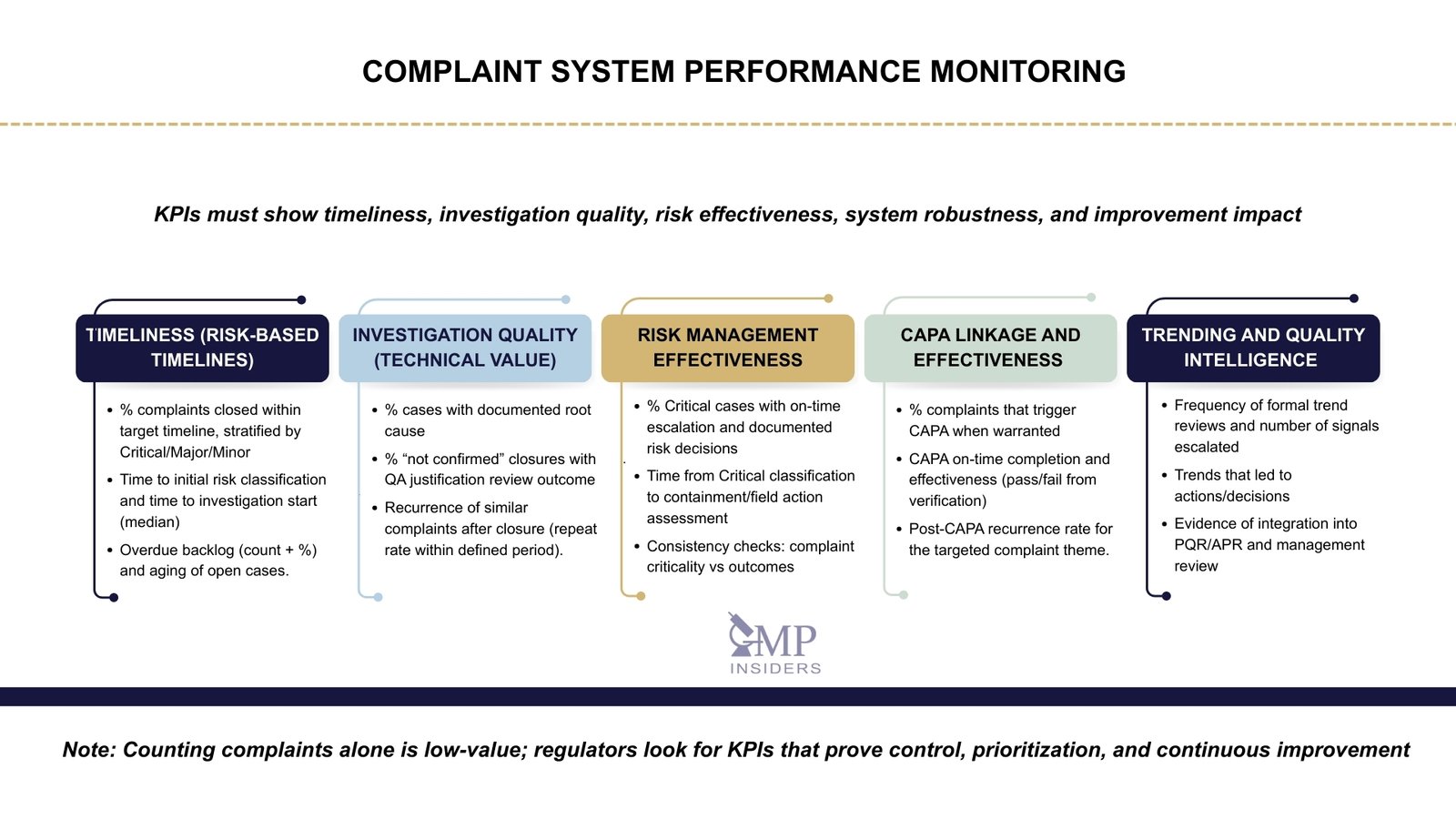
KPIs must reflect:
- Timeliness
- Quality of investigations
- Risk management effectiveness
- System robustness
- Contribution to continuous improvement
Metrics that simply count complaints without evaluating system performance have limited regulatory value.
Timeliness Indicators
Authorities consistently focus on whether complaints are addressed within defined, risk-based timelines. Key indicators typically include:
- Percentage of complaints closed within defined timelines
- Median and average closure time, stratified by criticality
- Number and proportion of overdue complaints
- Time to initial risk classification
- Time to investigation initiation
Persistent delay, backlog of open cases, or regular timeline breaches are interpreted as indications of insufficient QA capacity, weak prioritisation, or inadequate governance.
Investigation Quality Indicators
Beyond timeliness, regulators expect companies to evaluate whether complaint investigations demonstrate real technical value. Indicators may include:
- Percentage of complaints with documented root cause (where applicable)
- Proportion of cases closed as “not confirmed” with justification quality review
- Internal quality review findings on investigation depth and completeness
- Recurrence of similar complaints following previously “closed” investigations
CAPA Linkage and Effectiveness
When complaints identify systemic weaknesses, authorities expect effective CAPAs. Relevant performance measures include:
- Percentage of complaints leading to CAPA (where warranted)
- CAPA timeliness
- CAPA effectiveness outcomes
- Recurrence rates of complaint themes following CAPA implementation
If CAPA does not measurably reduce complaint recurrence, the system is not functioning effectively.
Trending and Quality Intelligence Indicators
Trending must demonstrate more than passive reporting. Indicators may include:
- Frequency of formal complaint trend review
- Number of trends identified and acted upon
- Integration of complaint trend outcomes into Product Quality Review / APR
- Senior management review engagement
Authorities may request evidence that trends prompted real decision-making and system improvement.
Regulatory Basis and Expectations
Complaint-handling requirements are explicitly defined in major GMP frameworks. The intent of each is consistent: structured control, documented evaluation, timely, risk-based decision-making, and demonstrable quality oversight.
EU GMP – Volume 4, Chapter 8 (Complaints and Product Recall)
EU GMP requires a documented and effectively implemented system for receiving, recording, investigating, and evaluating complaints. Key expectations include:
- Every complaint must be recorded, assessed, and evaluated to determine whether it relates to a potential quality defect.
- Complaint handling must be under QA responsibility, with a clear definition of roles and decision authority.
- Investigations must be objective, scientifically justified, and supported by appropriate evidence, not assumptions.
- When a potential defect exists, manufacturers must evaluate batch relevance, potential market exposure, and the necessity of a recall.
- Complaint information must interface with recall management, product quality defect procedures, and ongoing product quality review (PQR).
- Records must be retained in a secure, controlled, and retrievable manner.
- Complaints must be trended and evaluated as part of ongoing quality oversight.
US FDA – 21 CFR 211.198 (Complaint Files)
21 CFR 211.198 requires manufacturers to maintain written, approved, and implemented procedures for complaint handling. Core requirements include:
- Written procedures must describe how complaints are received, documented, evaluated, and investigated.
- The Quality Unit must review each complaint to determine whether it represents a possible failure to meet specifications.
- Investigations must be conducted where warranted and must be adequately documented, including conclusions and supporting data.
- If no investigation is conducted, this must be scientifically justified and documented.
- Complaint files must be maintained in an accessible and controlled manner.
- Links to CAPA, manufacturing evaluation, and field actions must be demonstrable.
FDA inspection experience shows repeated instances in which companies conclude “no manufacturing defect” without evidence, conduct weak investigations, or fail to link complaints to broader system performance. These are typically unacceptable.
EU GDP – Guidelines on Good Distribution Practice of Medicinal Products for Human Use (2013/C 343/01)
Where complaints involve storage, transport, handling, temperature excursions, product integrity, or suspected falsification, GDP expectations apply in addition to GMP obligations. Authorities expect:
- Defined interfaces between GDP and GMP systems, ensuring structured information flow.
- Risk-based evaluation of temperature excursions, handling damage, compromised packaging, and suspected tampering or falsification.
- Clear responsibility allocation between the manufacturer, MAH, wholesalers, and distributors.
- Traceability and documented investigation across the distribution chain under quality oversight.
GDP-related complaints must not be treated solely as commercial or logistics issues. If product quality may be affected, they remain GMP-relevant quality risk signals.
Pharmacovigilance / Vigilance Expectations
When complaints include potential safety information, systems must demonstrate controlled linkage to pharmacovigilance/vigilance processes.
For medicinal products, this aligns with EU GVP Module VI and FDA 21 CFR 314.80 / 600.80; for devices/combination products, EU MDR 2017/745 and FDA 21 CFR 803 apply.
Authorities expect:
- Defined criteria to recognise safety-relevant complaints
- Immediate transfer to PV / vigilance with preserved timelines and traceability
- Alignment between complaint records and safety databases
Complaint systems and safety systems must operate as an integrated framework, not independently.