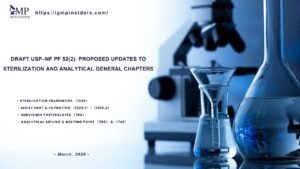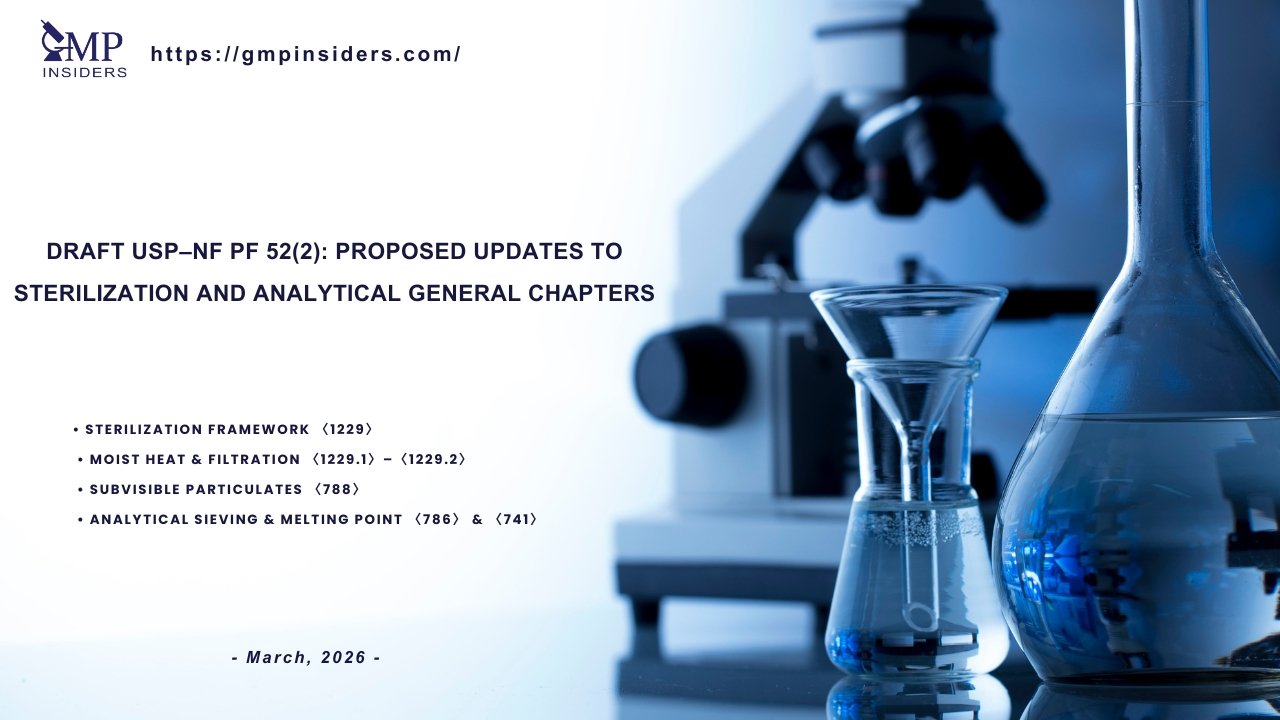
USP has published draft proposals in the Pharmacopeial Forum 52(2) that affect several general chapters relevant to sterilization, particulate control, analytical sieving, and melting point testing. The proposed revisions cover 〈1229〉, 〈1229.1〉, 〈1229.2〉, 〈1229.4〉, 〈788〉, 〈786〉, and 〈741〉.
The most significant changes are within the 〈1229〉 sterilization chapter series. USP is proposing to reorganize this framework by broadening the general sterilization chapter, expanding the moist heat chapter, and relocating sterilizing filtration content into a revised 〈1229.2〉, with 〈1229.4〉 proposed for omission.
In parallel, the draft also introduces more targeted revisions to other general chapters, including a scope clarification for 〈788〉, a more rigorous and harmonized structure for 〈786〉, and an explicit USP Reference Standards section in 〈741〉.
From a regulatory and GMP perspective, these proposals are important because they affect how firms reference compendial expectations in validation strategies, analytical procedures, training materials, and controlled documentation. While the draft does not primarily introduce new compliance limits, it does revise chapter structure, terminology, and qualification language in ways that may require technical assessment and document updates if adopted.
Overview of the PF 52(2) Draft Proposals
| Chapter | Type | Focus | GMP / Lab Impact |
|---|---|---|---|
| 〈1229〉 Sterilization of Compendial Articles | Revision | Retitle to Sterilization and consolidate content from several sterilization-related chapters | Becomes a broader umbrella chapter for sterilization concepts, process selection, validation, indicators, and cycle development |
| 〈1229.1〉 Steam Sterilization by Direct Contact | Revision | Retitle to Moist Heat Sterilization and absorb content from aqueous liquid sterilization and SIP | Moist heat strategy becomes more unified; document references and training content will need realignment |
| 〈1229.2〉 Moist Heat Sterilization of Aqueous Liquids | Revision | Retitle to Sterilizing Filtration of Liquids and integrate content from 〈1229.4〉 | Sterilizing filtration guidance shifts to a new chapter number; internal references and validation documents will need updating |
| 〈788〉 Particulate Matter in Injections | Revision | Retitle to Subvisible Particulate Matter in Injections | Improves scope clarity; particulate programs remain broadly the same but chapter citations and terminology should be updated |
| 〈786〉 Particle Size Distribution Estimation by Analytical Sieving | Revision | Add sieve qualification language, rename sections, improve rigor and clarity | Labs will need to review sieve qualification, SOP wording, and suitability of analytical sieving for finer materials |
| 〈741〉 Melting Range or Temperature | Revision | Add explicit USP Reference Standards section | More formalized apparatus accuracy checks and clearer linkage to USP melting point standards |
Cross-Cutting Themes in PF 52(2)
Across the PF 52(2) drafts, several broader themes stand out.
1. USP Is Restructuring the Sterilization Chapter System
The clearest change is not a single new acceptance limit or test method, but a reorganization of how sterilization guidance is distributed across chapters. USP is moving away from a more fragmented structure in which related content is spread across multiple narrower chapters. Instead, the proposal points toward:
- a broader general sterilization chapter,
- a broader moist heat chapter,
- a repurposed filtration chapter number,
- and omission of standalone chapters where the content is being absorbed elsewhere.
For regulated companies, this is important because even if the scientific expectations remain familiar, chapter references in SOPs, validation master plans, training records, qualification protocols, supplier technical files, and regulatory justifications may all need updating.
See Also: Terminal Sterilization vs Aseptic Processing
2. Validation and Lifecycle Thinking Are Being Reinforced
The revised sterilization texts continue to emphasize that sterility is not proven by end-product testing alone. Instead, sterility assurance remains anchored in validated processes, appropriate process selection, and control of critical operating conditions.
That means the new package continues to support a lifecycle view of sterilization involving:
- process development,
- material compatibility assessment,
- cycle selection,
- load and temperature mapping,
- biological and physical challenge work,
- routine control,
- and clearly justified release decisions.
3. USP Is Tightening Terminology
Some changes are mainly structural, but others are clearly aimed at improving technical precision.
For example:
- 〈788〉 is being retitled to explicitly say Subvisible Particulate Matter in Injections, which better reflects what the chapter actually covers.
- 〈786〉 shifts from a broader “Sieving Methods” wording to Analytical Sieving Methods, and the agitation subsections are renamed more precisely.
These are not dramatic scientific changes, but they matter for clarity, training, and interpretation.
4. External Standards and Reference Systems Are Becoming More Explicit
The drafts also show a stronger tendency to anchor chapter expectations more directly to recognized standards and reference materials.
Examples include:
- ASTM F838-20 in the filtration proposal,
- ISO 3310-1 in the analytical sieving proposal,
- and explicit listing of USP Melting Point Standards in 〈741〉.
This is useful from a GMP perspective because it reduces ambiguity around qualification and performance checks.
〈1229〉 Sterilization of Compendial Articles
Status: Revision
The proposed revision to 〈1229〉 is the central structural change within the PF 52(2) package. USP proposes to retitle the chapter from Sterilization of Compendial Articles to Sterilization and to consolidate into it content currently addressed in 〈1229.1〉, 〈1229.2〉, 〈1229.5〉, 〈1229.9〉, and 〈1229.14〉. This indicates a broader repositioning of 〈1229〉 as the principal general chapter for sterilization principles, validation strategy, sterilization indicators and integrators, and cycle development.
The revised text continues to reinforce the core compendial principle that sterility assurance is based on a validated and controlled sterilization process, not on sterility testing alone. It also retains the established validation approaches and frames their selection within a scientific and product-specific context.
Key Revisions
The main elements reflected in the revised draft include:
- Chapter retitle and scope expansion: The chapter title is shortened to “Sterilization” to reflect a broader, more general role within the USP sterilization framework.
- Content consolidation from related chapters: USP proposes to incorporate material currently addressed in: 〈1229.1〉; 〈1229.2〉; 〈1229.5〉; 〈1229.9〉; and 〈1229.14〉.
- Reinforcement of sterility assurance principles: The draft continues to state that sterility is expressed probabilistically and cannot be demonstrated solely by end-product testing.
- Retention of established validation approaches: The chapter continues to describe:
- overkill methods
- bioburden/biological indicator methods
- bioburden-based methods
- Greater lifecycle emphasis: The revised structure places a stronger focus on:
- process development
- process selection
- mapping activities
- load qualification
- biological indicators
- physicochemical integrators
- routine process control
- Recognition of parametric release: The draft explicitly identifies parametric release as the preferred approach for terminally sterilized products where scientifically justified, appropriately validated, and supported by the applicable framework.
GMP Impact
If adopted, 〈1229〉 would become the primary general chapter for overarching sterilization expectations within USP. From a GMP perspective, firms should assess the effect of this consolidation on:
- sterilization validation strategies
- validation master documentation
- training materials
- chapter cross-references in SOPs and protocols
- technical justifications used in change control or inspection support
For companies that currently rely on separate citation of 〈1229.5〉, 〈1229.9〉, or 〈1229.14〉, the proposed revision signals a more centralized compendial structure, with corresponding implications for document alignment and internal reference control.
〈1229.1〉 Steam Sterilization by Direct Contact
Status: Revision
USP proposes to revise 〈1229.1〉 by retitling the chapter from Steam Sterilization by Direct Contact to Moist Heat Sterilization and incorporating content currently addressed in 〈1229.2〉 Moist Heat Sterilization of Aqueous Liquids and 〈1229.13〉 Sterilization-in-Place. The proposal indicates a broader restructuring of the USP sterilization chapter series, under which 〈1229.1〉 would serve as the principal general chapter for moist heat sterilization.
The revised draft expands the chapter’s scope beyond traditional direct-contact steam applications. In addition to established principles such as saturated steam, gravity displacement, prevacuum processes, F₀-based lethality, component mapping, load mapping, and heat penetration or biological challenge studies for wrapped and hard goods, the chapter also includes dedicated sections on the validation of sterilization-in-place (SIP) processes and the sterilization of aqueous liquids.
Key Revisions
The main revisions reflected in the draft include:
- Chapter retitle: 〈1229.1〉 is proposed to be renamed from Steam Sterilization by Direct Contact to Moist Heat Sterilization.
- Content consolidation: USP proposes to incorporate into this chapter material currently addressed in:
- 〈1229.2〉 Moist Heat Sterilization of Aqueous Liquids
- 〈1229.13〉 Sterilization-in-Place
- Expanded chapter scope: The chapter continues to address core direct-contact steam sterilization concepts while also extending to validation of aqueous liquid sterilization and validation of SIP processes
- Greater emphasis on SIP validation principles: The draft describes SIP as an overkill moist heat process and reinforces expectations for:
- combined physical and microbiological validation
- use of thermocouples and biological indicators
- placement of monitoring tools and challenges at worst-case locations
GMP Impact
From a GMP perspective, this proposal is likely to affect how firms structure and reference moist heat sterilization requirements across validation and qualification documentation. Companies that currently rely on separate chapter references for direct-contact steam sterilization, SIP, and sterilization of aqueous liquids should assess whether internal chapter citations, training materials, and technical support documents remain aligned with this restructuring.
〈1229.2〉 Moist Heat Sterilization of Aqueous Liquids
Status: Revision
USP proposes to revise 〈1229.2〉 by changing the chapter title from Moist Heat Sterilization of Aqueous Liquids to Sterilizing Filtration of Liquids and incorporating content currently addressed in 〈1229.4〉 Sterilizing Filtration of Liquids. The proposal reflects a restructuring of the sterilization chapter series, under which sterilizing filtration of liquids would no longer be maintained as a standalone chapter under 〈1229.4〉 but would instead be addressed within the revised 〈1229.2〉.
The revised draft establishes a more explicit compendial framework for the sterilizing filtration of liquids. The proposed text addresses factors affecting filtration performance; the qualification of sterilizing-grade filters; integrity testing, including timing; control of prefiltration bioburden; responsibilities of the filter manufacturer and the filter user; and handling of integrity test failures.
Related Article: What is Moist Heat Sterilization?
Key Revisions
The main revisions reflected in the draft include:
- Chapter retitle: 〈1229.2〉 is proposed to be renamed from Moist Heat Sterilization of Aqueous Liquids to Sterilizing Filtration of Liquids.
- Content consolidation: USP proposes to incorporate into this chapter the material currently addressed in 〈1229.4〉 Sterilizing Filtration of Liquids
- Reassignment of chapter scope: The chapter would no longer address aqueous liquid moist heat sterilization, but instead serve as the USP chapter for sterilizing filtration of liquids.
- Expanded filtration control framework: The revised text addresses:
- factors affecting filtration performance
- sterilizing-grade filter qualification
- integrity testing and timing of integrity testing
- prefiltration bioburden control
- manufacturer and user responsibilities
- investigation of integrity test failures
- Updated technical reference: The proposal refers to ASTM F838-20 regarding sterilizing-grade filter performance.
GMP Impact
From a GMP perspective, this proposal is primarily significant for documentation, validation, and chapter reference. Companies that currently cite 〈1229.4〉 in sterile filtration validation packages, technical procedures, supplier qualification files, or regulatory support documents should assess the effect of transferring that content into revised 〈1229.2〉.
The proposal also reinforces the expectation that sterilizing filtration must be supported by a well-defined control strategy that addresses filter qualification, integrity testing, process-specific bioburden management, and justified use conditions.
〈788〉 Particulate Matter in Injections
Status: Revision
USP proposes to revise 〈788〉 by changing the chapter title from Particulate Matter in Injections to Subvisible Particulate Matter in Injections. Based on the draft text, this proposal is best understood as a clarification of the chapter’s scope rather than a substantive revision of the established testing framework.
The visible draft text does not indicate any change to the established numerical acceptance criteria. The chapter continues to distinguish between products with a nominal volume greater than 100 mL and those with a nominal volume of 100 mL or less, retaining the current limits for particles ≥10 μm and ≥25 μm.
The draft also continues to reflect the existing exemptions and specific applicability considerations, including those relating to irrigating solutions, radiopharmaceutical preparations, and products labeled for use with a final filter where scientifically justified.
Key Revisions
The main revisions reflected in the draft include:
- Chapter retitle: 〈788〉 is proposed to be renamed from Particulate Matter in Injections to Subvisible Particulate Matter in Injections.
- Clarification of scope: The revised title aligns more closely with the chapter’s actual subject matter, which is already focused on subvisible particulate matter.
- No visible change to core test methods: The draft continues to describe:
- Method 1: Light Obscuration Particle Count Test
- Method 2: Microscopic Particle Count Test
- No visible change to established acceptance criteria: The draft text continues to present the existing limits for products above and below 100 mL, including the current criteria for particles ≥10 μm and ≥25 μm.
- Existing applicability and exemption framework retained: The visible text continues to reflect the current treatment of specific product categories and justified exemptions.
GMP Impact
Manufacturers and QC laboratories should assess whether internal specifications, SOP titles, validation references, training materials, and chapter cross-references would need updating to align with the revised official chapter title if adopted. Based on the currently visible draft text, the underlying method structure, applicability logic, and acceptance approach remain unchanged.
〈786〉 Particle Size Distribution Estimation by Analytical Sieving
Status: Revision
USP proposes to revise 〈786〉 as a harmonized Pharmacopeial Discussion Group Stage 2 proposal coordinated through the European Pharmacopoeia. The revision is method-focused and intended to strengthen the chapter’s scientific and operational clarity.
According to the briefing, the principal changes include the addition of a new Qualification subsection under Test Sieves, revision of the section title Sieving Methods to Analytical Sieving Methods, renaming of subsection titles relating to mechanical agitation and air entrainment, and broader revision of the chapter text for clarity and technical precision.
Key Revisions
The main revisions reflected in the draft include:
- New Qualification subsection under Test Sieves: The revised chapter introduces a dedicated subsection addressing the qualification of test sieves.
- Reference to ISO 3310-1: Test sieves are expected to conform to the current edition of ISO 3310-1, with qualification performed in accordance with that standard.
- Revised section and subsection titles: The chapter retitles:
- Sieving Methods to Analytical Sieving Methods
- Mechanical Agitation to Sieving by Mechanical Agitation
- Air Entrainment Methods to Sieving by Air Entrainment Methods
- Clearer definition of method applicability: The draft states that analytical sieving is generally intended for materials in which at least 80% of particles exceed 75 µm, and indicates that alternative methods should be considered for finer materials where appropriate.
- More explicit procedural expectations: The proposed text clarifies endpoint determination, permissible mass loss, and conditions under which a validated fixed sieving time may be used for routine testing.
GMP Impact
From a laboratory control perspective, this revision is likely to affect analytical method procedures, sieve qualification practices, training materials, and method validation or verification packages.
The proposal provides a more explicit compendial basis for qualification of test sieves, clearer boundaries for when analytical sieving is appropriate, and more defined expectations for routine execution of the method. For firms operating across multiple regulatory regions, the harmonized nature of the revision is also relevant, as it supports greater alignment of particle size testing practices across pharmacopeial frameworks.
〈741〉 Melting Range or Temperature
Status: Revision
USP proposes to revise 〈741〉 by adding a new USP Reference Standards section identifying the USP melting point standards used to check apparatus accuracy. Although narrower in scope than the sterilization-related proposals in PF 52(2), this revision is still relevant to QC and analytical laboratories because it makes the reference standard framework more explicit within the chapter. The draft also retains the established emphasis on performing the determination at a heating rate of 1°/min to support the consistency and repeatability of results.
The proposed text provides greater specificity regarding the reference standards that may be used for apparatus accuracy checks. The inserted section lists the following materials: USP Acetanilide Melting Point Standard RS, USP Caffeine Melting Point Standard RS, USP Phenacetin Melting Point Standard RS, USP Phenyl Salicylate Melting Point Standard RS, USP Potassium Nitrate Melting Point Standard RS, USP Succinic Acid Melting Point Standard RS, USP Sulfanilamide Melting Point Standard RS, USP Theophylline Melting Point Standard RS, and USP Vanillin Melting Point Standard RS. The chapter states that these standards are intended to verify the device’s accuracy and may also be suitable for calibration.
Key Revisions
The main revisions reflected in the draft include:
- New USP Reference Standards section: The revised chapter introduces a dedicated section identifying USP melting point standards used for apparatus accuracy checks.
- Explicit listing of reference standards: The draft names the specific USP standards that may be used to verify device accuracy.
- Retention of the 1°/min heating rate principle: The chapter continues to emphasize a controlled heating rate of 1°/min to support consistency and repeatability.
- Recognition of modern instrumentation: Apparatus incorporating cameras or computerized systems remains acceptable, provided it is properly qualified.
- No visible change to core interpretive principles: The draft retains the established distinctions relating to melting behavior, temperature interpretation, and applicable procedures for different material types.
GMP Impact
From a laboratory control perspective, the proposal clarifies the compendial basis for melting point apparatus accuracy checks. Laboratories already using USP melting point standards would have a clearer USP chapter reference to support that practice, while laboratories relying on broader internal calibration or verification approaches should assess whether local procedures, qualification records, and training materials remain aligned with the revised chapter language if adopted.
Final Thoughts on the PF 52(2) Package
Taken together, these PF 52(2) drafts are less about introducing brand-new acceptance criteria and more about restructuring chapter architecture, sharpening chapter titles, and making method control expectations more explicit.
The sterilization group is the most consequential part of the package because it changes how several chapters will be organized and cited. By contrast, the proposals for 〈788〉, 〈786〉, and 〈741〉 are more targeted: they clarify the scope, strengthen the language of harmonized methods, and make reference-standard expectations more visible.
For regulated companies, the most sensible next steps are straightforward: map every current internal reference to 〈1229〉, 〈1229.1〉, 〈1229.2〉, and 〈1229.4〉; review whether analytical SOPs for particulates, sieving, and melting need terminology or qualification updates; and prepare comments where the proposed restructuring could create transition or citation complexity.