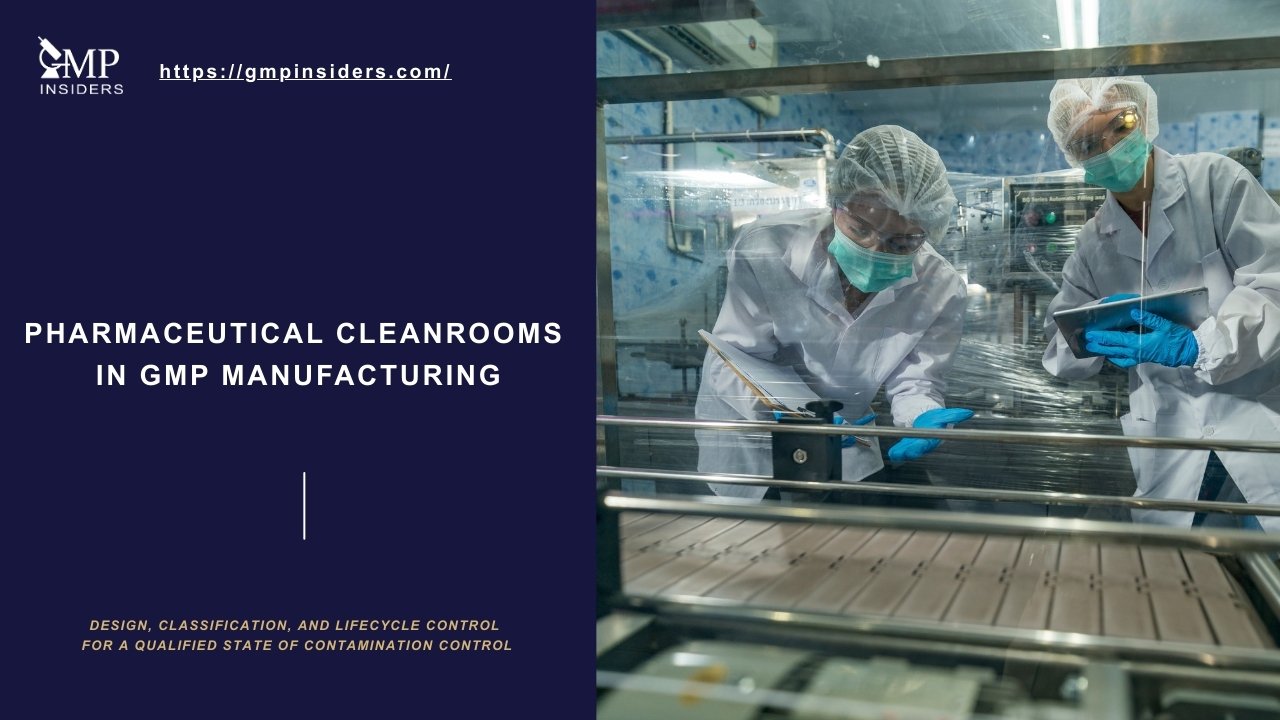
Cleanrooms are used in pharmaceutical manufacturing to provide controlled environmental conditions that prevent contamination from affecting product quality. They are designed and qualified to maintain defined limits for airborne particulate and microbiological contamination through appropriate filtration, airflow design, pressure differentials, and controlled environmental parameters.
Ongoing control is demonstrated through monitoring, trending, maintenance, and documented responses to adverse results, ensuring the area remains suitable for the intended operations across its lifecycle.
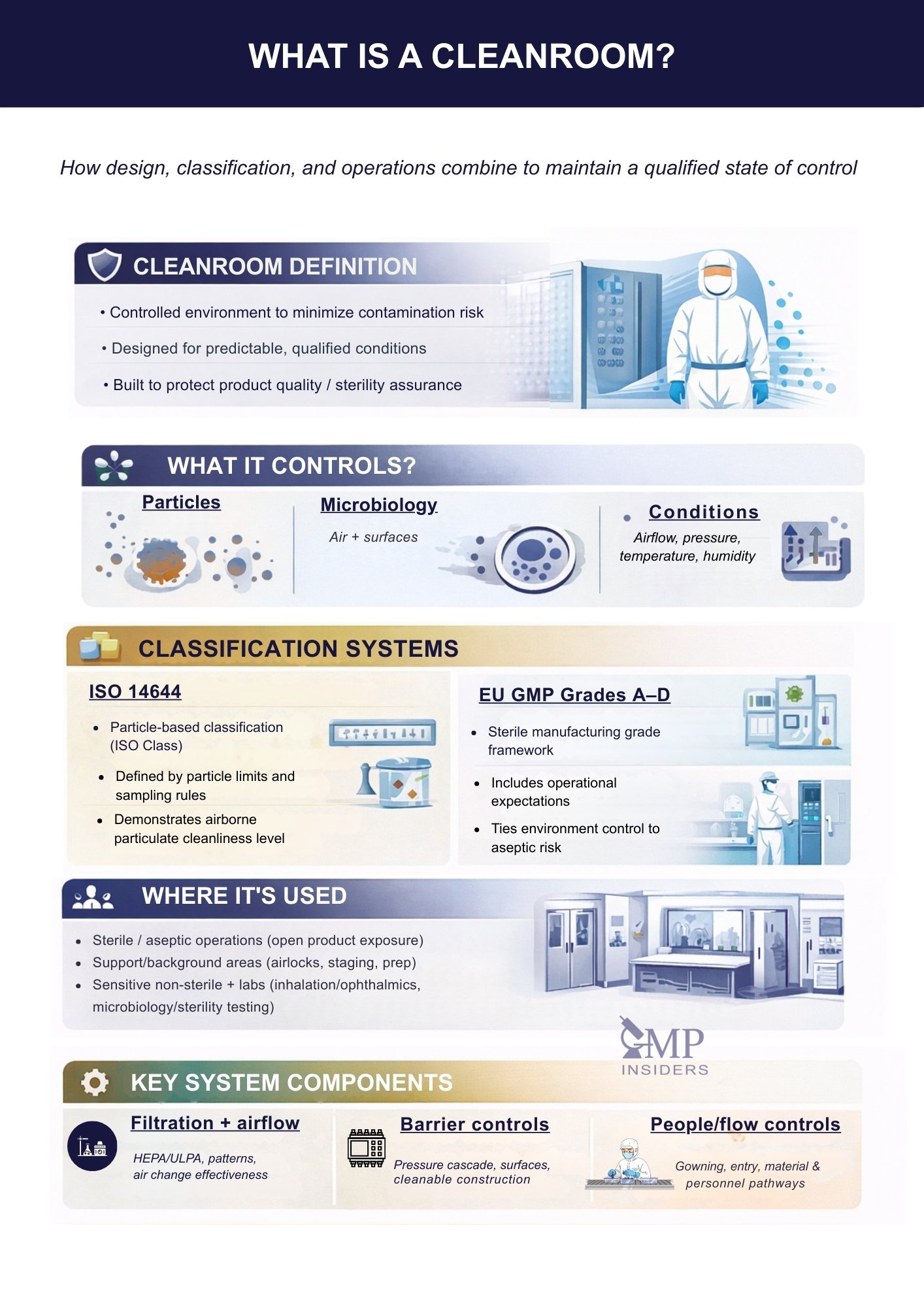
This article explains what a pharmaceutical cleanroom is, what environmental parameters it controls, how ISO 14644 classes and EU GMP Grades relate, where cleanrooms are used in pharma operations, and which design and operational elements are typically expected to maintain the area in a qualified state of control.
What Is a Cleanroom?
A cleanroom is a controlled environment designed to minimize and manage contamination that could affect the safety, quality, or performance of pharmaceutical products. Unlike ordinary rooms, cleanrooms are engineered to control airborne particles, microbial contamination, and environmental parameters such as airflow, temperature, humidity, and pressure.
These conditions are defined, qualified, and continuously verified to remain within validated limits.
In practical terms, a cleanroom is a space in which the environment is predictable and scientifically controlled. Air is filtered through HEPA or ULPA systems; airflow patterns are designed to remove and dilute contaminants; surfaces are constructed from materials that do not shed particles; and the movement of people and materials is carefully controlled.
Every design and operational element exists for one reason: to reduce the risk of contamination to an acceptable, scientifically justified level.
Regulatory frameworks such as EU GMP, FDA cGMP, and ISO 14644 define how cleanrooms must be designed, classified, operated, and monitored.
Cleanroom performance must be demonstrated under defined conditions. For this reason, qualification and monitoring activities distinguish between “at rest” and “in operation” states.
At rest means the installation is complete, the equipment is installed and operating, and no personnel are present. In operation refers to the condition in which the area is functioning as intended, including the presence of personnel and routine activities.
The objective is to demonstrate that the cleanroom remains under control under process-relevant conditions. Classification and qualification results are therefore interpreted together with operational controls, including personnel practices, material flows, interventions, cleaning and disinfection effectiveness, and environmental monitoring performance.
Where a process involves open product exposure or critical aseptic manipulations, evidence of control in operation is particularly important, as personnel and activities are the dominant sources of contamination.
What Does a Cleanroom Control?
A pharmaceutical cleanroom is designed to control specific environmental factors that can influence product quality, sterility assurance, and regulatory acceptability. Its purpose is not only to make the area visibly clean, but to maintain a scientifically defined level of environmental control that can be consistently demonstrated.
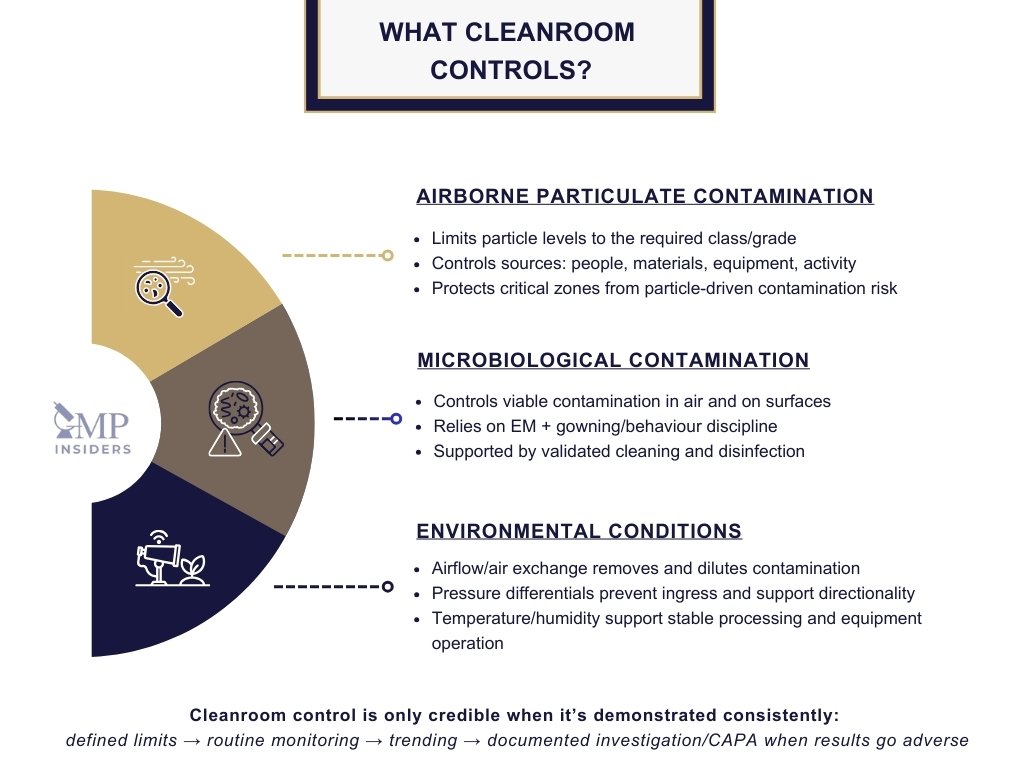
Airborne Particulate Contamination
Cleanrooms are primarily intended to limit the concentration of airborne particles originating from personnel, equipment, materials, and manufacturing activities. These particles can:
- Carry microorganisms into critical process areas
- Interfere with sensitive manufacturing operations
- Compromise product quality and sterility assurance
For this reason, cleanrooms operate under defined particle concentration limits that correspond to their classification and intended use.
Microbiological Contamination
Microorganisms represent a serious risk in pharmaceutical manufacturing, particularly in sterile product environments. Cleanrooms help control microbial presence through:
- Qualified environmental monitoring programs
- Strict personnel hygiene and behavior controls
- Validated cleaning and disinfection practices
This structured approach reduces the risk of bioburden and supports patient safety.
Environmental Conditions
Cleanrooms also control key physical environmental parameters that support both manufacturing performance and regulatory compliance, including:
- Airflow characteristics and air exchange rates: to dilute, remove, and continuously refresh air, reducing contamination buildup.
- Pressure differentials: to prevent contaminated air from entering cleaner zones and to maintain directional airflow between classified areas.
- Temperature and humidity: to support product stability, process consistency, operator comfort, and reliable equipment operation.
These parameters are defined during qualification, scientifically justified, and maintained through validated HVAC and control systems to ensure sustained environmental control.
Cleanroom Classes in Pharmaceutical Industry
Not all cleanrooms operate at the same level of control. In the pharmaceutical industry, environments are classified according to the degree to which particulate and microbiological contamination must be controlled, based on the risk and criticality of the process being performed.
ISO 14644 Cleanroom Classes
ISO 14644-1 provides an international classification system for airborne particles based on particle concentration. Cleanrooms are classified (commonly ISO 5 to ISO 8 in the pharmaceutical industry) according to the maximum allowable number of particles of defined sizes per cubic meter of air.
In practice, this classification enables manufacturers to define, measure, and demonstrate the cleanliness of their environment in a standardized, globally recognized manner.
SEE ALSO: Cleanroom Classification According to ISO 14644-1
EU GMP Grades A, B, C, and D
In addition to ISO classification, EU GMP Annex 1 cleanroom grades govern pharmaceutical sterile manufacturing:
- Grade A: Highest control level, typically for critical aseptic operations such as filling and open product exposure
- Grade B: Background environment for Grade A activities
- Grades C and D: Support areas used for preparation, less critical processing, or background environments where lower particle levels are acceptable
These grades are linked not only to particulate limits, but also to microbiological expectations and operational requirements.
SEE ALSO: GMP Cleanroom Classifications: Grade A, B, C, and D
How the Systems Relate
ISO classes provide a particle-based classification framework, whereas GMP Grades incorporate both particulate expectations and a broader sterility-assurance context within manufacturing. In pharmaceutical practice, they are often used together: ISO defines measurable particle control, while GMP Grades define how that control connects to process risk and regulatory expectations.
Where Are Cleanrooms Used in the Pharmaceutical Industry?
Cleanrooms are used wherever environmental control directly affects product quality, sterility assurance, or regulatory compliance. Their application is not limited to sterile manufacturing; they support a wide range of activities in which contamination must be minimized and controlled.
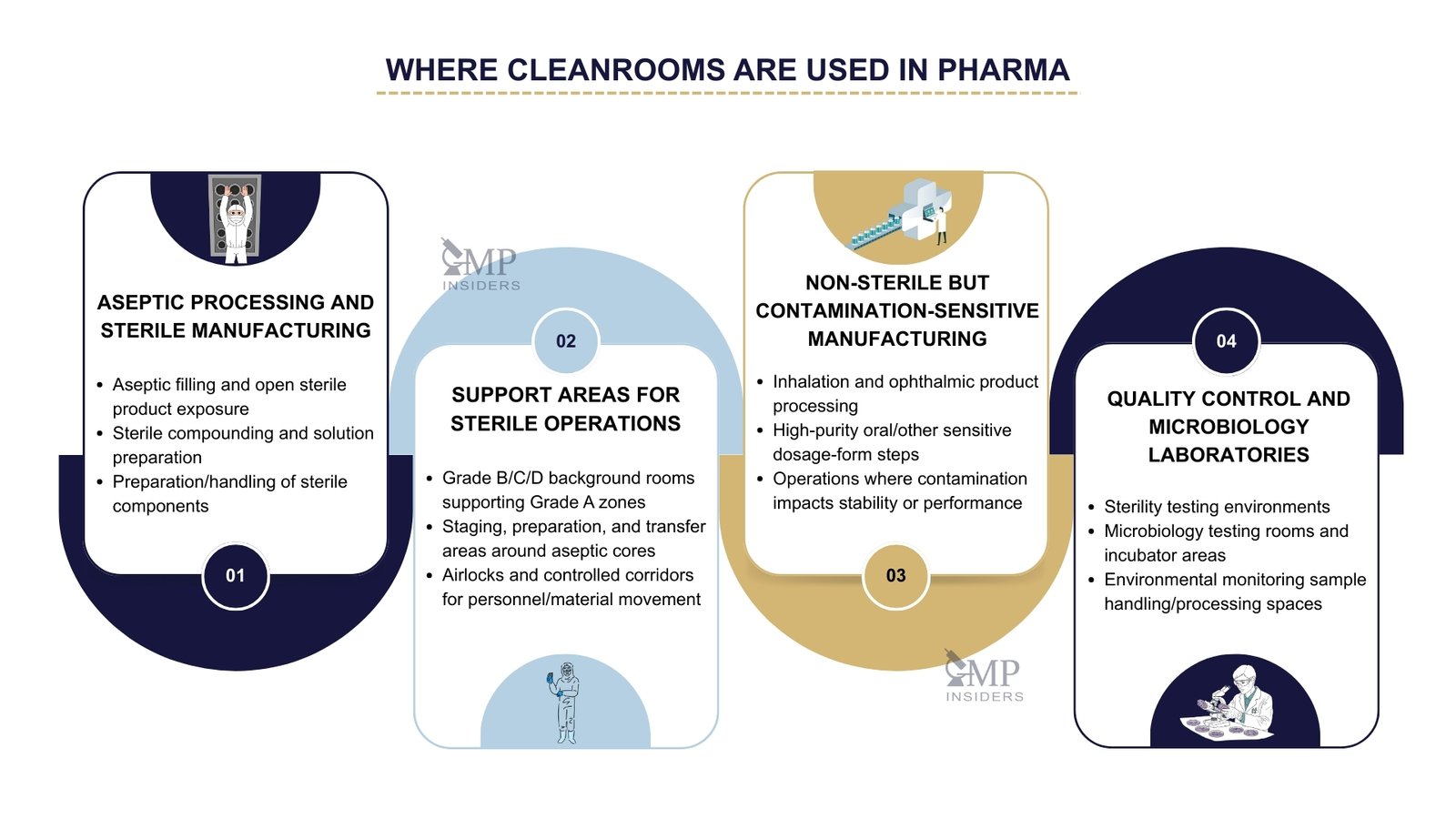
Aseptic Processing and Sterile Manufacturing
Cleanrooms play a central role in sterile product manufacturing, particularly in:
- Aseptic preparation and filling of injectable products
- Operations involving open product exposure
- Compounding of sterile formulations
- Preparation of sterile components and solutions
These environments require the highest level of environmental control because any contamination may directly reach the patient.
Support Areas for Sterile Operations
Surrounding rooms that support aseptic areas also operate as classified cleanrooms. These include preparation areas, staging zones, and background environments that provide controlled conditions for entry into critical processing spaces. Their role is to maintain a contamination barrier and to support the movement of products, components, and personnel under controlled conditions.
Non-Sterile but Contamination-Sensitive Manufacturing
Even where sterility is not required, controlled environments are often needed to:
- Protect products with microbial or particulate sensitivity
- Handle inhalation products, ophthalmics, or high-purity oral dosage forms
- Manage processes where contamination may affect product performance or stability
Here, cleanrooms help maintain consistency, reduce variability, and support GMP expectations.
Quality Control and Microbiology Laboratories
Many pharmaceutical laboratories also operate within controlled environments, particularly:
- Microbiological testing rooms
- Environmental monitoring laboratories
- Sterility testing areas
In these cases, the cleanroom supports the integrity and reliability of analytical results.
Key Components of a Cleanroom
A pharmaceutical cleanroom is not defined solely by its appearance or cleanliness; it is designed as a controlled system in which every component contributes to preventing contamination and ensuring regulatory compliance. Its effectiveness depends on how well its design elements, engineering controls, and operational practices work together.
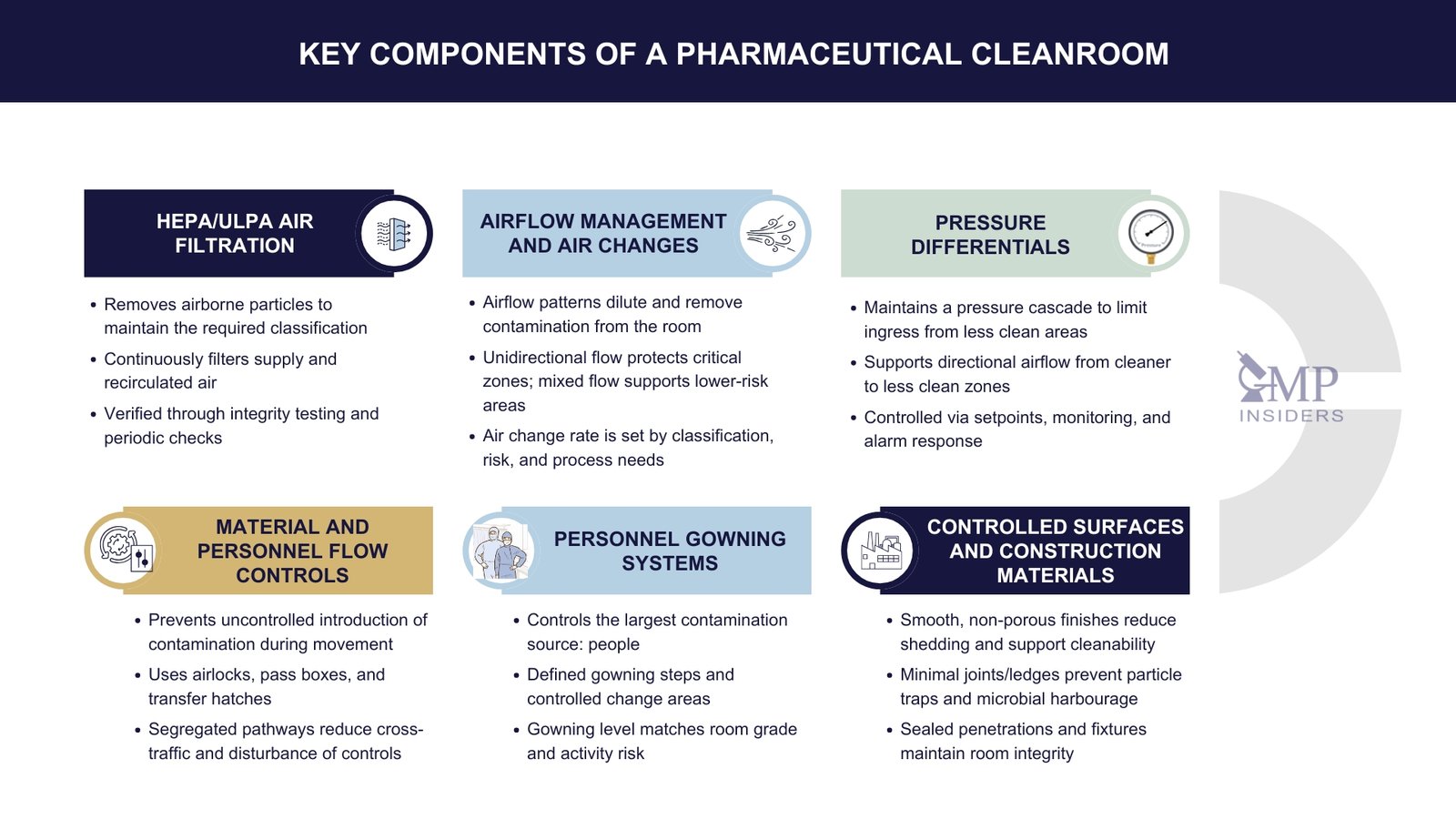
HEPA / ULPA Air Filtration
Cleanroom air is filtered through high-efficiency filtration systems:
- HEPA filters remove the majority of submicron airborne particles
- ULPA filters provide even higher efficiency where required
These filters continuously clean recirculated and supply air, helping maintain the room’s classification.
SEE ALSO: Type of HEPA Filters Used in the Pharmaceutical Industry
Airflow Management and Air Changes
Airflow patterns are engineered to remove and dilute contamination:
- Laminar (unidirectional) airflow is typically used in critical areas to sweep contamination away from product contact zones
- Turbulent or mixed airflow may be used in less critical spaces
The number of air changes per hour is determined by classification, risk, and process requirements.
Pressure Differentials
Positive pressure is maintained in most pharmaceutical cleanrooms to prevent contaminated air from entering controlled areas from surrounding spaces. Pressure gradients between zones of varying cleanliness help ensure that contamination flows outward to less-controlled areas rather than inward toward critical environments.
Controlled Surfaces and Construction Materials
Cleanrooms are constructed from materials designed to minimize shedding, prevent particle build-up, and withstand repeated cleaning and disinfection. This typically includes:
- Smooth, non-porous, easy-to-clean wall, floor, and ceiling finishes
- Minimal joints, ledges, and particle traps
- Sealed penetrations, doors, and fixtures
Personnel Gowning Systems
Since people are the largest contamination source, cleanrooms include structured gowning control:
- Defined gowning areas and procedures
- Use of gowns, masks, gloves, shoe covers, and head coverings
- Differentiated gowning requirements depending on room classification and activity
Material and Personnel Flow Controls
To reduce contamination risk, the movement of both people and materials is carefully managed through:
- Airlocks
- Pass boxes and transfer hatches
- Segregated flows and defined movement pathways
This prevents the uncontrolled introduction of contaminants into critical environments.
People, Procedures, and Behaviour in Cleanrooms
Technology and engineering controls define the structure of a cleanroom, but its performance in day-to-day pharmaceutical operations depends primarily on how personnel behave within it. Personnel are consistently identified as the primary source of contamination, which is why disciplined procedures, training, and controlled behavior are fundamental to cleanroom integrity.
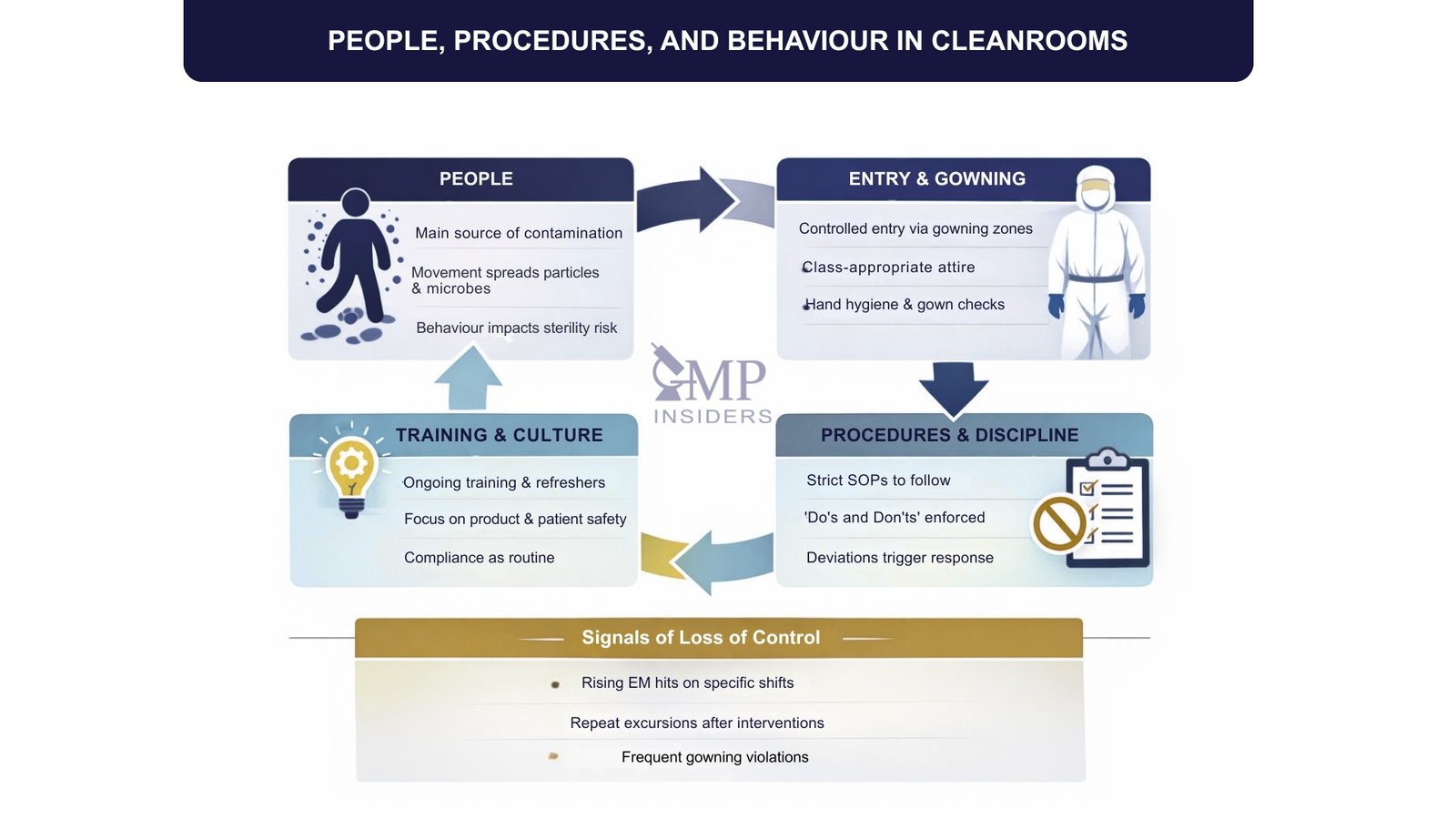
People as the Primary Contamination Source
Even when fully gowned, operators continuously shed particles and can introduce microorganisms through movement, poor hygiene, or incorrect practices. Simple actions such as rapid movement, unnecessary talking, improper glove use, or touching inappropriate surfaces can significantly increase the risk of contamination. Cleanroom operation, therefore, relies on trained personnel who understand not only what to do, but why it matters.
Gowning and Entry Procedures
Access to a cleanroom is controlled through structured entry systems and defined gowning procedures. This typically includes:
- Controlled change rooms and gowning zones
- Class-appropriate gowning (e.g., gloves, masks, coveralls, hoods, footwear)
- Strict rules for hand hygiene and gown integrity
- Verification that personnel are trained and authorized to enter
Gowning is part of the contamination control strategy and must be performed consistently and correctly.
SEE ALSO: Risk-Based Contamination Control Strategy (CCS)
Defined Procedures and Discipline
Activities performed inside cleanrooms are governed by approved SOPs that define:
- How operations are performed
- What personnel may and may not do
- How to handle materials, components, and equipment
- How to respond to deviations or contamination events
Adherence to procedures is critical because cleanroom performance must be predictable, repeatable, and defensible during inspection.
Training, Awareness, and Culture
Sustained cleanroom control requires more than initial instruction. Personnel must:
- Receive initial and periodic training
- Understand the impact of their actions on product and patient safety
- Maintain situational awareness and accountability
- Support a culture where compliance is normal behavior, not an obligation
In mature pharmaceutical environments, cleanroom discipline becomes part of organizational culture rather than a task enforced only by QA.
Cleanroom Operation and Maintenance
A cleanroom does not remain compliant simply because it has been well designed or initially qualified. Its performance depends on how it is operated, monitored, cleaned, and maintained throughout its lifecycle. In pharmaceutical manufacturing, cleanroom control must be continuously demonstrated rather than assumed.
Routine Environmental Monitoring
Environmental monitoring programs are established to verify that the cleanroom continues to operate within defined limits. These typically include:
- Airborne particle monitoring
- Viable airborne and surface microbiological monitoring
- Pressure differential checks
- Temperature and humidity monitoring
Monitoring is risk-based, aligned with classification and process criticality, and supported by defined alert and action limits. Results must be reviewed, trended, and acted upon where deviations occur.
Cleaning and Disinfection Practices
Cleanrooms require structured and validated cleaning and disinfection programs. These typically define:
- Cleaning frequencies for different classifications and areas
- Approved disinfectants, rotation strategies, and sporicidal use where necessary
- Methods and equipment to be used
- Documentation expectations and verification activities
The intent is not simply to clean, but to maintain a microbiologically controlled environment with scientifically justified practices.
Preventive Maintenance and Periodic Qualification
Mechanical systems such as HVAC and filtration are critical to cleanroom performance and must be maintained proactively. Activities include:
- Preventive maintenance schedules
- Periodic replacement or integrity testing of HEPA/ULPA filters
- Calibration of instruments and sensors
- Periodic requalification to verify continued compliance with classification requirements
These activities demonstrate that the environment continues to perform as validated initially.