Every batch manufactured in the pharmaceutical industry requires complete, traceable, and reviewable documentation. This is achieved through a set of batch records that guide the process, document the execution, and verify that critical steps were followed as approved. These documents go far beyond the commonly referenced “Batch Manufacturing Record.”
They include master records that define the process. These execution records capture real-time data, packaging and labelling records, and supporting logs that document equipment, cleaning, in-process control, and analytical activities. Together, they provide the technical and regulatory foundation for releasing a batch to the market.
In this article, we break down the main types of batch records used in the pharmaceutical industry, their purposes, regulatory basis, and their place in the overall manufacturing lifecycle.
What Are Batch Records?
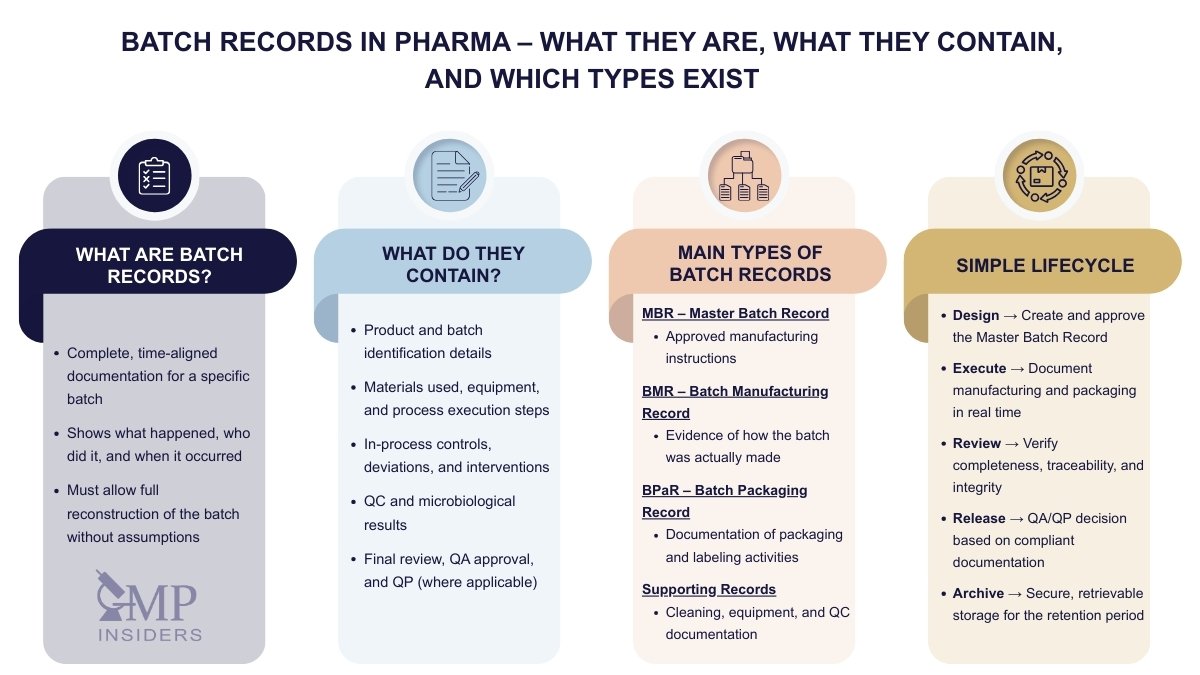
А batch record is the full, time-aligned documentation for a specific batch of finished product or API. It brings together everything that happened to that batch: manufacturing steps, packaging operations, equipment cleaning status, in-process controls, and quality control results, including who performed each step and when.
The aim is simple: anyone reviewing the record should be able to reconstruct the batch’s history without guessing or filling in gaps.
Core Elements
Whether on paper or in an EBR system, a batch record typically includes at least:
- Identification of the product and batch (name, strength, dosage form, batch/lot number).
- Materials and components used, with internal codes, quantities, and lot numbers.
- Executed manufacturing and packaging steps, with dates, times, and operator/checker identification.
- In-process control results and any deviations, alarms, or non-routine interventions.
- Equipment identification and status/cleaning information relevant to the batch.
- Analytical and microbiological results that support batch release.
- Final review and approval entries from production and QA (and QP where applicable).
Purpose of Batch Records
Batch records support four main areas:
- Traceability – clear linkage from raw materials and intermediates through to finished product and distribution decisions.
- Demonstration of control – evidence that the approved and validated process was followed.
- Data integrity and accountability – every action and decision is attributable, legible, and recorded at the time it occurred.
- Regulatory review – core evidence set used by inspectors and by the QP or QA to decide whether a batch can be released.
Types of Batch Records
The documentation package for each batch is built from several record types, each serving a distinct purpose within the manufacturing lifecycle. Understanding how these GMP documents relate to one another is essential for maintaining process control, ensuring traceability, and supporting batch certification.
Master Batch Record (MBR)
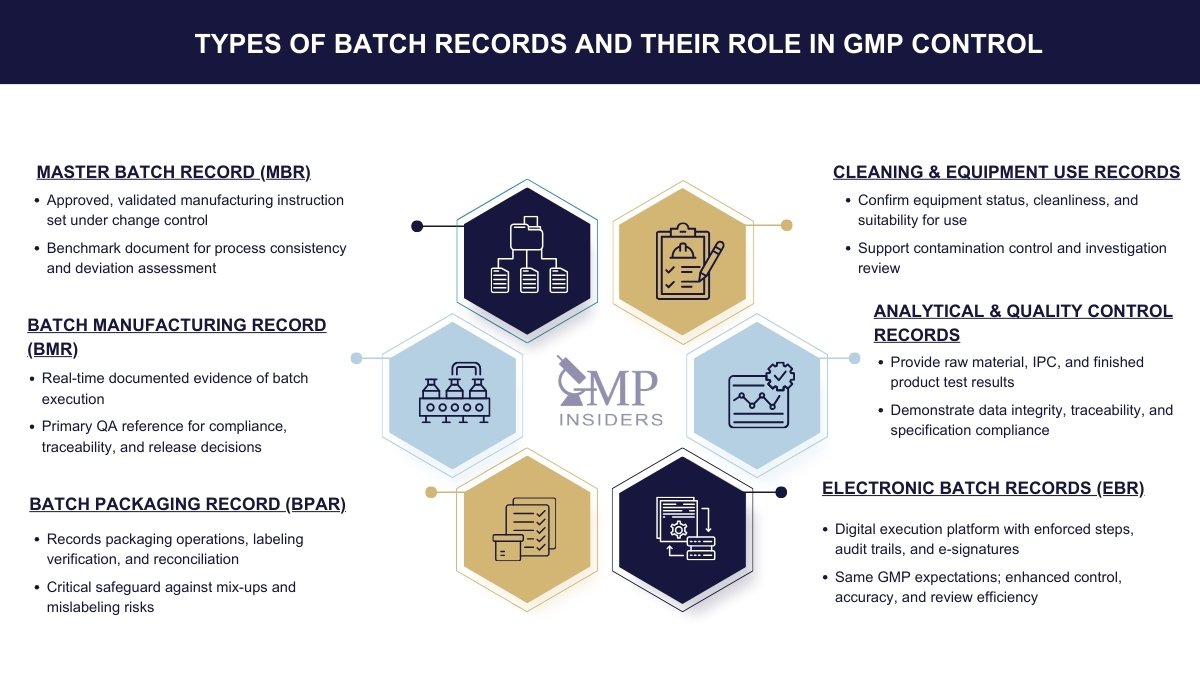
The Master Batch Record defines the approved manufacturing process for a product. It serves as the authoritative instruction set that operators must follow and represents the process as validated and filed with regulatory authorities.
Unlike day-to-day paperwork, the MBR is a controlled, version-managed document. Any modification to it must undergo formal change control because a change to the MBR is a change to the process itself.
Professionally, the MBR functions as:
- The blueprint for how the product must be manufactured
- The reference point for batch review and deviation assessment
- The standard against which process consistency is measured
An effective MBR removes operator interpretation by providing clear, complete, and approved instructions. Its quality directly affects the Batch Production Record that follows.
Batch Manufacturing Record (BMR)
If the MBR is the blueprint, the BMR is the evidence of execution. It documents the batch’s manufacturing steps in detail and captures real-time operational data.
The BMR shows:
- what was done,
- when it was done,
- by whom,
- using which equipment and materials,
- and whether the results remained within approved limits.
It is the primary document used by QA during batch review because it reveals:
- process adherence,
- the presence or absence of atypical events,
- the accuracy and completeness of recorded data, and
- whether the batch can be released.
A well-maintained BMR provides a transparent manufacturing history that aligns with the MBR instructions. A poorly maintained BMR indicates data integrity risks and is a common focus area during inspections.
Batch Packaging Record (BPaR)
After manufacturing, the focus shifts to packaging, a GMP-critical stage due to the risk of mislabeling, component mix-ups, and product substitution. The Batch Packaging Record documents all activities conducted during packaging and labelling and provides full traceability of printed components.
The BPaR demonstrates:
- that the correct packaging materials were used,
- that the artwork and variable data (batch number, expiry date) were verified,
- that line clearance was performed to remove remnants of the previous batch, and
- that in-process checks were performed at the required intervals.
Because packaging errors directly affect patient safety, regulators carefully examine BPaRs. Clear reconciliation, verified labelling, and consistent entries are essential elements of a compliant batch record.
Cleaning and Equipment Use Records
While not batch records by name, cleaning logs and equipment-use records are batch-relevant documents. QA must review them to confirm that production equipment was clean, suitable, and in the correct state before the batch began.
These records demonstrate:
- the cleaning status of each piece of equipment,
- its sequence of use across products and batches,
- whether cleaning was performed according to the validated procedure, and
- that no cross-contamination risks were present.
In GMP investigations, these logs are frequently referenced to determine whether equipment condition contributed to a deviation or atypical result. Their role is supportive but essential: they document the batch’s manufacturing history.
Analytical and Quality Control Records
Manufacturing records alone cannot justify batch release. Analytical and QC records provide the scientific confirmation that the batch meets all quality specifications.
These records include:
- results of raw material and in-process testing,
- finished product results,
- method and equipment used,
- review and approval signatures, and
- any investigations associated with OOS, OOT, or atypical data.
From a regulatory standpoint, QC documentation must clearly demonstrate data integrity and traceability. These records become part of the total batch package reviewed before release and are stored in alignment with data retention requirements.
Electronic Batch Records (EBR)
Modern facilities increasingly use Electronic Batch Records as a digital alternative to paper-based documentation. Although the captured data is identical, the execution and control methods differ significantly.
EBRs:
- automate data capture from equipment and sensors,
- enforce process steps and prevent unauthorized changes,
- incorporate audit trails and electronic signatures,
- reduce transcription errors,
- and support review-by-exception approaches.
Transitioning from paper to EBRs does not change the regulatory requirements; only the format changes. The same principles of traceability, accuracy, contemporaneous entry, and completeness continue to apply.
How to Create and Manage Batch Records
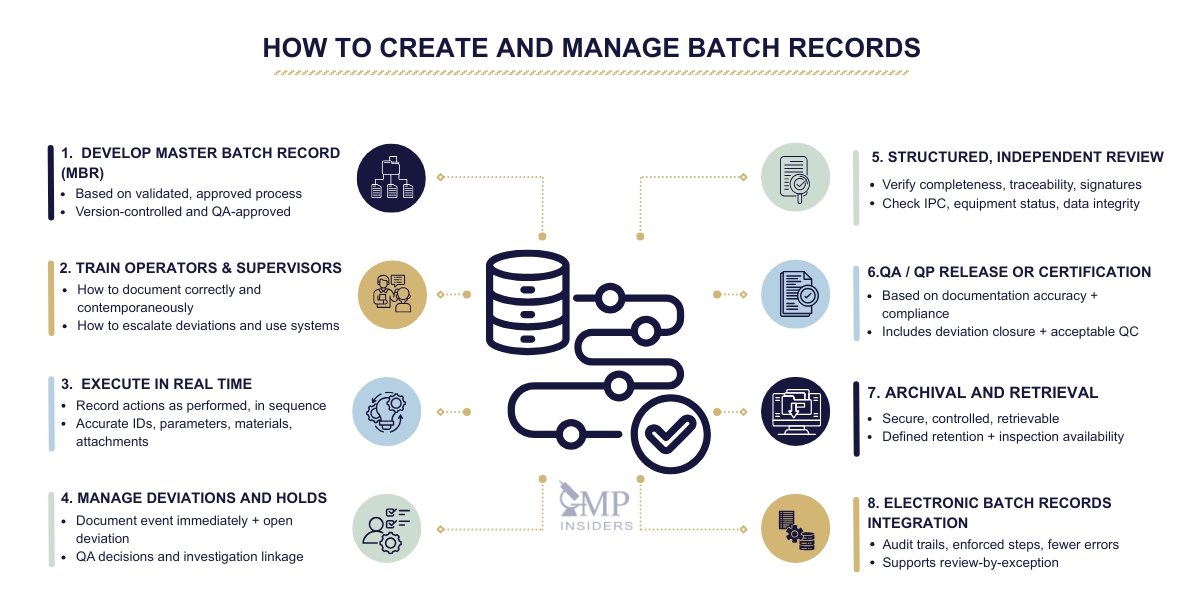
Creating and managing batch records requires a controlled, consistent approach that aligns process knowledge, regulatory requirements, and day-to-day operational practices. The goal is not only to document the batch but to ensure that the documentation itself supports process control, traceability, and reliable decision-making.
Develop Clear, Controlled Master Records
The starting point is the Master Batch Record (MBR), which defines the approved, validated manufacturing process.
A compliant MBR should be:
- Based on validation studies, process characterization, and regulatory filings
- Written in clear, operational language that eliminates subjective interpretation
- Version-controlled under the quality documentation system
- Linked to equipment lists, material specifications, analytical methods, and SOPs
- Reviewed and approved by QA, Production, and relevant technical functions
The quality of the MBR determines the clarity and consistency of all subsequent batch records.
Train Operators and Supervisors on Documentation Practices
Proper completion of batch records depends heavily on consistent operator training.
Training should include:
- How to record data contemporaneously
- How to perform corrections without obscuring the original entry
- How to record time, ID, signatures, and check steps
- How to escalate deviations or unexpected events
- How to use electronic systems if EBRs are implemented
This ensures that the record reflects what actually happened, not what operators remember later.
Execute Batch Records in Real Time
Execution requires disciplined recording of each activity as it occurs.
Key expectations:
- Entries must match the sequence defined in the MBR
- Data should be entered as soon as the step is completed, not later in the shift
- Equipment IDs, material lots, and actual parameters must be accurate
- Any automation printouts (balance tickets, sensor outputs) must be attached or electronically linked
- Any deviation from the instruction must be immediately documented and assessed
Real-time documentation is a core pillar of data integrity.
Manage Deviations, Holds, and Atypical Events Properly
No batch runs perfectly. What matters is how non-routine events are documented.
GMP-aligned handling includes:
- Describing the event in the batch record when it happens
- Opening a deviation or non-conformance for further investigation
- Recording immediate actions (hold, pause, checks performed)
- Documenting QA approval when continuation is allowed
- Linking the investigation outcome to the batch record
This ensures transparency and supports accurate batch release decisions.
SEE ALSO: Deviation Management Process in GMP
Perform Structured, Independent Batch Record Review
After execution, batch records undergo a systematic review.
A robust review includes:
- Verification that all steps were completed and signed
- Check of material traceability, yields, and reconciliations
- Review of IPC results and equipment status
- Confirmation that deviations and investigations are closed
- Assessment of data integrity (consistency, legibility, corrections)
Review should be independent, typically by production first, then QA.
Approve and Certify the Batch
Once the documentation is complete, QA (and the QP in the EU system) makes the release or certification decision.
The decision is based on:
- Completeness and accuracy of the batch records
- Compliance with MBR instructions
- Acceptable analytical results
- Closure and evaluation of all deviations
- Compliance with regulatory and MA/CMC requirements
Documentation must fully support that the batch remained under control.
Maintain, Archive, and Retrieve Records Securely
Retention and archival requirements vary by region, but the principles remain the same: records must be secure, accessible, and protected throughout the retention period.
Good practices include:
- Controlled storage for both paper and electronic records
- Defined retention times (expiry + 1 year minimum in EU)
- Secure access with traceability of retrieval
- Regular backup and disaster-recovery measures for EBR systems
- Procedures for providing records during inspections
Proper archival ensures that documentation remains available for future audits, investigations, or regulatory requests.
Integrate Electronic Systems for Efficiency and Data Integrity
When migrating to Electronic Batch Records (EBRs), companies must ensure the system is validated and aligned with Annex 11/Part 11 requirements.
Key advantages of EBRs:
- Automated enforcement of process parameters
- Integrated audit trails and electronic signatures
- Fewer manual errors and transcriptions
- Real-time deviation capture
- Faster batch review (review-by-exception)
Digital systems strengthen data reliability and streamline batch disposition.
Lifecycle of Batch Records
Batch records follow a defined lifecycle that begins long before a batch is manufactured and continues well after the product is released. Each phase serves a specific function in demonstrating that the process is controlled, the documentation is reliable, and the batch remains fully traceable.
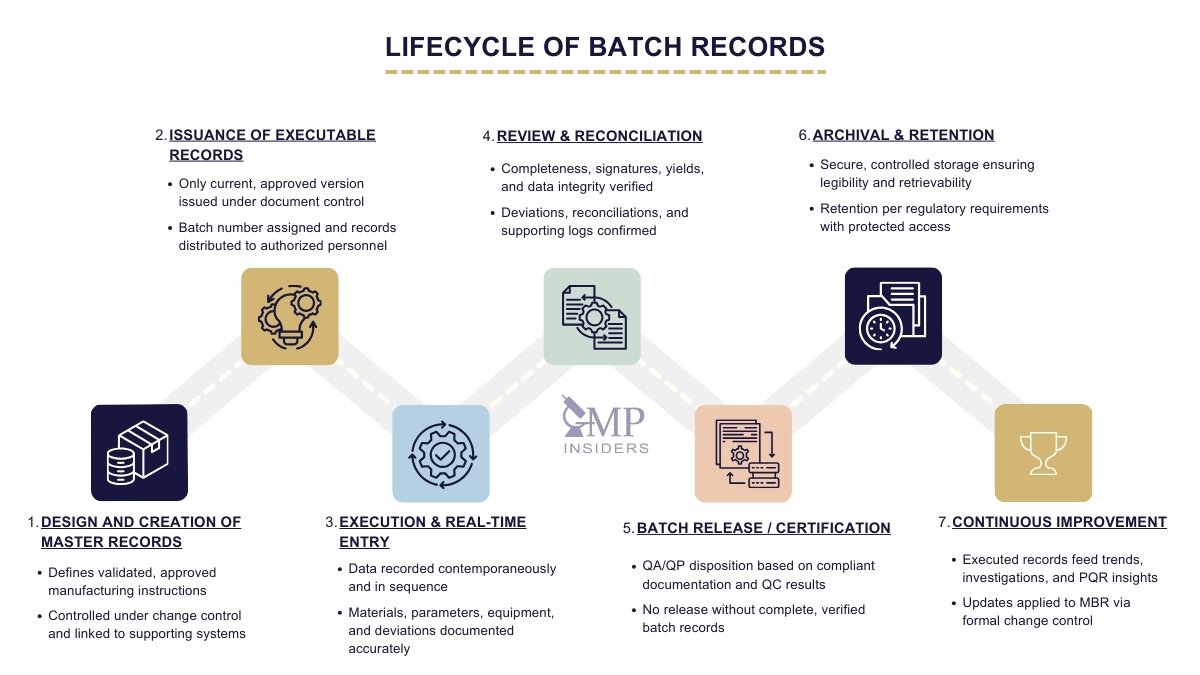
1. Design and Creation of Master Records
The lifecycle begins with the development of the Master Batch Record (MBR), which represents the approved, validated process. This stage includes:
- Translating process development and validation data into a clear operational document
- Аligning instructions with equipment capability, material specifications, and control strategies
- Linking the MBR to analytical methods, packaging records, and relevant SOPs
- Formal approval under change control
This establishes a controlled template from which all executed batch records will be generated.
2. Issuance of Executable Records
Before manufacturing begins, the approved MBR is issued as an executable Batch Manufacturing Record (BMR) and, when applicable, a Batch Packaging Record (BPaR).
Key expectations:
- Issuance through a controlled document management system
- Confirmation that the current version is used
- Assignment of batch number and manufacturing date
- Distribution to authorized production personnel
In electronic systems, “issuance” includes generating a controlled template instance in the EBR system.
3. Execution and Real-Time Data Entry
This phase covers the actual manufacturing, packaging, and testing of the batch.
Activities include:
- Recording operations as they occur
- Documenting materials, parameters, equipment, and in-process results
- Capturing deviations, alarms, or non-routine events
- Attaching or linking supporting data (e.g., balance printouts, instrument outputs)
This forms the factual, chronological history of the batch. Regulators place the strongest emphasis on this phase, as it contains the primary evidence of GMP compliance.
4. Review and Reconciliation
After execution, production, and QA review, the complete set of batch documentation.
This stage ensures:
- All steps were completed and appropriately signed
- Data is consistent, legible, and accurate
- Material and label reconciliations match the MBR expectations
- All deviations, OOS/OOT events, or equipment issues are addressed
- Calculations are correct, and supporting logs are available
For electronic records, this includes, where applicable, audit trail review.
5. Batch Release or Certification
Once QA determines that the batch documentation is complete and compliant, the batch moves to formal disposition. In the EU system, this is the point where the Qualified Person (QP) certifies the batch for release.
Release decisions are based on:
- Compliance with the MBR
- Acceptable QC results
- Closure of all deviations and investigations
- Alignment with MA/CMC expectations
- Completeness of documentation
No batch may be released without complete and verified batch records.
6. Archival and Retention
After release, batch records enter the archival phase, where they must remain secure, legible, and retrievable for the whole retention period.
Requirements include:
- Controlled storage (paper or electronic)
- Protection against loss, alteration, and unauthorized access
- Defined retention time (expiry + 1 year in EU; expiration + 3 years in US; 3 years minimum for APIs)
- Traceable retrieval procedures for audits, PQRs, or investigations
- Validated backups and disaster recovery for EBRs
This phase ensures that the batch record remains available for regulatory inspections or future analysis.
7. Continuous Improvement and Updates
The batch record lifecycle does not end with archival. Information obtained from executed records drives improvements to the master documents.
Triggers for updating the MBR include:
- Repeated deviations
- Trends observed in PQR or CPV
- Changes to equipment or materials
- Updates to regulatory filings
- Improvements arising from inspections
Changes follow formal change control to ensure continuity and traceability across versions.
The Role of Electronic Batch Records (EBRs)
The pharmaceutical industry is steadily moving from paper-based batch documentation to fully digital systems. Electronic Batch Records (EBRs) integrated with Manufacturing Execution Systems (MES) are transforming how processes are executed, documented, and reviewed. While the regulatory principles remain unchanged, the way we achieve compliance is evolving rapidly.
EBRs introduce a level of control, traceability, and data connectivity that goes far beyond traditional documentation. They enforce compliance in real time, reduce the risk of human error, and enable more streamlined review processes.