
Fluid bed technology is among the most widely used processing platforms in pharmaceutical manufacturing. It enables efficient drying, wet granulation, coating, and particle modification within a single piece of equipment. The combination of high heat and mass transfer rates, excellent mixing, and a flexible configuration makes fluid-bed systems essential for the production of solid dosage forms.
Solid oral dosage forms remain the dominant pharmaceutical products worldwide, and their manufacture relies heavily on particle engineering technologies that ensure consistent flow, compressibility, content uniformity, and dissolution performance. Among these technologies, fluid bed processing occupies a central position due to its flexibility and efficiency.
Over the years, fluid-bed equipment has evolved from simple batch dryers into highly engineered systems featuring advanced spray technologies, modular inserts, automation, and real-time process monitoring.
This article provides a comprehensive, practice-oriented overview of fluid bed technology, covering fundamental fluidization principles, equipment design, pharmaceutical unit operations, critical process parameters, process analytical technology (PAT), scale-up considerations, advantages and limitations, troubleshooting strategies, and emerging trends.
Fundamentals of Fluidization
The performance of any fluid-bed operation is governed by the fundamentals of gas–solid flow, including particle motion, bed hydrodynamics, and the coupled heat and mass transfer that drives drying, granulation, and coating outcomes.
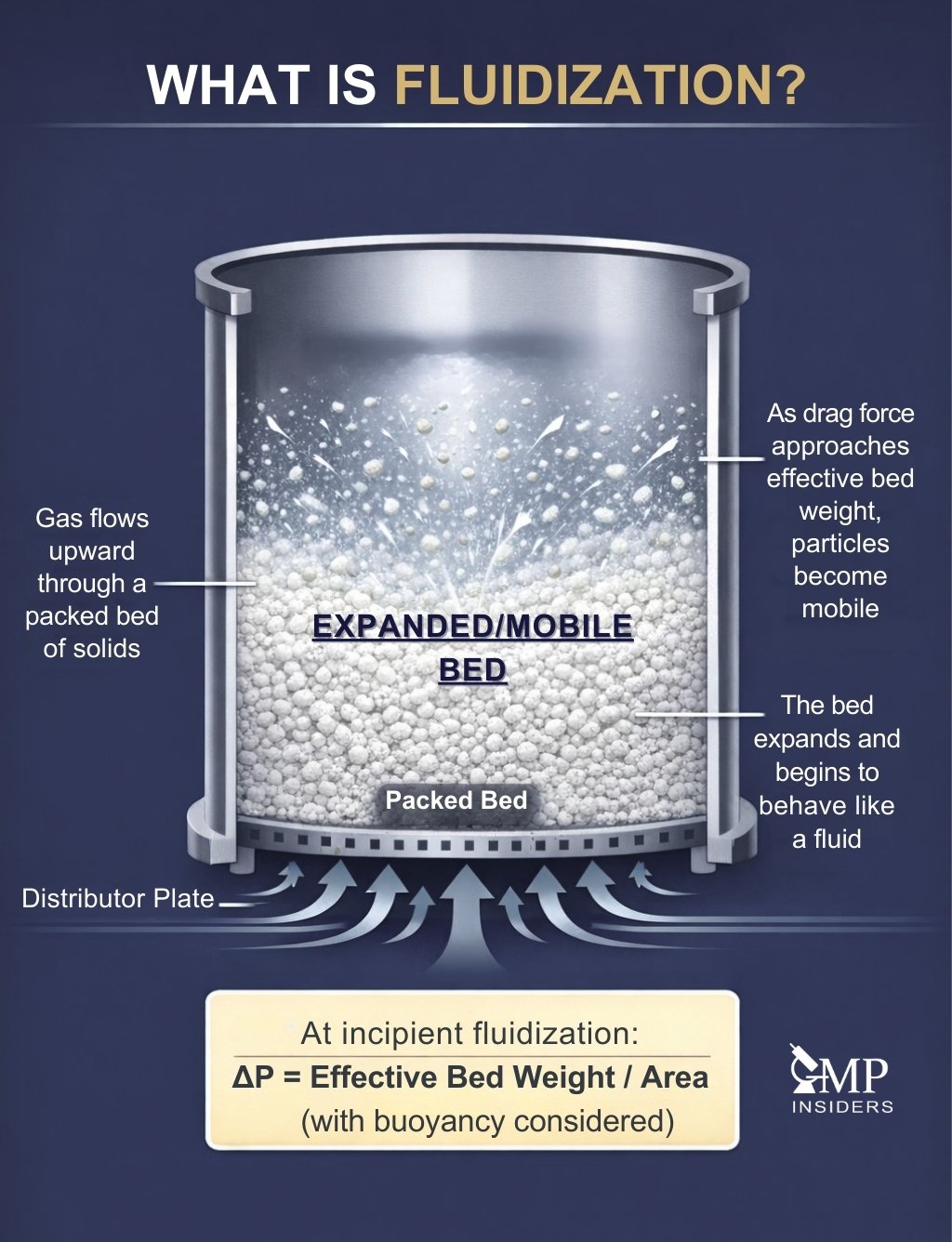
Fluidization occurs when a gas stream, typically heated, conditioned, and HEPA-filtered air, flows upward through a bed of solids at a velocity high enough to overcome the particles’ tendency to remain packed. As the drag force exerted by the gas approaches the bed’s effective weight, particles become mobile, the bed expands, and the system begins to behave like a fluid.
Transition to Fluidization and Flow Regimes
The transition from a fixed bed to a fluidized bed occurs at the minimum fluidization velocity (Uₘf). Below Uₘf, gas percolates through void spaces between stationary particles, often following preferential paths if the powder is non-uniform or cohesive. As U approaches Uₘf, the bed pressure drop (ΔP) increases; at incipient fluidization, ΔP approximates the effective bed weight per unit area (accounting for buoyancy).
This ΔP behavior is a practical operational anchor: fluidization is not only “seen” by bed expansion, but also confirmed and controlled via ΔP, airflow, and exhaust conditions.
Above Uₘf, the bed exhibits progressively more dynamic behavior as a function of velocity, equipment geometry, and powder characteristics. Further increases in gas velocity can lead to:
- Bubbling fluidization (gas voids/bubbles forming and rising through the bed)
- Turbulent fluidization (intense mixing, less distinct bubble structure)
- Entrainment/elutriation (fines carried out of the bed), which becomes increasingly likely as the gas velocity approaches particle terminal velocity and as the fines fraction increases
Maintaining a stable regime is essential because drying uniformity, spray capture, agglomeration risk, and coating quality all depend on a controlled hydrodynamic state.
Particle Properties and Fluidization Behavior
Fluidization quality is highly sensitive to particle and powder properties, including particle size distribution (PSD), density, shape, surface roughness, and cohesiveness. Coarse, dense, near-spherical particles fluidize more readily, whereas fine or cohesive powders are prone to:
- Channeling and non-uniform gas distribution
- Dead zones and partial fluidization
- Bed collapse/defluidization, especially under high moisture or overwetting conditions
In pharmaceutical processing, many materials fall into intermediate-to-difficult fluidization behavior, particularly when the PSD includes a significant fines fraction or when electrostatics and moisture increase interparticle attraction.
A practical way to frame this is through Geldart-type behavior: cohesive powders (commonly “Group C-like”) require more conservative operating windows and greater attention to air distribution, while freer-flowing powders (A/B-like) are generally more tolerant but can still suffer from segregation and entrainment if fines are present.
Because of this sensitivity, stable fluidization cannot be achieved with airflow alone. It depends on:
- Distributor design (type, open area, and the pressure drop across the distributor relative to the bed)
- Bed loading and depth (too shallow can destabilize; too deep can limit penetration and promote non-uniformity)
- Column geometry and scale effects (wall friction, bypassing, and non-ideal flow patterns)
- Conditioned air properties (temperature, humidity/dew point), which influence drying capacity and cohesion
Heat and Mass Transfer Advantages
A key advantage of fluidized beds is their high heat and mass transfer efficiency. Continuous particle motion increases gas–solid contact, reduces boundary-layer limitations, and minimizes temperature and moisture gradients within the bed. As a result, drying is faster and more uniform than in many alternative technologies.
In drying processes, performance is governed not only by inlet temperature but also by overall drying capacity, which is strongly influenced by inlet air humidity (dew point) and airflow. Typical drying behavior progresses from an initial period in which surface moisture removal can dominate to a later stage in which internal moisture diffusion becomes rate-limiting.
In practice, this is why outlet air conditions (temperature and humidity) and product temperature trends are used to judge whether the process is capacity-limited or diffusion-limited at a given point in time.
These characteristics are particularly beneficial for:
- Wet granulation, where solvent removal must be balanced against agglomeration growth to avoid overwetting, collapse, or excessive densification
- Coating, where stable particle circulation and controlled evaporation are prerequisites for uniform film formation and high spray-capture efficiency
Operational Signals and Control Relevance
In routine operation, fluidization is managed through measurable indicators that reflect hydrodynamics and transfer performance, typically:
- Bed ΔP (stability, channeling, onset of collapse, changes in bed structure)
- Airflow/superficial velocity (primary lever for regime control)
- Inlet/outlet temperature and exhaust humidity/dew point (drying capacity, endpoint behavior)
- Product temperature (thermal exposure and process progression)
- Fines carryover/filters load (entrainment tendencies and attrition)
By tying these signals to fundamental behavior, Uₘf, regime shifts, and the balance between spray input and drying capacity, fluid-bed processes become more predictable, more scalable, and more defensible during troubleshooting and validation.
Fluid Bed Equipment Design and Configurations
Fluid-bed processors come in multiple configurations, each designed to deliver a defined particle circulation pattern, controlled spray exposure, and predictable drying capacity for unit operations such as granulation, coating, drying, and (in rotor systems) pelletization/high-density agglomeration.
Equipment design matters because small differences in air distribution, spray-zone geometry, and exhaust handling can shift the process from stable operation to overwetting, attrition, or non-uniform coating.
Main Components of a Pharmaceutical Fluid-Bed Processor
A typical system consists of the following functional blocks (with the “why it matters” that is often missing in generic descriptions):
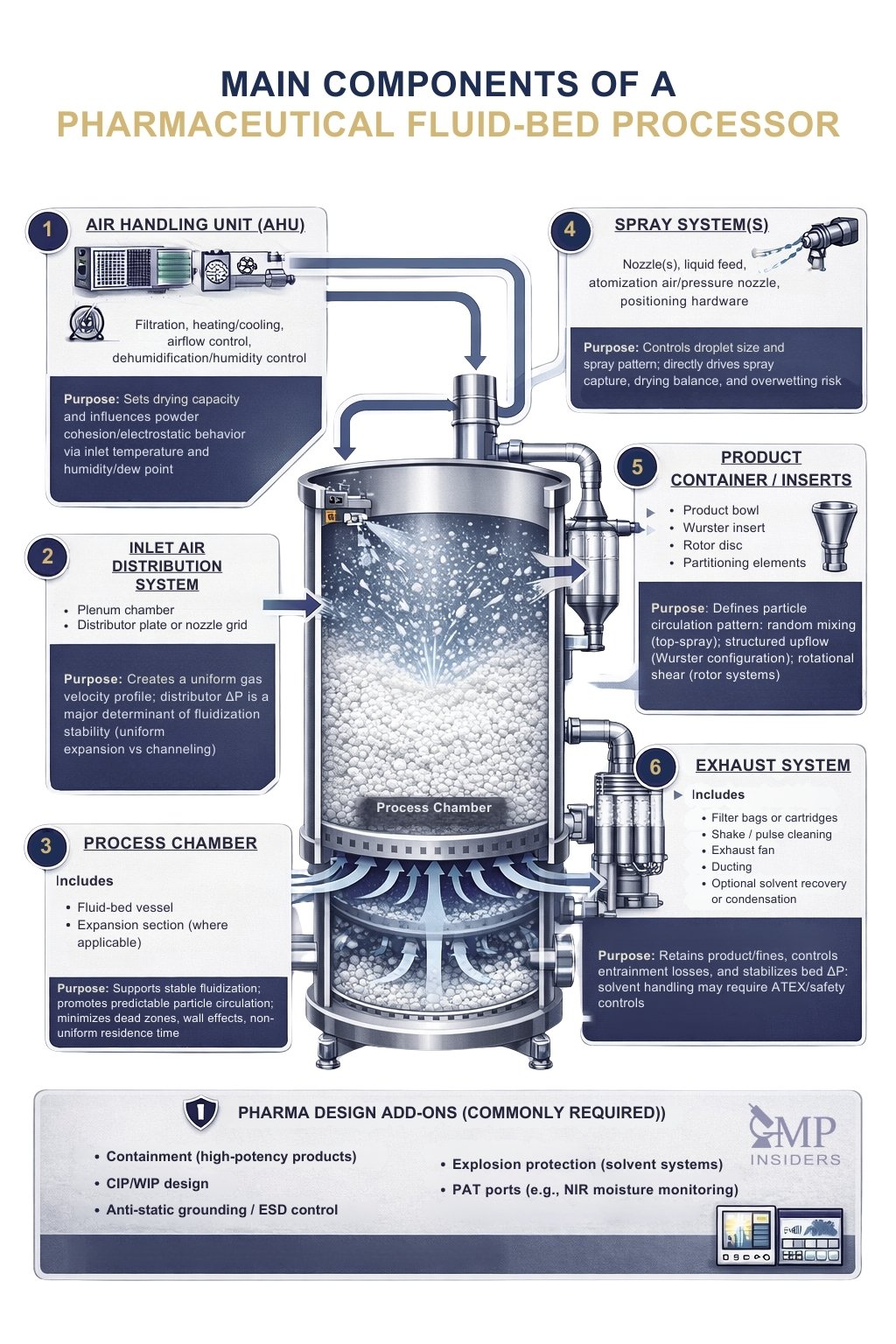
- Air handling unit (AHU): filtration (pre + HEPA where applicable), heating/cooling, airflow control, and often dehumidification/humidity control
Purpose: sets drying capacity and influences cohesion/ESD behavior via inlet temperature and humidity/dew point.
- Inlet air distribution system: plenum + distributor plate/nozzle grid
Purpose: creates a uniform gas velocity profile; distributor ΔP is a major determinant of fluidization stability (channeling vs uniform expansion).
- Process chamber (often with expansion section): vessel geometry designed to support stable fluidization and predictable particle circulation
Purpose: limits dead zones, reduces wall effects, and supports consistent residence time in the spray and drying zones.
- Spray system(s): nozzle(s), liquid feed, atomization air (or pressure nozzle), and positioning hardware
Purpose: controls droplet size and spray pattern; directly drives spray rate vs drying capacity balance, spray capture, and overwetting risk.
- Product container / inserts: bowls, Wurster insert, rotor disc, partitioning elements
Purpose: defines circulation pattern (random mixing vs structured upflow column vs rotational shear).
- Exhaust system: filter bags/cartridges, shake/pulse cleaning, exhaust fan, ducting; optional solvent recovery/condensation
Purpose: retains product/fines, controls entrainment losses, and stabilizes ΔP; solvent handling may impose safety/ATEX requirements.
- Controls and automation (PLC/SCADA): closed-loop control of airflow, temperatures, spray rate, atomization air, and alarms/interlocks
Purpose: enables reproducibility and supports validation; ΔP trends and exhaust conditions often serve as key control/endpoint indicators.
Design add-ons commonly required in pharma: containment (high-potency), CIP/WIP design, anti-static/grounding, explosion protection for solvent systems, and PAT ports (e.g., NIR moisture).
Fluid-Bed Configurations Used in Pharma
Fluid-bed processors are built around the same core principle, controlled particle motion in an air stream, but the insert and spray-zone geometry define how particles circulate and how liquid is deposited and dried. In practice, configuration selection is less about “what the equipment can do” and more about which circulation pattern best supports the target unit operation.
Top-Spray Configuration (Granulation-First)
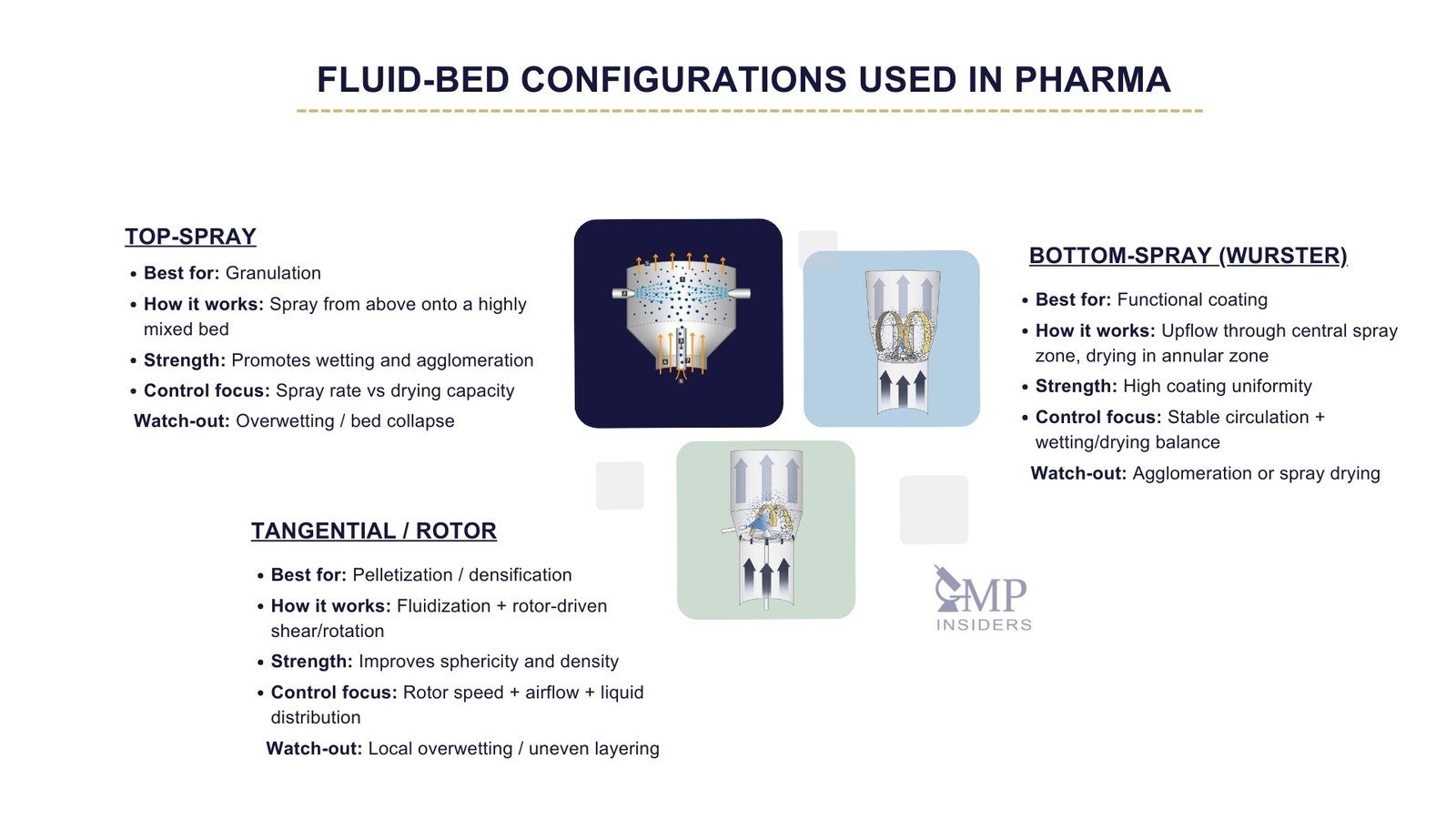
In a top-spray system, the nozzle is positioned above the fluidized bed, and the binder (or coating) solution is atomized downward onto moving particles. Because droplets contact a broad, highly mixed bed surface, this setup naturally promotes wetting, nucleation, and agglomeration, making it the most common configuration for fluid-bed wet granulation.
Top-spray systems are also popular because they are straightforward to operate and flexible across development and production scales. The main control challenge is balancing spray-to-drying capacity: if liquid input locally exceeds evaporation capacity, overwetting can accelerate granule growth and drive the bed toward excessive agglomeration or collapse.
Best suited for
- Wet granulation of powders to free-flowing granules
- Simple layering or non-critical coatings (case-dependent)
Key control focus
- Spray rate vs drying capacity (airflow + inlet temperature + inlet humidity)
- Atomization quality and spray distribution (droplet size and wetting uniformity)
Bottom-Spray (Wurster) Configuration (Functional Coating-First)
Bottom-spray systems use a Wurster insert that creates a defined, repeatable circulation loop. Particles are drawn upward through a central column (spray zone), receive coating, then fall into the annular region where they dry before re-entering the column. This separation of wetting and drying zones is the reason Wurster processes can achieve high coating thickness uniformity and strong control over functional performance.
As a result, Wurster coating is typically preferred for modified-release, enteric, and taste-masking applications, particularly on pellets and multiparticulates, where uniform film build directly drives dissolution consistency.
Best suited for
- High-uniformity functional coatings (MR/enteric/taste masking)
- Pellets and multiparticulates (starter cores, layered systems)
Key control focus
- Stable circulation through the partition (air balance, gap, nozzle alignment)
- Preventing spray drying vs agglomeration (wetting–drying equilibrium)
Tangential / Rotor Configuration (Pelletization and Densification)
Tangential (rotor) systems combine fluidization with controlled rotation, typically using a rotating disc or amodified distributor. This introduces higher shear and a more structured circulation field, supporting processes that require densification, sphericity, and controlled layering.
Because of these mechanisms, rotor systems are commonly used for pelletization, powder layering, and the production of high-density granules, where mechanical strength and shape control are priorities.
Best suited for
- Pelletization and rounding
- Powder layering/drug layering onto cores
- Dense, robust granules with higher sphericity
Key control focus
- Rotor speed (shear/shape/density) together with airflow distribution
- Uniform liquid delivery across the rotor zone to avoid localized overwetting
Pharmaceutical Unit Operations in Fluid Beds
Fluid-bed technology supports several core pharmaceutical unit operations by combining intense gas–solid contact, controlled particle movement, and high heat/mass transfer. While drying, granulation, and coating share common equipment elements, each operation has distinct rate-limiting steps, failure modes, and critical process parameters (CPPs) that must be controlled to deliver consistent critical quality attributes (CQAs).
Fluid Bed Drying
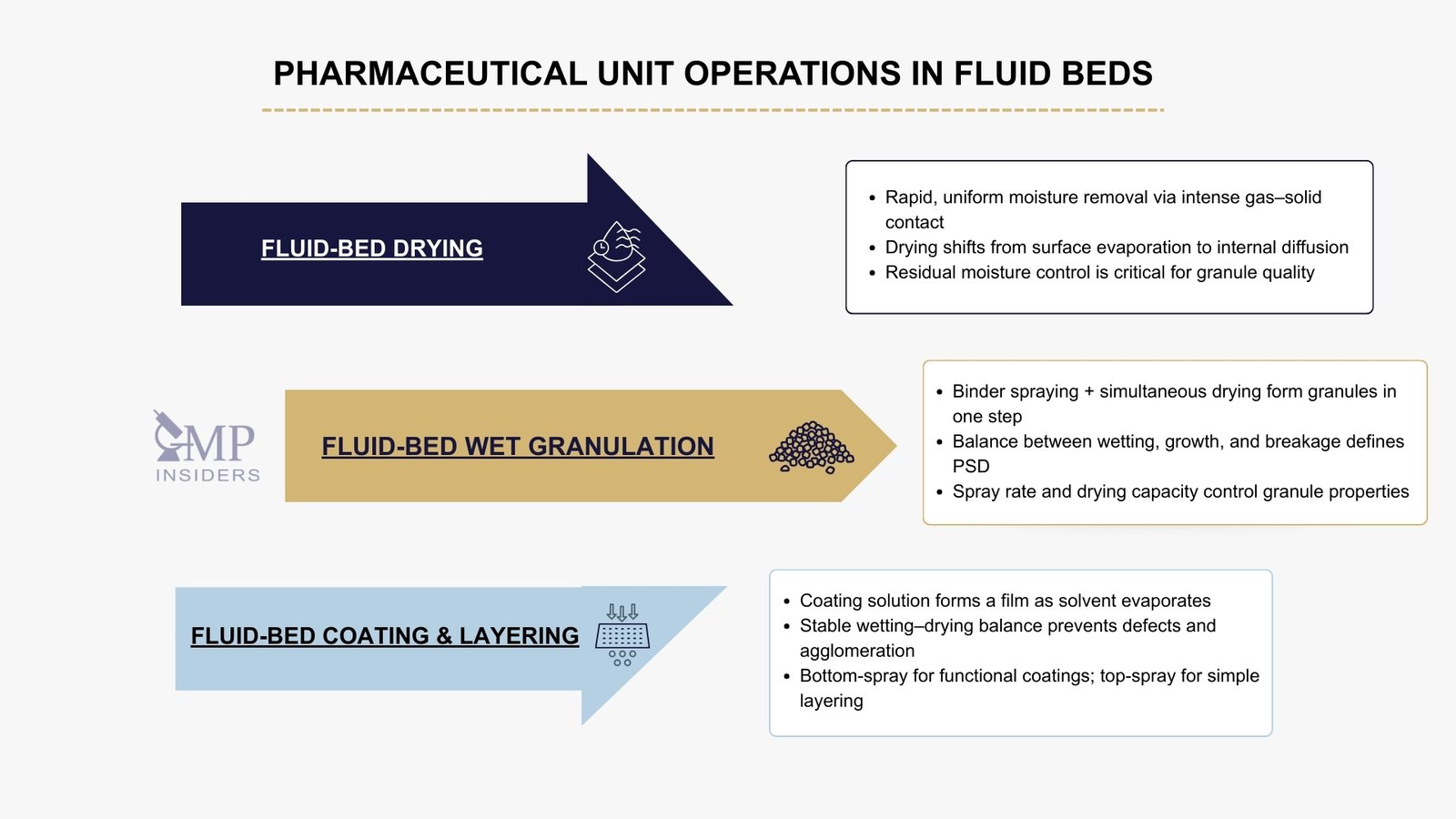
Fluid bed drying is widely used for powders, granules, and pellets. Compared with tray or static-bed dryers, fluid bed drying offers faster drying rates and more uniform moisture removal.
Key operating parameters include inlet air temperature, airflow rate, and bed depth. Drying typically proceeds through an initial constant-rate period, where surface moisture evaporates rapidly, followed by a falling-rate period governed by internal moisture diffusion.
Control of residual moisture is critical: excessive dryness can cause brittle granules, while high moisture content can degrade stability and compressibility.
Wet Granulation in Fluid Beds
Fluid bed wet granulation combines spraying and drying in a single step. Powder particles are wetted with a binder solution and agglomerate into granules while the solvent is simultaneously evaporated.
The granulation process involves three overlapping mechanisms:
- Wetting and nucleation
- Granule growth and consolidation
- Breakage and attrition
Achieving the desired granule size distribution requires balancing these competing mechanisms through appropriate control of spray rate, droplet size, binder properties, and drying conditions.
Granule quality attributes include particle size distribution, bulk density, porosity, flowability, and moisture content. These properties directly affect downstream tableting or capsule-filling performance.
See Also: Wet vs Dry Granulation – Comparison
Fluid Bed Coating and Layering
In fluid bed coating, particles are sprayed with a coating formulation that deposits a film on their surface as the solvent evaporates. Applications include protective coatings, modified-release systems, taste masking, and aesthetic coloring.
Successful coating depends on maintaining a balance between wetting and drying. Insufficient drying leads to agglomeration, whereas excessive drying can cause droplets to spray-dry before they reach the particle surface.
Bottom-spray systems are generally preferred for high-precision functional coatings, whereas top-spray systems are often used for simpler layering or color coating applications.
Process Parameters
Building on equipment design and configuration, fluid-bed processors are used for drying, granulation, and coating operations that directly shape particle structure and downstream performance.
Because fluid-bed systems couple bed hydrodynamics with spray deposition and evaporation, most variables interact rather than operate independently. Robust development, therefore, depends on understanding parameter interactions and translating them into a practical control strategy.
Critical Process Parameters (CPPs)
Fluid-bed performance is driven by a set of interdependent variables that control fluidization regime, drying capacity, wetting behavior, and particle circulation. Shifts in one parameter often propagate through the system (e.g., changes in airflow alter bed temperature, ΔP, entrainment, and spray capture). A holistic view is required to prevent instability and ensure reproducible outcomes.
Airflow Rate and Superficial Velocity
Airflow determines the degree of fluidization and is the primary driver of particle mobility, mixing intensity, and heat/mass transfer.
- Too low: poor mixing, channeling, dead zones, and potential defluidization/bed collapse (especially during spraying).
- Too high: increased entrainment, filter loading, attrition, and loss of fines; coating/granule breakage can increase due to higher collision energy.
In routine operation, airflow is interpreted together with bed pressure drop (ΔP) and exhaust trends, since ΔP provides an immediate indication of bed structure and stability.
Inlet Air Condition (Temperature and Humidity) and Outlet Air Temperature
Inlet air provides the drying “driving force” through its temperature and moisture capacity (humidity/dew point). Outlet air temperature and humidity reflect the system’s current balance between evaporation and sensible heating.
- Higher inlet temperature and/or lower inlet humidity increase drying capacity but may increase the risk of spray-drying defects, surface defects, or thermal stress for sensitive components.
- Lower inlet temperature and/or higher humidity reduce drying capacity and increase the risk of overwetting, agglomeration, and prolonged high-moisture exposure.
Using inlet and outlet conditions together is more informative than either alone because outlet conditions track real-time process progression and endpoint behavior.
Spray Rate and Atomization Conditions
Spray rate, atomization (pressure/nozzle design/atomization air), and droplet size distribution define the spray pattern and the frequency of wetting events at the particle surface.
- High spray rate / large droplets: higher local liquid loading → overwetting, uncontrolled agglomeration, bed collapse.
- Over-atomization / very fine droplets: droplets can dry in-flight → low spray capture, rough coatings, high fines, weak granules.
The practical control principle is to maintain a stable liquid-to-drying-capacity ratio while preserving a circulation pattern that ensures uniform spray exposure.
Binder or Coating Formulation Properties
Formulation properties (viscosity, solids content, surface tension, solvent system, polymer type/plasticizer level) influence wetting kinetics, penetration, and film formation.
- Higher viscosity and/or high solids content can increase droplet size and increase nozzle sensitivity, potentially leading to non-uniform distribution.
- Very low-viscosity systems may penetrate rapidly, altering nucleation and granule structure, or may dry too quickly, depending on solvent volatility and ambient air conditions.
Formulation optimization and process optimization must be treated as a coupled problem in fluid-bed work.
Bed Load and Particle Size Distribution (PSD)
Bed load governs bed depth, collision frequency, and circulation behavior. PSD affects fluidization quality and the probability of spray–particle interaction.
- High load: higher ΔP and potentially reduced circulation efficiency; can improve coating efficiency but may reduce drying responsiveness.
- Broad/bimodal PSD: segregation tendencies, non-uniform wetting, increased entrainment of fines, and variable growth dynamics.
For reproducible processing, the incoming material should be well characterized (PSD, bulk density, moisture, flow properties), and bed load should be controlled within a defined operating window.
Process Analytical Technology (PAT)
Process Analytical Technology (PAT) enables in-process measurement of critical material attributes and process states, supporting more consistent control of fluid-bed operations. In fluid-bed granulation and coating, PAT is particularly valuable because product attributes can change rapidly with variations in spray–drying balance, circulation stability, and moisture dynamics.
Common PAT Tools In Fluid-Bed Processing
PAT in fluid beds typically combines in-line/on-line sensors with data models that translate signals into actionable attributes:
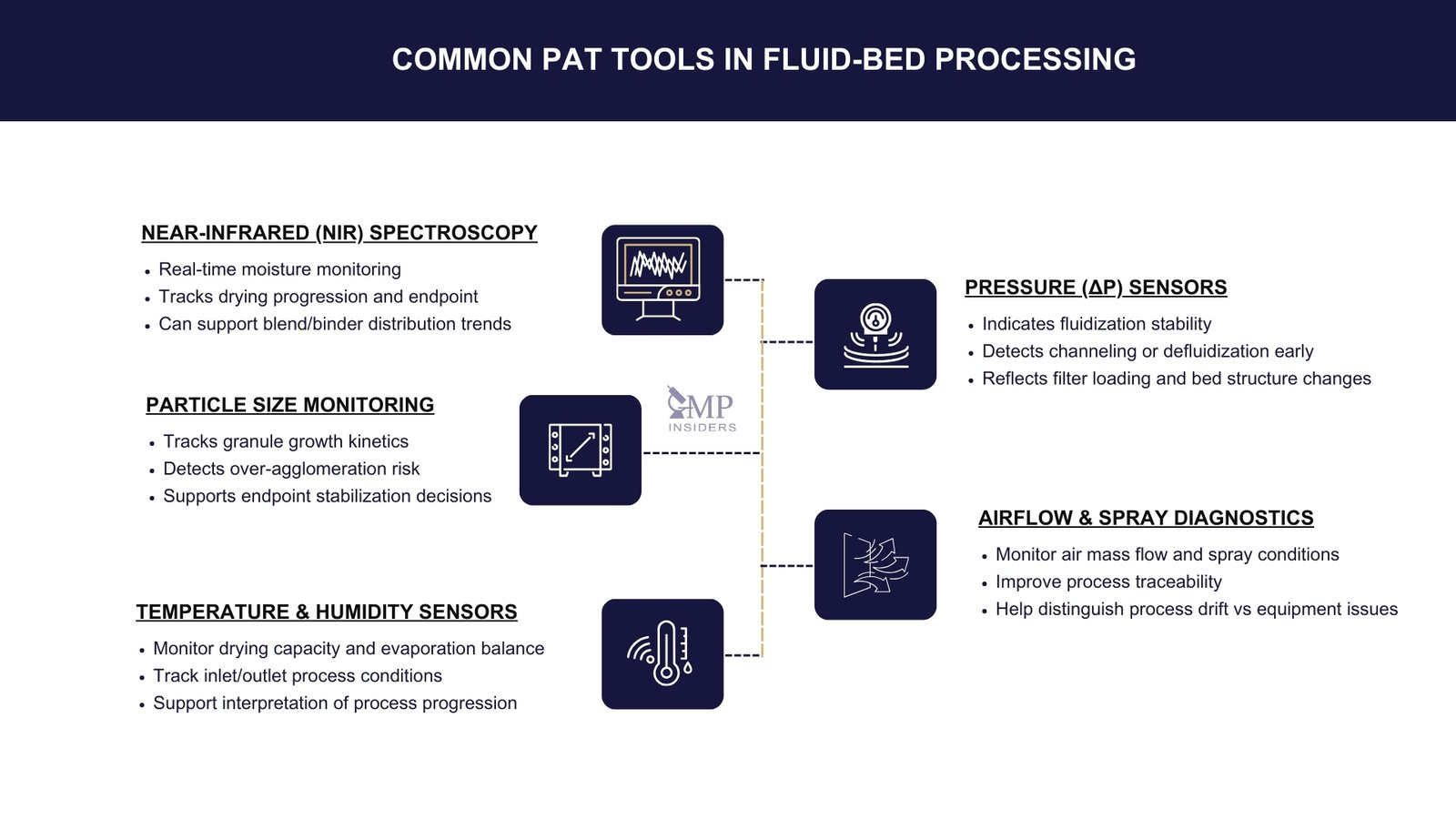
- Near-infrared (NIR) spectroscopy: Used to monitor moisture content in real time and, depending on calibration/model quality, can support assessment of binder distribution, blend uniformity signals, or API-related trends (application-dependent).
- Particle size and particle growth monitoring: In-line particle sizing tools (e.g., optical/laser-based approaches) provide insight into granule growth kinetics, onset of over-agglomeration, and stabilization toward an endpoint.
- Temperature and humidity measurements: Inlet/outlet temperature and exhaust humidity/dew point are fundamental for tracking drying capacity and process progression; product temperature (when available) helps interpret thermal exposure and evaporation dynamics.
- Pressure/ΔP sensors: Bed pressure drop (ΔP) trends provide direct feedback on fluidization stability, filter loading, channeling risk, and early signs of defluidization during spraying.
- Airflow and spray system diagnostics (where implemented): Mass-flow measurement of inlet air and monitoring of spray variables (pump rate, atomization air, nozzle pressure) strengthen traceability and help distinguish process drift from equipment-related faults.
Advanced Implementations
More mature PAT strategies integrate multiple sensors (e.g., NIR + exhaust humidity + ΔP + airflow) with multivariate data analysis (MVDA) to:
- predict moisture trajectories and endpoints,
- detect deviations earlier than end-product tests,
- provide soft sensors for attributes that are not directly measurable continuously.
Benefits of PAT Integration
PAT supports both development and routine manufacturing by enabling:
- Improved process understanding: links between airflow/inlet condition/spray behavior and resulting CQAs become quantifiable.
- Reduced batch-to-batch variability: real-time adjustment of spray rate or inlet conditions helps keep the process within a controlled window.
- Endpoint control: more defensible decisions for spray stop and drying endpoint based on measured trajectories rather than fixed time.
- Early detection of deviations: abnormal ΔP/exhaust/NIR patterns can flag overwetting, channeling, entrainment, or spray-system issues before product quality is compromised.
Scale-Up and Technology Transfer
Scale-up of fluid bed processes presents challenges due to changes in equipment geometry, airflow patterns, and spray dynamics. Parameters that perform well at the laboratory scale may not directly translate to the production scale.
Successful scale-up strategies focus on maintaining similar physical conditions rather than identical numeric settings. Key considerations include relative droplet size, bed moisture profiles, and particle circulation patterns.
Combining experimental data with modeling approaches and structured scale-up trials reduces risk during technology transfer.
Advantages and Limitations
Like any complex manufacturing technology, fluid-bed processing delivers significant operational benefits but also introduces failure modes and scale sensitivities that must be considered during process selection, development, and lifecycle control.
Advantages
Fluid-bed processing is often selected because it can consolidate steps that would otherwise require separate equipment and multiple transfers. That consolidation is why the downstream benefits, speed, uniformity, and reduced handling risk are achievable when the process is well-designed and controlled.
Integration of Multiple Unit Operations
A major strength of fluid-bed technology is its ability to integrate drying, mixing, wet granulation, and coating within a single system. Because these steps can be performed sequentially without transferring material between units, process flows are simplified, the footprint is reduced, and intermediate hold steps are minimized.
From a GMP standpoint, fewer transfers and open handling steps lower the probability of mix-ups, contamination, and product loss, while also reducing the number of interventions that must be controlled and documented.
High Efficiency and Short Processing Times
Once unit operations are consolidated, the next benefit is throughput. Fluid beds provide excellent heat and mass transfer because particles remain in continuous motion and repeatedly contact conditioned air.
This accelerates drying and solvent evaporation compared with static systems, often shortening cycle times and improving productivity. The practical condition for this advantage is stability: cycle-time gains are most reliable when airflow, inlet air conditions, and spray load remain balanced, so the bed remains fluidized without excessive entrainment or attrition.
Strong Uniformity When the Process Is Well Controlled
Speed is valuable, but only if it comes with consistent product attributes. When particle circulation is stable and spray distribution is well controlled, fluid-bed processing can deliver a reproducible granule PSD, controlled residual moisture, and a uniform coating build.
These particle-level outcomes translate into downstream performance: improved flowability, more consistent die fill and tablet weight, and more predictable dissolution behavior for coated systems. At this stage, PAT and trend-based controls become a natural extension of the process, helping confirm that the same physical conditions are maintained batch-to-batch.
Reduced Material Handling and Contamination Risk
The same “single-system” concept also reduces material handling as a direct consequence. Fewer transfers mean fewer opportunities for dust generation, operator exposure, and environmental ingress, which is particularly important for potent or sensitive products.
Closed or semi-closed operation can also improve yield by limiting product losses during transfer and reducing manual interventions. In addition, fewer open handling steps typically simplify contamination control and cleaning logic, provided the equipment, filters, and product-contact surfaces are designed for effective cleanability and verification.
Limitations
While the advantages are compelling, they depend heavily on how the formulation behaves in a fluidized state and on whether the process can be kept within a stable operating window. In practice, many limitations manifest as instability during spraying, unexpected sensitivity to material variability, or difficulty reproducing the same hydrodynamics at different scales.
High Sensitivity to Formulation and Incoming Material Properties
Fluid-bed performance is highly dependent on material attributes such as PSD (especially fines fraction), density, surface roughness, hygroscopicity, and electrostatic behavior. When powders are fine or cohesive, gas distribution can become non-uniform, circulation quality can degrade, and spray capture can become inconsistent, leading to variability in granule growth or coating quality.
For this reason, formulation development and process design need to be aligned, with clear controls on incoming material properties and a defined operating window that reflects the powder’s actual behavior.
Risk of Defluidization During Spraying (Cohesive/Wet Systems)
This sensitivity is most critical during wet granulation and coating, where liquid is intentionally introduced into a bed that must remain mobile. If local liquid addition exceeds drying capacity, or if air distribution and circulation are uneven, sticky zones form, agglomeration accelerates, and the bed can collapse.
Defluidization is rarely caused by a single variable; it typically results from an imbalance among spray rate, droplet size, airflow regime, inlet air condition, and bed load. Preventing it requires structured development, conservative startup strategies, and real-time indicators (e.g., ΔP stability and exhaust trends) that reveal instability early.
Complex Parameter Interactions
Even when a process appears stable, fluid beds remain challenging because the system is dynamic and strongly coupled. Adjusting airflow affects ΔP, particle velocity, entrainment, heat transfer, and spray capture simultaneously; changing inlet temperature alters drying capacity and can shift the balance between deposition and spray drying; modifying atomization changes droplet size and wetting distribution, which in turn affects growth kinetics and bed structure.
This interdependence makes troubleshooting difficult when relying solely on “one-factor” adjustments, which is why structured experimentation (e.g., DoE) and monitoring are often necessary for robust control.
Scale-up Challenges
Finally, scale-up is rarely a simple translation of setpoints. Changes in chamber geometry, distributor design, filter area, and spray zone proportions can alter circulation patterns and local wetting intensity, even if nominal airflow or spray rate is kept “equivalent.”
As a result, lab-scale settings often need to be remapped at pilot and commercial scales by targeting similar physical conditions, such as fluidization regime, spray-to-drying balance, and particle motion patterns, rather than by copying numeric values. Without a systematic scale-up strategy and bridging trials, variability in PSD, moisture, and coating uniformity becomes more likely at a larger scale.
Troubleshooting Common Issues
Fluid-bed processes can shift quickly from stable operation to quality drift because hydrodynamics, spray deposition, and drying capacity are tightly coupled. For that reason, troubleshooting is most effective when it follows a structured, evidence-based sequence rather than isolated “one-parameter” changes.
Common issues include bed collapse/defluidization, overwetting, excessive agglomeration, uneven coating, high attrition/fines, and variable residual moisture.
Although these symptoms can look different across drying, granulation, and coating, they typically originate from the same three domains: airflow regime and distribution, spray behavior, and material properties (PSD/fines, cohesiveness, moisture sensitivity, electrostatics).
A practical troubleshooting approach is to first confirm bed stability and drying capacity, then assess spray quality and distribution, and only then consider formulation-related contributors:
- Airflow and bed hydrodynamics: verify trends in superficial velocity and ΔPfor signs of channeling, filter loading, or impending collapse. Confirm distributor performance, and that bed load/depth is within the validated window.
- Inlet/outlet conditions: review inlet temperature and humidity/dew point, along with outlet temperature/humidity, to determine whether the process became capacity-limited (insufficient evaporation) or developed over-drying conditions (spray-drying risk).
- Spray system: check spray rate vs drying capacity, atomization pressure/air, nozzle alignment, spray pattern, and potential nozzle partial blockage. Many coating and granulation issues trace back to localized wetting caused by spray distribution problems rather than “wrong” bulk setpoints.
- Material and formulation: confirm incoming PSD and fines fraction, pre-blend moisture, binder/coating viscosity and solids content, and electrostatic behavior, especially if the issue appears batch-dependent rather than time-dependent.
Because parameter interactions are nonlinear, incremental adjustments informed by real-time data (ΔP, exhaust trends, PAT moisture/particle growth) are preferred to drastic setpoint changes, particularly at commercial scale, where large shifts can trigger collapse or introduce a new failure mode. When multiple changes are needed, altering one factor at a time in a defined sequence improves root-cause clarity and preserves comparability to validated conditions.