Cleanrooms are a critical component of pharmaceutical manufacturing, mainly when producing sterile or high-risk medicinal products. To maintain product safety and comply with global regulatory expectations, manufacturers must control airborne particulate contamination by designing and operating facilities within defined cleanliness standards.
One of the most widely accepted frameworks for cleanroom classification is the ISO 14644-1 standard, which outlines specific limits for airborne particles based on size and concentration.
Related Article: Pharmaceutical Cleanrooms in GMP
Regulatory systems like the EU GMP Annex 1 and FDA aseptic processing guidance incorporate ISO-based classifications but add further microbiological and procedural requirements.
This article breaks down the ISO cleanroom classes, particle count requirements, and how they connect to EU GMP Annex 1 Grades A through D, and the key considerations companies must address to ensure compliance throughout facility design, operation, and monitoring.
What Is ISO 14644-1 Cleanroom Classification?
ISO 14644-1 is the foundational international standard that defines the classification of air cleanliness in cleanrooms and controlled environments, based on the concentration of airborne particles.
Originally developed to replace the outdated FED-STD-209E (Airborne Particulate Cleanliness Classes in Cleanrooms and Clean Zones), it is now globally recognized and applied across industries, with particular relevance in pharmaceuticals, biotechnology, and medical device manufacturing.
ISO 14644-1 establishes nine cleanroom classes, from ISO Class 1 (the cleanest) to ISO Class 9 (the least clean), which is determined by the maximum allowable particle concentration per cubic meter of air for specific particle sizes (≥0.1 μm, ≥0.3 μm, ≥0.5 μm, etc.).
Pharmaceutical manufacturers typically operate in ISO Classes 5, 7, and 8, as these correspond to the cleanroom grades (A–D) defined in EU GMP Annex 1. Each classification is determined by:
- Particle size range and detection limits
- Air sampling volume and frequency
- Number of sample locations based on room size
The classification must be validated at rest and, where required, in operation, depending on the criticality of the area. ISO 14644-1 forms the basis for system design and environmental control strategies, but compliance with it alone does not guarantee GMP conformance.
Instead, it provides the baseline that must be integrated with operational procedures, cleaning validation, and microbial monitoring.
ISO Class 5 Cleanrooms
ISO 5 is among the strictest cleanroom classifications commonly used in pharmaceuticals.
- Maximum particle limits: 3,520 particles/m³ (≥0.5 µm) and 29 particles/m³ (≥5.0 µm).
- Pharma relevance: Corresponds to EU GMP Grade A and to Grade B when the room is “at rest”, meaning the cleanroom has equipment running but no personnel inside.
- Applications: Aseptic filling zones, laminar airflow (LAF) workbenches, isolators, and RABS.
- Key consideration: Because personnel are the main contamination source, ISO 5 areas used for aseptic processing require continuous particle monitoring during operations, as required by EU GMP Annex 1.
Related Article: ISO Class 5 Cleanroom Requirements
ISO Class 6 Cleanrooms
ISO 6 is less common in pharmaceutical facilities but can serve as a transition or background environment.
- Maximum particle limits: 35,200 particles/m³ (≥0.5 µm) and 293 particles/m³ (≥5.0 µm).
- Pharma relevance: Sometimes used as a buffer between ISO 5 critical zones and ISO 7 background areas.
- Applications: High-containment labs, or pre-sterile material staging when tighter control is required.
- Key consideration: Not directly mapped to GMP Grades, but can be implemented as part of risk-based zoning.
ISO Class 7 Cleanrooms
ISO 7 is one of the most widely used classifications in sterile manufacturing.
- Maximum particle limits: 352,000 particles/m³ (≥0.5 µm) and 2,930 particles/m³ (≥5.0 µm).
- Pharma relevance: Corresponds to EU GMP Grade B (background to A) or Grade C in some contexts.
- Applications: Background areas for aseptic processing, sterile preparation, and compounding.
- Key consideration: Personnel gowning must be stringent (full aseptic gowning if serving as Grade B).
ISO Class 8 Cleanrooms
ISO 8 is the most common classification for support and preparation areas in pharma.
- Maximum particle limits: 3,520,000 particles/m³ (≥0.5 µm) and 29,300 particles/m³ (≥5.0 µm).
- Pharma relevance: Typically maps to Grade D at rest, or Grade C under certain conditions.
- Applications: Component preparation, weighing, washing, staging, and background zones for lower-risk sterile manufacturing.
- Key consideration: Still requires defined gowning and cleaning regimes to prevent cross-contamination.
ISO Class 9 Cleanrooms
ISO 9 is the least strict classification under ISO 14644-1.
- Maximum particle limits: 35,200,000 particles/m³ (≥0.5 µm) and 293,000 particles/m³ (≥5.0 µm).
- Pharma relevance: Generally not used for sterile manufacturing, but may apply to controlled warehouses or less critical support areas.
- Applications: Secondary packaging areas, raw material storage, or clean but non-sterile product handling.
- Key consideration: Often overlaps with controlled but non-classified (CNC) areas in GMP facilities.
Cleanroom Classification vs. Monitoring
It’s essential to differentiate between:
- Classification: A discrete activity during cleanroom qualification or requalification.
- Monitoring: A continuous or scheduled activity post-classification to ensure the room remains within its classified state.
ISO 14644-2 governs ongoing monitoring, while ISO 14644-1 governs initial classification.
ISO Cleanroom Classification Criteria
Cleanroom classification under ISO 14644-1 is based on quantitative measurement of airborne particulate matter. These classifications define the maximum allowable concentration of particles per cubic meter for specified size ranges and serve as a baseline for cleanroom design, operation, and qualification.
Particle Size Ranges and Limits
The primary determinant of classification is the concentration of airborne particles equal to or greater than specific sizes, typically:
- ≥ 0.1 μm
- ≥ 0.2 μm
- ≥ 0.3 μm
- ≥ 0.5 μm
- ≥ 1.0 μm
- ≥ 5.0 μm
Pharmaceutical applications most commonly monitor particles ≥0.5 μm and ≥5.0 μm, as these sizes are relevant to product contamination and serve as reference points in EU GMP Annex 1.
Maximum Particle Concentrations per ISO Class
Each ISO Class specifies the maximum allowable particle concentration (in particles per cubic meter).
(Particles per cubic meter of air)
This data forms the benchmark during cleanroom qualification and is verified through particle counting during operational states (at rest/in operation).
How to Perform Cleanroom Classification According to ISO 14644-1
To classify a cleanroom or clean zone, the following steps are required:
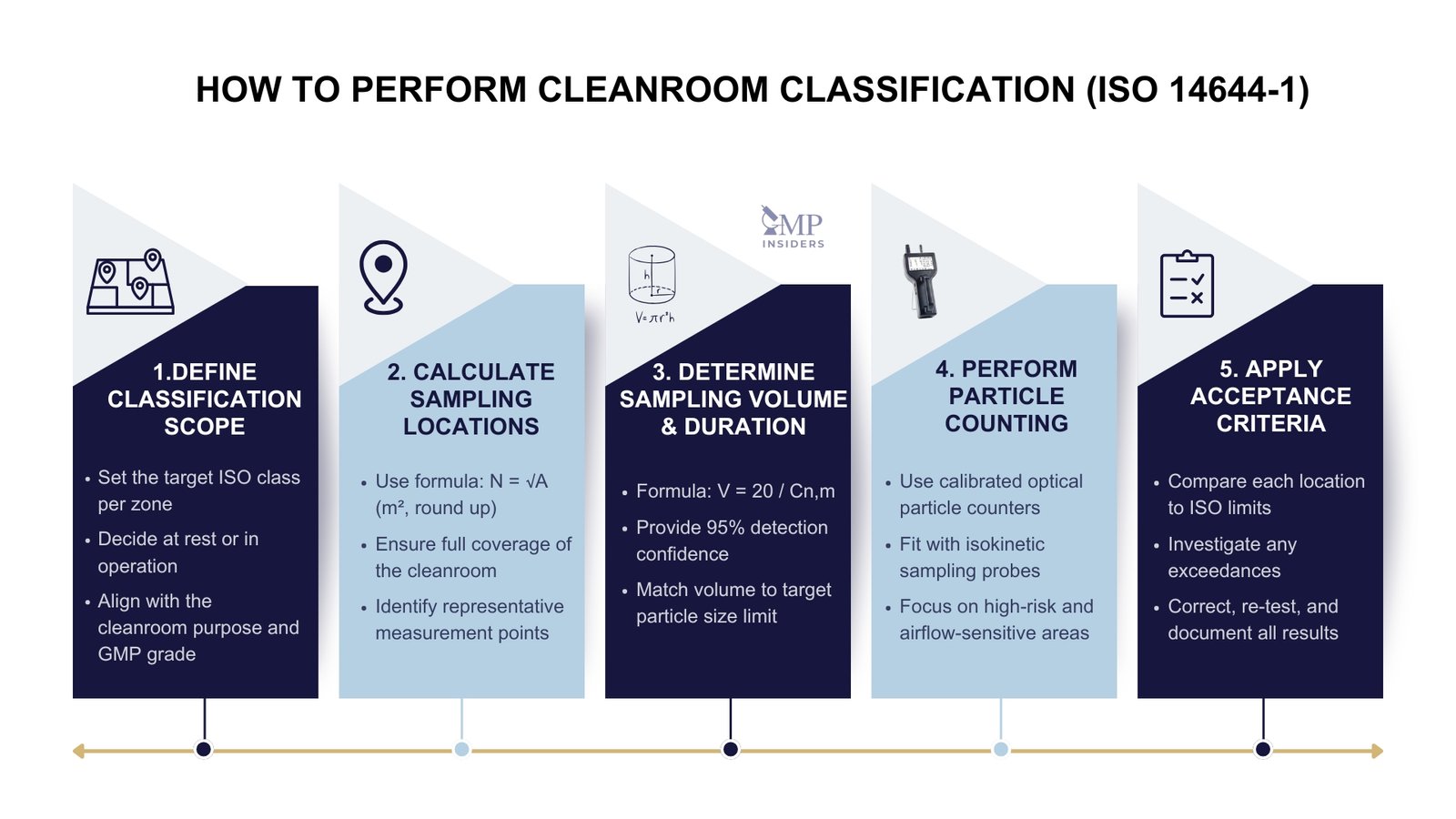
1. Define Classification Scope
- Determine the ISO Class targeted for each cleanroom or zone
- Identify the state for classification:
- At rest: With equipment installed and systems operating, no personnel present
- In operation: With personnel performing routine operations (for aseptic processing areas)
2. Calculate Sampling Locations
- Number of sampling points is calculated using the square root method:
N = √A (rounded up), where A is the cleanroom area in m². - Example: For a 49 m² room, N = √49 = 7 sampling locations.
3. Sampling Volume and Duration
- Minimum air volume per location must be sufficient to detect the class limit of particle concentration with 95% confidence.
- ISO 14644-1 provides a formula:
- V = 20/Cn,m, where:
- V = minimum sample volume (liters)
- Cn,m = class limit (particles/m³) for the particle size being measured
- Sampling is done using calibrated optical particle counters, with isokinetic sampling probes placed in areas most at risk (e.g., near HEPA filters, operator paths).
4. Perform Particle Counting
Sampling must be carried out using calibrated optical particle counters fitted with isokinetic sampling probes to ensure representative collection of airborne particles. Sampling locations should be those identified during the planning phase, focusing on areas at highest risk of contamination. These typically include:
- Proximity to HEPA filter outlets or air supply diffusers.
- Operator working zones, particularly in aseptic areas.
- Locations with complex airflow patterns or potential turbulence.
Measurements should be taken without disturbing normal airflow conditions. For in operation classifications, sampling must reflect typical operational activities to provide an accurate assessment of cleanroom performance under real working conditions.
5. Apply Classification Acceptance Criteria
Results from each sampling location are compared against the ISO 14644-1 particle concentration limits for the target class. All measured values must be within the specified limits for the cleanroom to achieve classification. If one or more locations exceed the allowable concentration:
- The cleanroom fails classification.
- An investigation must be conducted to identify the root cause (e.g., HVAC performance, filter integrity, personnel practices).
- Corrective and preventive actions must be implemented, followed by re-testing to confirm compliance.
All results, calculations, and justifications must be documented as part of the cleanroom qualification records, following GMP documentation requirements.
Connecting ISO Classes to GMP Grades
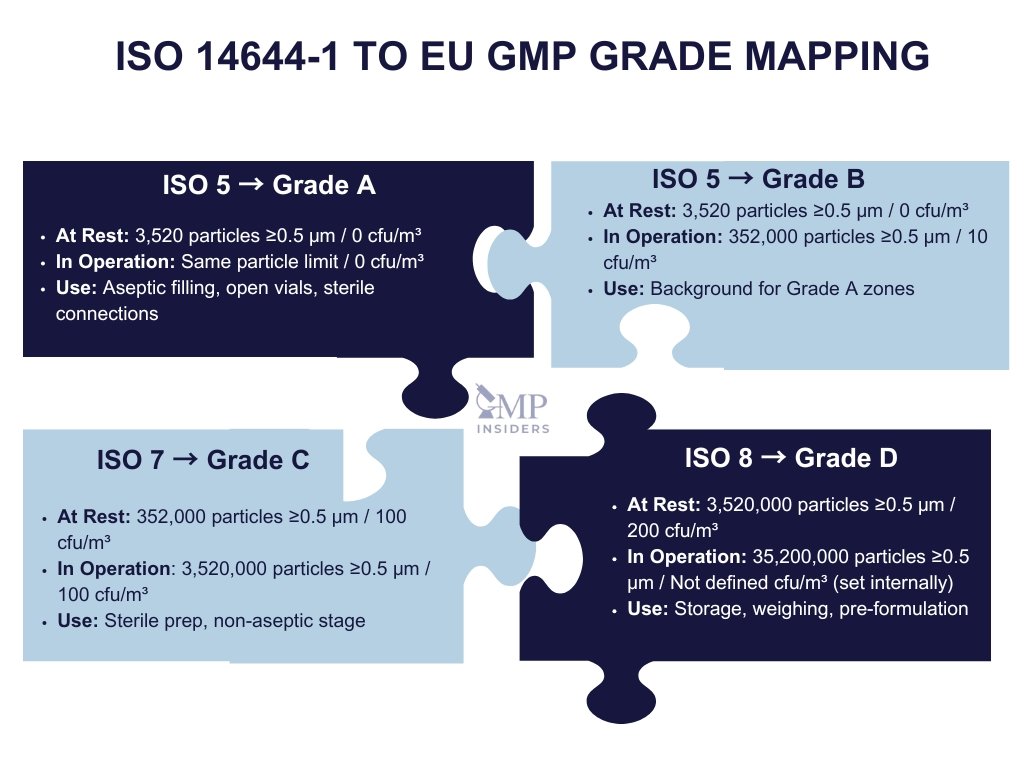
Pharmaceutical manufacturers must comply with both technical standards (ISO 14644-1) and regulatory guidelines (EU GMP Annex 1).
While ISO 14644-1 defines air cleanliness in terms of airborne particles, Annex 1 introduces GMP Grades that incorporate not only particle limits but also microbiological requirements and operational risk levels.
This mapping is critical for:
- Facility zoning and HVAC design
- Environmental monitoring programs
- Aseptic processing and filling line setup
- Risk-based contamination control strategies
SEE ALSO: GMP Cleanroom Classifications: Grade A, B, C, D
ISO-to-GMP Cleanroom Grade
*Note: Annex 1 defines Grade D only “at rest” — operational limits may be set internally based on risk assessment.
Interpreting the Particle and Microbial Limits Together
While ISO 14644-1 provides limits for non-viable particles, EU GMP Annex 1 supplements this with viable microbiological limits, which are assessed using:
- Active air samplers (cfu/m³)
- Settle plates (cfu/4h exposure)
- Contact plates (cfu/25cm² surfaces)
- Glove/fingertip monitoring (cfu/glove)
Practical Examples of Mapping in Use
Aseptic Filling Line (Open Vial Fill)
- Grade A / ISO 5: Laminar airflow (LAF) zone directly over filling needles
- Grade B / ISO 7: Background area with operators in full aseptic gowning
SEE ALSO: Media Fill Tests – Aseptic Process Simulation (APS)
Cleanroom for Sterile API Packaging
- Grade C / ISO 7–8: Closed containers, minimal product exposure
- Grade D / ISO 8: Secondary packaging or preparation of raw materials
Terminally Sterilized Product Manufacturing
- Grade C / ISO 7–8 may suffice for bulk solution preparation
- Grade D / ISO 8 often used for weighing, washing, and staging operations
Cleanroom Qualification and Monitoring
Before a cleanroom can be used for pharmaceutical manufacturing, it must undergo a formal qualification process to confirm that its design, installation, and operation meet the required ISO class and GMP grade.
Cleanroom qualification is typically performed in three phases:
- IQ (Installation Qualification) – Verifies that equipment, utilities, and finishes are installed correctly as per design.
- OQ (Operational Qualification) – Confirms that environmental systems (HVAC, filtration, alarms) function as intended under controlled test conditions.
- PQ (Performance Qualification) – Demonstrates that the cleanroom maintains its classified state under actual operating conditions (in operation, with personnel).
The qualification must be documented in detailed protocols and executed using calibrated instruments and validated test methods.
SEE MORE: Cleanroom Qualification and Validation
Key Qualification Tests per ISO 14644-3
Per ISO 14644-3, the following performance tests are typically performed:
All qualification data must be reviewed and approved by QA before release for GMP operations.
Environmental Monitoring Program (EMP)
Once qualified, cleanrooms require a routine monitoring program to demonstrate continued compliance and to detect any environmental deterioration that may affect product quality.
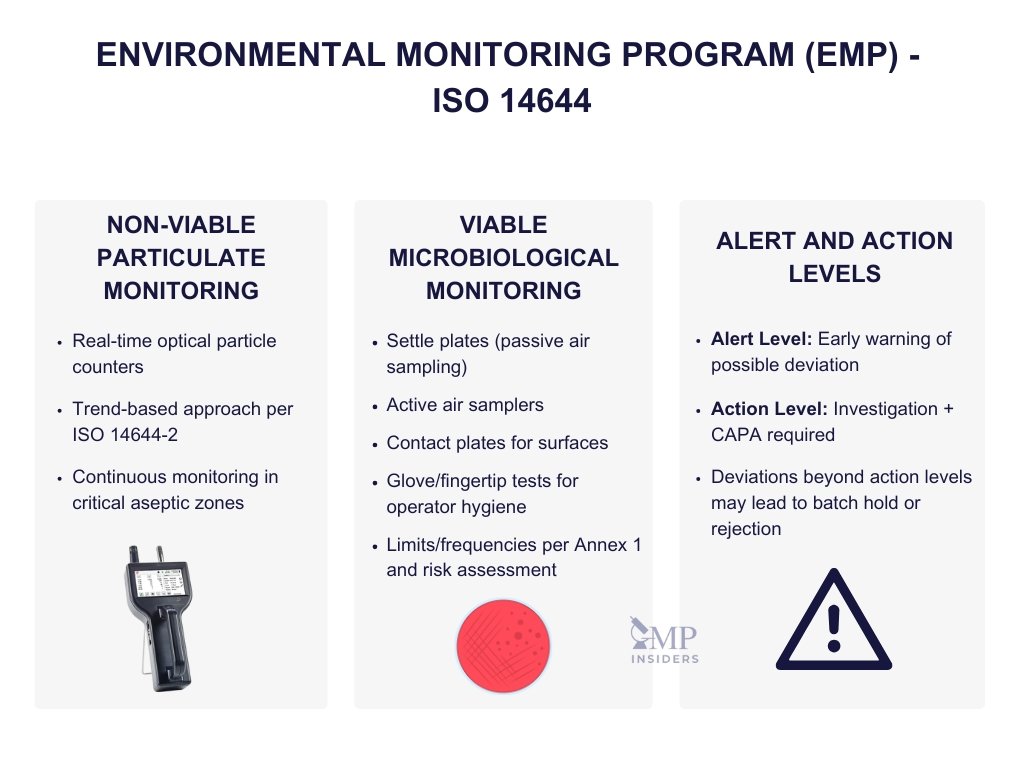
EMP includes both non-viable particulate and viable microbiological monitoring, based on:
- Risk to product exposure
- Process criticality
- Frequency and location (worst-case points)
1. Non-Viable Particulate Monitoring
- Conducted using real-time optical particle counters
- ISO 14644-2 recommends trend-based monitoring, not just pass/fail
- Critical zones require continuous particle monitoring during aseptic operations
2. Viable Microbiological Monitoring
- Performed using:
- Settle plates (passive air)
- Active air samplers
- Contact plates for surfaces
- Glove/fingertip tests for personnel hygiene
- Limits and frequencies must align with Annex 1 and internal risk assessments
3. Alert and Action Levels
Pharmaceutical companies must define:
- Alert levels – Indicate early warning of potential deviation
- Action levels – Require investigation and documented corrective actions
Deviations beyond these levels must be investigated via deviation management and may lead to hold or rejection of associated batches.
SEE ALSO: Environmental Monitoring In the Pharmaceutical Industry
Trend Analysis and Continuous Improvement
Environmental data must not only be collected but also analyzed over time to identify:
- Gradual performance degradation (e.g., HEPA filter loading)
- Seasonal effects
- Operator-induced contamina tion patterns
Tools such as statistical trend charts, heat maps, and Pareto analyses support a risk-based contamination control strategy.
Cleanroom Requalification and Revalidation
ISO 14644-2 requires periodic requalification:
- At least annually for cleanrooms classified as ISO Class 5 and 6, typically used in high-risk or aseptic environments.
- Every 2–4 years for ISO Class 7 and 8 areas, based on risk assessment, occupancy, and operational load.
Requalification intervals must be justified and documented as part of the facility’s contamination control strategy and quality system.
Trigger Events Requiring Immediate Requalification
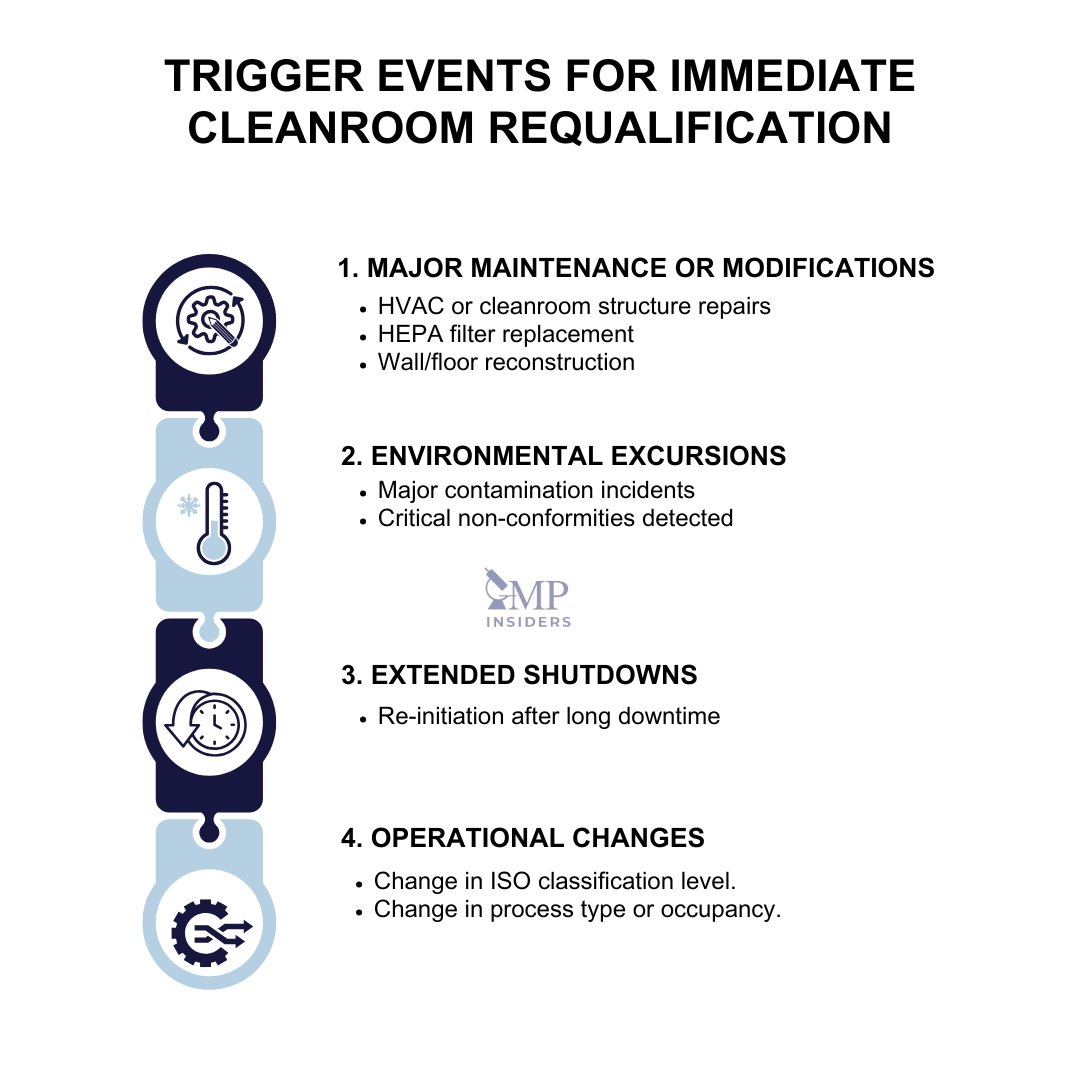
Requalification should be performed outside of the routine schedule if any of the following occur:
- Significant maintenance, repair, or modification of the HVAC or cleanroom structure (e.g., filter replacement, wall/floor reconstruction).
- Environmental excursions, such as major contamination events or critical non-conformities.
- Extended shutdowns followed by the re-initiation of operations.
- Change in classification level, process type, or occupancy.
All requalification activities must include:
- Airborne particle count testing per ISO 14644-1
- HEPA filter integrity testing (if applicable)
- Confirmation that the cleanroom maintains its designated ISO class in its current operational state
Additional ISO Standards for Pharma Cleanrooms
Below are some of the ISO 14644 series and related standards that support the full lifecycle management of cleanroom performance in GMP pharmaceutical settings.
ISO 14644-2: Monitoring and Periodic Testing
ISO 14644-2 complements ISO 14644-1 by providing guidance on the ongoing monitoring of cleanrooms to ensure that they continue to meet their classification requirements over time.
Key Concepts:
- Focuses on performance-based monitoring rather than rigid schedules.
- Emphasizes the importance of a risk-based approach: monitoring should be more frequent in higher-grade areas or processes with higher contamination risk.
- Requires establishing a monitoring plan based on:
- Historical data and cleanroom trends
- Process criticality
- Occupancy and operational load
Pharmaceutical manufacturers typically integrate these recommendations into their Environmental Monitoring Programs (EMP) and requalification protocols.
ISO 14644-3: Test Methods
ISO 14644-3 specifies test methods and procedures used during cleanroom qualification and requalification.
Common Tests Include:
- Airflow visualization (smoke study)
- HEPA/ULPA filter integrity testing (e.g., PAO or DOP tests)
- Airflow velocity and uniformity
- Room pressurization and recovery time
- Containment leak testing
This standard is essential for executing IQ/OQ/PQ in GMP cleanroom projects and is often cross-referenced in validation protocols and engineering acceptance testing (FAT/SAT).
ISO 14644-4: Design, Construction & Start-up
The ISO 14644-4 specifies requirements for designing, constructing, and commissioning cleanrooms and clean air devices. It covers facility layout, HVAC specification, materials, zoning, and operational commissioning protocols.
Widely applied in pharmaceutical facility design to ensure the operational environment supports ISO cleanliness targets from the start.
ISO 14644-5: Operations
A major revision of the ISO 14644-5 was released in mid-2025 redefining cleanroom operations to include a formal Operations Control Programme (OCP). The OCP requires documented procedures for:
- Impact assessment
- Personnel/material entry and exit
- Cleaning, maintenance, shutdown/restart protocols
- Operational SOPs, training, and flow diagrams
- Consumables qualification, risk-based management
The updated standard integrates various industry Recommended Practices (e.g. IEST-RP‑CC003–5) and aligns more closely with modern pharmaceutical regulatory expectations and cleanliness frameworks.
ISO 14644-16: Energy Efficiency in Cleanrooms
Published in 2019, ISO 14644-16 addresses the design, operation, and maintenance of cleanrooms to energy efficiency, a growing concern for sustainability in pharmaceutical manufacturing.
Why it Matters:
- Cleanrooms, especially ISO 5 and Grade A environments, consume substantial energy due to high air change rates (ACH).
- The standard offers guidance on:
- Optimizing HVAC performance
- Balancing energy use with contamination control
- Applying metrics for energy consumption and performance indicators
ISO 14698: Biocontamination Control
Although not part of the 14644 series, ISO 14698 is frequently referenced in pharmaceutical contexts, particularly where aseptic processing or biologics are involved.
Key Elements:
- Establishes principles and methods for assessing, controlling, and monitoring biocontamination.
- Encourages implementation of a Contamination Control Strategy (CCS) based on:
- Risk assessment
- Identification of contamination sources (personnel, surfaces, air)
- Zoning, barrier systems, and cleaning regimes
While EU GMP Annex 1 is now the primary source for microbiological expectations, ISO 14698 remains useful for building robust contamination control frameworks.
SEE ALSO: Risk-based Contamination Control Strategy
FAQ
Final Thoughts
Cleanroom classification according to ISO 14644-1 forms the technical foundation for maintaining controlled environments in pharmaceutical manufacturing. However, compliance with ISO particle limits alone is not sufficient.
Proper control requires the integration of classification, environmental monitoring, personnel behavior, facility design, and microbiological safeguards, all aligned with regulatory frameworks such as EU GMP Annex 1.
By understanding how ISO classes map to GMP grades and implementing a risk-based environmental monitoring strategy, manufacturers can ensure their cleanrooms remain in a state of control throughout their lifecycle.