Material transfer is part of daily pharmaceutical operations. Components, tools, documents, samples, cleaned accessories, and small equipment items are moved continuously between rooms, often with different cleanliness levels, pressure conditions, functions, or process sensitivities. Because these transfers are so routine, their impact on contamination control is sometimes underestimated.
Every transfer creates an interface between two areas. If that interface is not properly defined, routine movement can lead to unnecessary personnel traffic, frequent door openings, pressure disturbances, and a higher risk of particle or microbial transfer into controlled areas.
Pass boxes, also referred to as pass-through hatches, are used to manage this transfer interface. Throughout this article, both terms are used interchangeably. Pass-through hatch is the term used in EU GMP Annex 1, while pass box is more commonly used in industry practice and supplier literature.
A pass box provides a controlled point for moving materials between adjacent areas while supporting room segregation and reducing direct movement of personnel. Used correctly, it helps maintain the intended material flow, limits unnecessary exposure between rooms, and supports a more stable, controlled environment.
This article explains the main types of pass boxes used in pharmaceutical facilities, with particular focus on static and dynamic units. It also reviews typical applications, important design features, and practical risk-based considerations for selecting and using pass boxes as part of contamination control and material flow.
What Is a Pass-box?
A pass box is a fixed transfer chamber installed between two adjacent rooms to allow materials to move from one side to the other without direct personnel passage. It serves as a controlled transfer interface that helps preserve room segregation while supporting routine material movement in a more disciplined and predictable manner.
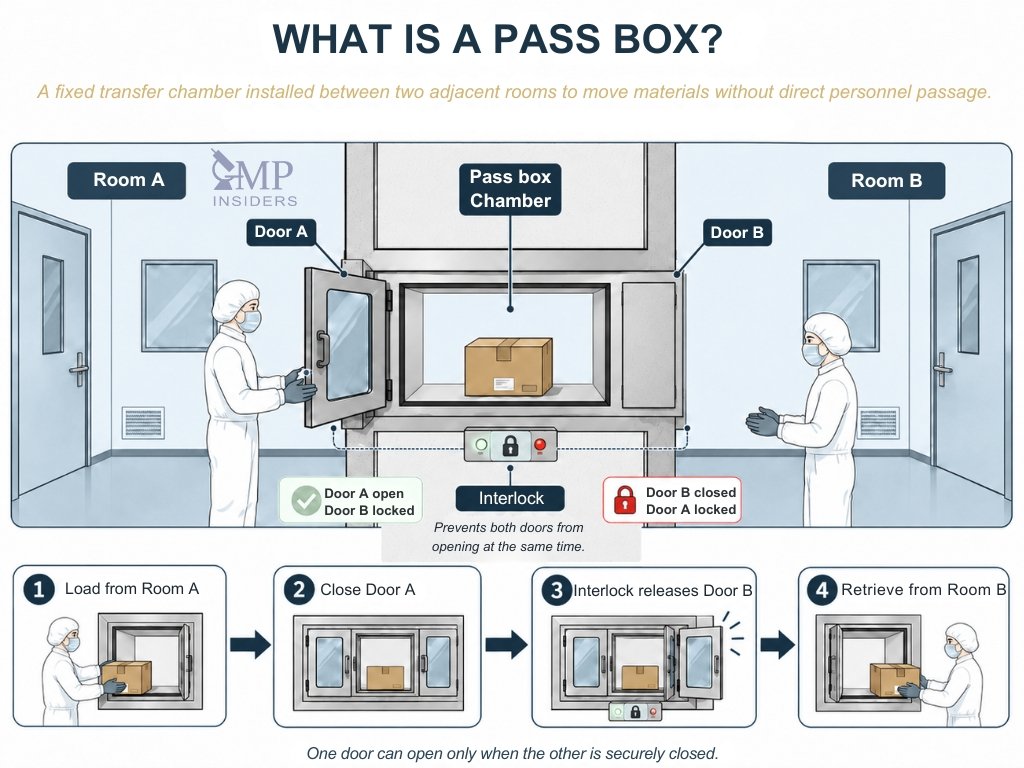
In practice, many items need to move repeatedly between rooms during normal operation. These may include components, cleaned utensils, labels, documents, samples, garments, small tools, and production-support items. If every small transfer is handled through normal room entry, the result is often unnecessary door opening, increased operator movement, and greater disturbance of the controlled environment. A pass box reduces that burden by providing a dedicated route for smaller transfers that do not require a person to enter the adjoining space.
Its function becomes more important when the connected rooms differ in cleanliness, operational sensitivity, or processing activity. At that interface, the transfer point itself can become a source of risk if it is poorly designed or used without clear rules. A pass box helps manage that risk by creating a defined chamber in which the item is loaded from one side, the door is closed, and retrieval takes place from the opposite side, following an established sequence. The chamber may operate as a simple interlocked enclosure or include active airflow and additional control features, depending on the required level of protection.
For that reason, a pass box should not be viewed as a simple opening in the wall. In pharmaceutical design, it is part of the wider strategy for controlling material flow, reducing avoidable room disturbance, and maintaining separation between adjacent areas. Its value lies not only in moving materials efficiently, but in doing so in a way that supports the intended environmental and operational conditions of the rooms it connects.
The extent of that role depends on the type of pass box, the sensitivity of the items being transferred, and the needs of the receiving side. A unit used for routine transfer between rooms of similar condition is not expected to perform the same function as one installed at a more sensitive room interface. That distinction is what makes pass box selection an engineering and contamination-control decision, rather than a simple architectural detail.
Why Are Pass-boxes Used in Pharmaceutical Facilities?
Pass boxes are used because material movement is unavoidable, but uncontrolled movement creates unnecessary risk. Even in well-organized facilities, small items have to move frequently between rooms throughout the day. When these transfers rely on repeated room entry, they increase personnel traffic, interrupt the intended flow of operations, and create more opportunities for particles, microorganisms, or air disturbances to affect the surrounding environment.
A pass box provides a more controlled alternative. It allows defined items to move through a dedicated chamber rather than through routine operator movement between adjoining spaces. This helps reduce unnecessary entry and exit, supports better room discipline, and makes the transfer process easier to standardize through procedures, cleaning requirements, and routine checks.
In pharmaceutical operations, pass boxes are commonly used for the transfer of:
- components and packaging items
- cleaned tools and utensils
- samples and sampling accessories
- labels, documents, and batch-related materials
- garments and small operational items
- small equipment or change parts used in adjacent rooms
Their value is not the same at every transfer point. In some cases, the main benefit is simply reducing unnecessary movement between rooms of similar condition. In other cases, the pass box plays a more protective role by helping maintain separation between areas where the receiving side is cleaner or more sensitive. In both situations, the principle is the same: the pass box supports material flow in a way that places more control around the transfer itself.
Basic Pass-box Design Principle
The fundamental design principle of a pass box is to enable the transfer of materials through a closed, controlled chamber without establishing a direct open connection between the adjoining rooms. Although this principle is simple in concept, it is critical in controlled pharmaceutical environments, where the pass box serves as a transfer interface intended to maintain segregation between areas.
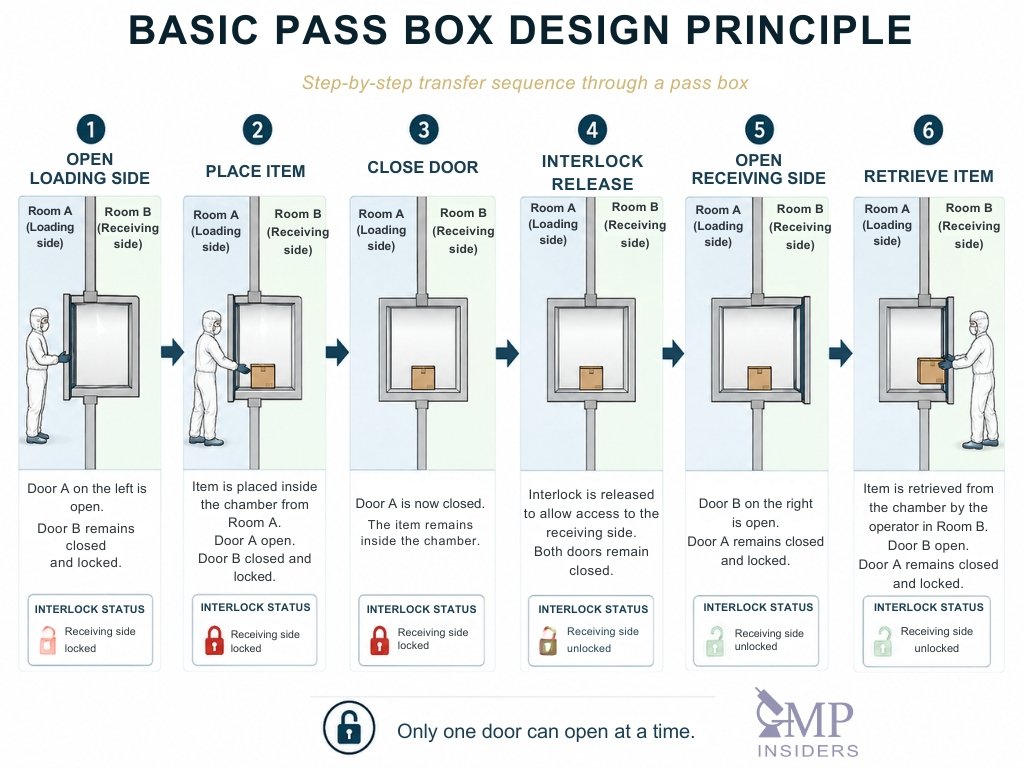
A key design and operational control for any pass box is preventing the simultaneous opening of opposing doors. This is typically achieved through a mechanical or electronic interlocking system, often supplemented by visual indicators, audible alarms, or status signals. Regardless of the specific arrangement, the control objective remains the same: one door must be fully closed before the opposite door can be opened, thereby preventing direct exposure between the two rooms during the transfer process.
A typical pass box is installed at the wall interface between two controlled areas and consists of an enclosed chamber with one access door on each side. Materials are introduced from one room, the loading-side door is closed, and then removed from the opposite side.
Depending on the intended use and classification requirements, the pass box may operate as a simple interlocked transfer chamber or may incorporate additional features such as active airflow, HEPA filtration, pressure control, status indication, alarms, ultraviolet systems, or other transfer-supporting controls. The required level of control should be determined by the transfer’s criticality and the environmental conditions at the interface.
The pass box should be suitable for routine use in a controlled environment. It should support effective cleaning, reliable operation, and clear transfer sequencing. Smooth internal surfaces, hygienic finishes, cleanable corners, robust door assemblies, suitable sealing arrangements, and adequate visibility into the chamber are essential design considerations. These features directly influence whether the pass box can be operated consistently without compromising the surrounding controlled areas.
The pass box design should also be appropriate for the specific transfer application. A simple interlocked pass box used to move documents, components, or wrapped items between areas of similar environmental conditions may require only robust construction and reliable door interlocking.
By contrast, a pass box located at a more critical interface may require active air handling, filtered airflow, defined pressure relationships, enhanced monitoring, alarms, or stricter operating logic to protect the receiving area. In all cases, the design should be based on the contamination-control challenge posed by the transfer route, rather than on generic equipment selection alone.
SEE ALSO: Risk-based Contamination Control Strategy (CCS)
A pass box must also be considered in relation to the surrounding HVAC and pressure cascade strategy. It is located at the interface between rooms that may have different pressure, airflow, and cleanliness requirements. Therefore, its design and operation should be coordinated with the facility’s overall contamination control strategy. A dynamic pass box can support a properly designed pressure cascade, but it cannot compensate for an inadequately designed room pressure regime. This consideration should be addressed during facility and process design, rather than after room layouts and HVAC concepts have already been finalized.
Main Types of Pass-boxes Used in Pharmaceutical Facilities
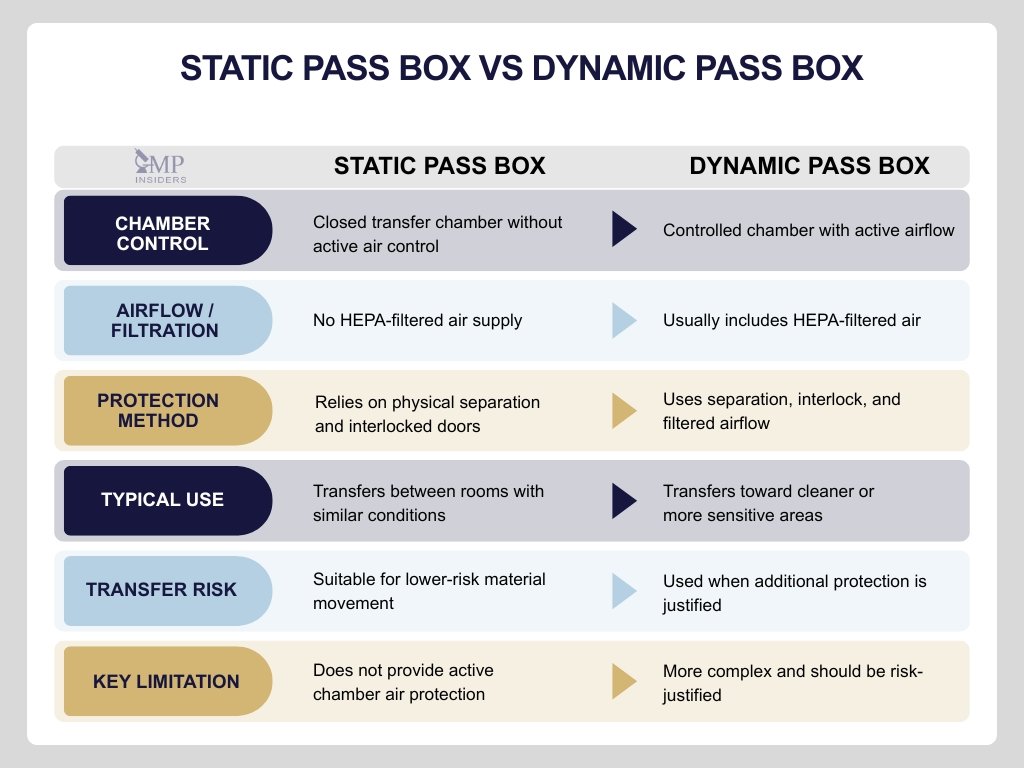
Pass boxes are commonly classified into two principal categories: static pass boxes and dynamic pass boxes. This classification is technically meaningful because it is based on how the transfer chamber is controlled during operation. Although a range of alternative terms may be used in supplier documentation, these often refer to optional features, configuration details, or specialized transfer systems rather than to distinct core pass box types.
Some references also identify an intermediate category, often described as semi-active or semi-dynamic. In such designs, the chamber may be ventilated by air overflow from an adjacent higher-pressure area, or airflow may operate only during defined transfer phases rather than continuously. Whether this arrangement is treated as a separate category or as a sub-variant of the dynamic pass box family is largely a matter of terminology.
The distinction between static and dynamic pass boxes is important because the two designs serve different purposes in contamination control. While they may appear similar externally, they differ in operating principle, environmental control capability, qualification expectations, monitoring requirements, and suitability for different transfer routes.
Selection should therefore be based on the classification and pressure relationship of the connected areas, the nature and condition of the materials being transferred, the applicable contamination control strategy, and the level of protection required during the transfer process.
Static Pass-box
A static pass box is the simpler of the two main types. It functions as a closed transfer chamber with doors on both sides and a system that prevents simultaneous door opening, but it does not include active airflow or internal air-cleaning support during normal operation. Its protective role is based mainly on physical separation, controlled transfer sequencing, and reduction of unnecessary direct exposure between the two connected spaces.
The key difference is that a dynamic pass box does not rely solely on physical separation. It also uses active chamber air control to support its protective function. Depending on the design, this may involve filtered supply air, defined airflow patterns, status indicators, alarms, and other features to maintain the intended chamber conditions during transfer. Because of that, dynamic pass boxes usually carry a greater qualification and maintenance burden than static units.
Dynamic pass boxes are typically considered when the interface between rooms presents a more meaningful environmental difference, when the cleaner side must be better protected during transfer, or when the transferred materials themselves justify a more controlled chamber environment. This does not mean that a dynamic unit is inherently better in every case. It means that it is appropriate where the transfer risk justifies the added level of engineering control.
Their advantages include stronger chamber air control, better suitability for more sensitive receiving environments, and improved support for transfer points that require greater environmental protection. Their limitations are equally important to recognize. Dynamic pass boxes are more complex, require airflow-related maintenance and verification, and should only be selected where the additional protection provides real operational value.
Other Pass-box Variants and Specialized Transfer Configurations
Beyond static and dynamic units, some transfer systems are designed with additional features to support specific operational needs. These should not usually be treated as separate core pass box categories. The primary classification still depends on whether the unit functions as a passive transfer chamber or as an actively controlled one.
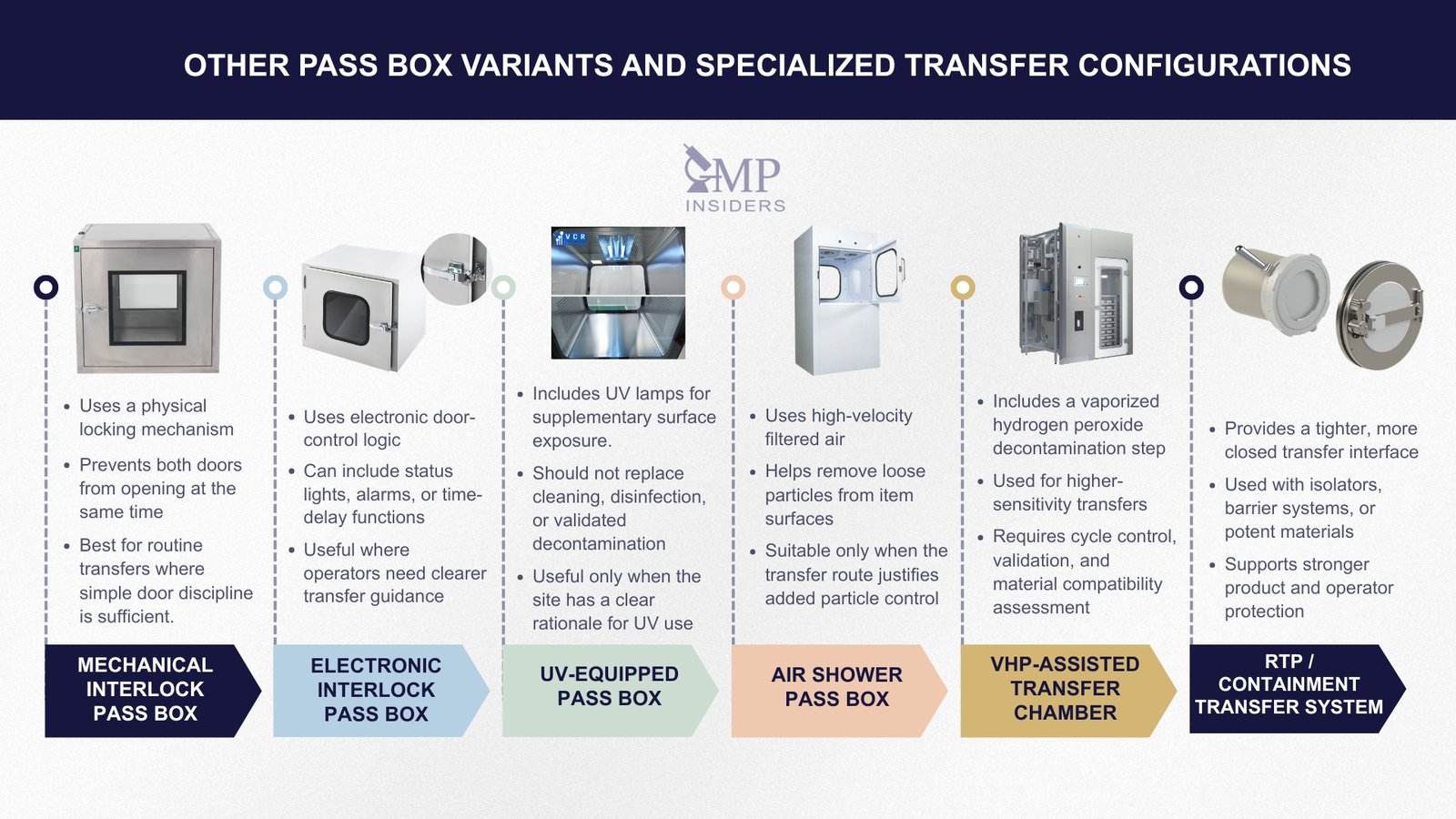
Most of the other names used in practice refer either to the way the doors are controlled, to supplementary transfer-supporting features, or to more advanced systems used when a standard pass box is no longer sufficient.
This distinction is important because supplier descriptions often make the subject look more complicated than it really is. A pharmaceutical facility does not benefit from a long list of equipment names unless those distinctions reflect a real difference in transfer function and contamination-control value. The more useful question is what the added feature is intended to achieve, whether it genuinely improves the transfer process, and whether that added complexity is justified by the risk at the specific interface.
Mechanical Interlock Pass-box
A mechanical interlock pass box uses a physical locking arrangement to prevent both doors from being opened simultaneously. This is one of the most common and robust solutions used in standard pass box construction. Its main advantage is simplicity: because the control logic is mechanical rather than software-based, the system is often easier to understand, easier to maintain, and less dependent on electrical components.
Mechanical interlocks are widely used where the primary goal is straightforward room separation and disciplined transfer sequencing. In these applications, the facility may not need alarm functions, timed door release, or more advanced operator guidance. A durable mechanical arrangement may be entirely adequate, particularly when the transfer route is well defined, and the risk profile does not justify additional complexity.
They are commonly preferred where:
- the transfer point is routine and clearly defined
- the required protection is achieved mainly through door discipline
- the facility wants a robust design with fewer technical dependencies
- ease of maintenance is an important consideration
Their limitations should also be recognized. A mechanical interlock system offers less flexibility than an electronically controlled one. If the facility needs visible door-status indication, integration with alarms, time-delay logic, or more structured control of the operating sequence, a mechanical arrangement may be too limited for that application.
Electronic Interlock Pass-box
An electronic interlock pass box performs the same basic separation function, but the locking logic is handled electronically. This allows the unit to incorporate additional operating features and gives the facility greater flexibility in controlling the transfer sequence.
Electronic interlocks are often selected when the transfer point requires clearer operator guidance or when the pass box is expected to interface with status lights, alarms, timed-release functions, or other control features. In itself, electronic control is not automatically better than mechanical control. Its value depends on whether those added functions improve discipline and reduce the likelihood of misuse at that specific transfer interface.
Typical features may include:
- controlled door locking logic
- visual door-status indicators
- audible or visible alarms
- time-delay opening functions
- operating sequence logic linked to transfer cycles
These systems are advantageous where:
- the facility wants clearer operating feedback during transfer
- the transfer route benefits from visible confirmation of unit status
- the pass box is used frequently by multiple operators
- the application requires tighter procedural control
Compared with mechanical systems, electronic interlocks usually involve greater control flexibility but also more technical dependence. Power supply, control circuitry, sensors, and indicators contribute to the unit’s overall reliability, so the added features should be used only where they add real value.
UV-Equipped Pass box
Some pass boxes are fitted with ultraviolet lamps intended to provide supplementary reduction of surface bioburden on transferred items. This is one of the most commonly misunderstood features in supplier descriptions. A UV-equipped pass box should not be described as if the presence of a lamp automatically confers a validated decontamination function on the transfer process.
In practice, UV effectiveness depends on factors such as lamp condition, lamp intensity, exposure time, shadowing, item geometry, distance from the source, and the nature of the exposed surface.
UV-C lamp output also degrades significantly over time, with typical losses of around 30 percent or more within the first year of use, and effectiveness is wavelength-dependent (254 nm is the standard germicidal wavelength). These factors underscore why UV cannot be relied upon as a primary control: even a lamp that appears to be working may no longer deliver the expected dose.
For that reason, UV should be handled with caution. At most, it may serve as a supplementary feature in selected applications. It should not be presented as a substitute for cleaning, disinfection, validated decontamination, or an appropriately designed transfer process. The facility should be able to justify why the feature is present and what realistic contribution it is expected to make.
A balanced way to position UV-equipped pass boxes is to state that they may be used:
- as an additional support feature in some transfer arrangements
- where the site has a defined rationale for supplementary surface exposure
- only with a clear understanding of their limitations, including lamp degradation and shadowing
Air Shower Pass box
An air shower pass box is a more specialized configuration that uses high-velocity filtered air to dislodge loose particles from the outer surfaces of transferred items before they are retrieved from the cleaner side. Its function is different from that of a standard dynamic pass box. A dynamic pass box controls the chamber environment through active filtered airflow, whereas an air shower unit adds a more directed air-cleaning action aimed at the item itself.
This kind of transfer system is more niche and should not be treated as a routine requirement. Its relevance depends heavily on the nature of the items being transferred, the particulate challenge involved, and whether the items can tolerate that airflow without being disturbed, damaged, or made more difficult to handle.
It may be considered where:
- loose particulate on the outer surface of transferred items is a specific concern
- the transfer route justifies an additional particle-reduction step
- the items being transferred are compatible with the air shower conditions
- the facility is prepared to manage the higher engineering burden
Important cautions also apply. Not every transfer route needs this level of intervention, and an air shower pass box should not be presented as simply a “better” dynamic unit. It is a more specialized tool intended for specific use cases, and it introduces additional complexity in design, airflow control, cleaning, and maintenance.
VHP-Assisted Transfer Chambers
Some transfer systems are designed to incorporate vaporized hydrogen peroxide (VHP) into the transfer process. These are used when the facility requires more than room separation and more than active chamber airflow. In such cases, the transfer interface is expected to support a defined decontamination objective before the item proceeds to the receiving side.
This type of system belongs to a more advanced category than an ordinary pass box. It should usually be described as a decontamination-assisted transfer chamber rather than as a routine pass box feature. Its use is most relevant when the receiving side is highly sensitive, when the transfer forms part of a barrier concept, or when introduced items require a defined decontamination step before entry.
A VHP-assisted transfer system may be appropriate where:
- transferred items need a controlled decontamination step
- the receiving side has stricter environmental protection requirements
- the transfer route supports higher-sensitivity operations
- the facility has the procedures, validation strategy, and technical capability to manage the cycle properly
These systems also come with clear implications:
- demanding cycle development and routine cycle control, typically supported by biological indicator (BI) studies (a 6-log reduction of Geobacillus stearothermophilus spores is the common benchmark)
- material compatibility considerations, since VHP can interact with certain materials over time
- greater validation and routine verification burden
- more complex maintenance and fault management
For that reason, they should be presented as advanced solutions rather than default upgrades to ordinary pass boxes.
RTPs and Containment-Oriented Transfer Systems
In some pharmaceutical applications, especially those involving potent compounds, barrier technology, or high-containment operations, a conventional pass box may not provide a sufficiently closed interface.
In these cases, facilities may use rapid transfer ports (RTPs) or other containment-oriented transfer systems designed to move items across a boundary while maintaining a much tighter degree of separation.
These systems should not be grouped carelessly with standard wall-mounted pass boxes. They belong to a related but more specialized family of transfer technologies that also includes alpha-beta port systems, bag-in/bag-out systems for waste removal, and sealed canister or split-butterfly valve arrangements for powder transfer. Their purpose is not only to facilitate room-to-room movement but also to maintain a more closed connection and reduce the risk of exposure during transfer, connection, and disconnection.
They become more relevant where the transfer route involves:
- potent materials
- closed processing environments
- isolators or barrier systems
- stronger requirements for operator protection
- stronger requirements for product protection
How to Select the Right Pass-box
Choosing a pass box should not begin with the equipment’s appearance, the supplier’s preference, or the available wall space. It should begin with the transfer route itself. The correct unit is determined by where it is installed, what passes through it, how sensitive the receiving side is, how often the transfer takes place, and what level of control is actually needed during routine use.
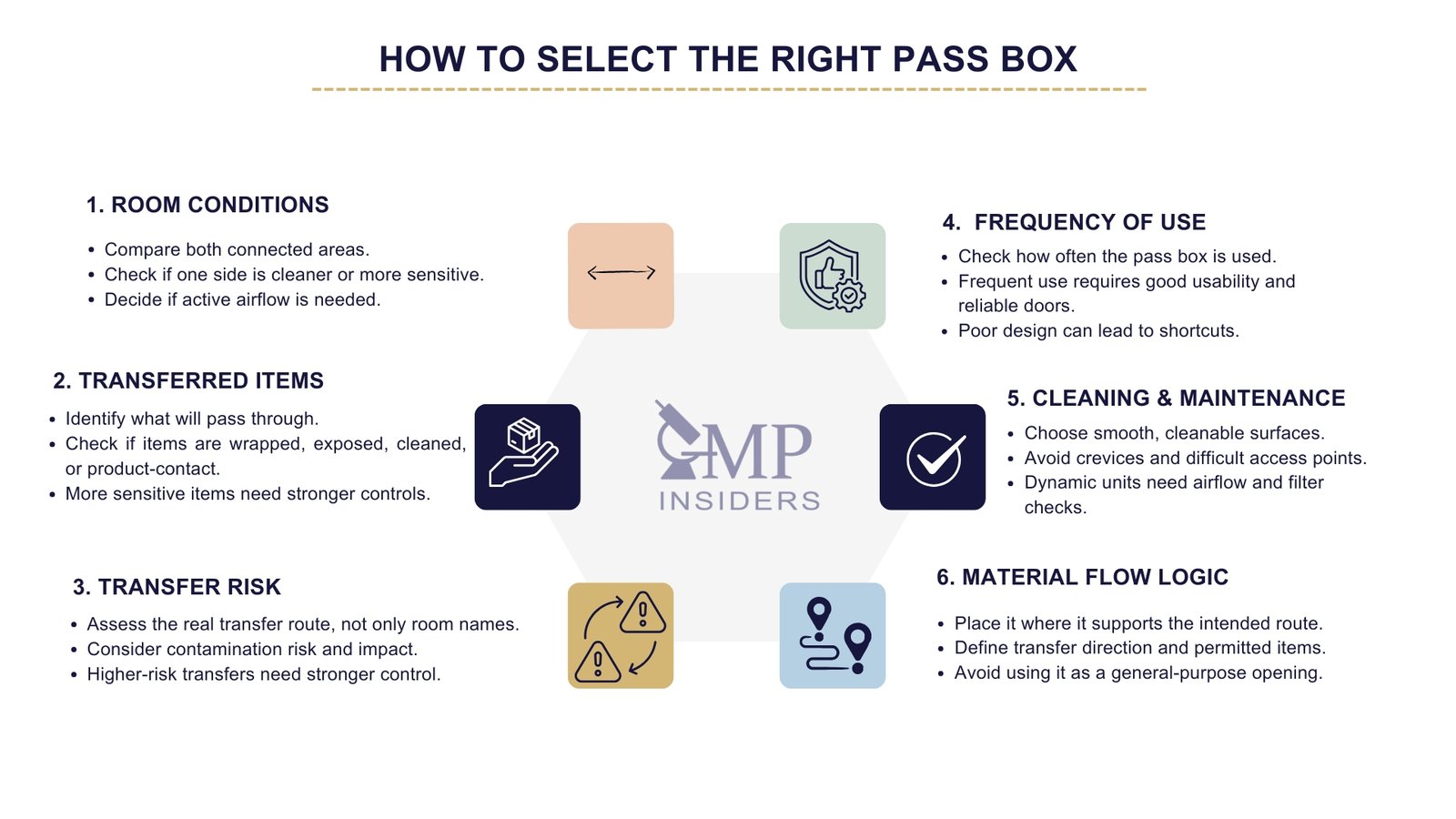
In practice, this is where facilities often oversimplify the decision. A pass box may look suitable because it fits the opening, has interlocked doors, and appears easy to clean, but that does not automatically mean it is the right choice for the application. The key question is whether the unit provides the appropriate level of protection and operational control for the interface it is meant to support.
Start With the Conditions on Both Sides
The first thing to assess is the condition of the two connected areas. A transfer between rooms of similar environmental status is not the same as a transfer into a cleaner, more sensitive, or more tightly controlled room. The pass box sits directly at that interface, so its function depends on the relationship between the two sides.
Key questions include:
- Are both rooms under similar environmental conditions?
- Is one side cleaner or operationally more sensitive?
- Does the receiving side need added protection during transfer?
- Would a simple interlocked chamber be sufficient, or is active chamber control more appropriate?
As a practical rule, a static pass box may be suitable when the conditions on both sides are broadly comparable, and the transfer risk is limited. A dynamic pass box is more appropriate when the transfer point must provide additional protection on the receiving side. For transfers into classified GMP areas, current Annex 1 expectations strongly favor units with active filtered airflow.
Consider What Is Actually Being Transferred
The next issue is the nature of the transferred items. A pass box used for documents, labels, outer-wrapped materials, or routine support items does not necessarily require the same design as one used for cleaned tools, product-contact accessories, or items entering a more sensitive environment.
The pass box selection should therefore reflect:
- the type of material being transferred
- whether the item is wrapped, protected, or exposed
- whether it is product-contact related
- whether it has already been cleaned or disinfected
- whether surface contamination on the item is a realistic concern
Typical items moved through pass boxes may include packaging components, cleaned utensils and tools, production accessories, samples and sample-related items, documents and labels, garments and operational supplies, and small equipment or change parts.
The more sensitive the transferred item, or the more sensitive the receiving environment, the stronger the need for a justified pass box design and transfer procedure.
Assess the Transfer Risk, Not Just the Room Labels
Facilities sometimes make decisions based only on room names or classification labels, but that is often too superficial. Two areas may both be controlled rooms and still present very different transfer risks depending on what happens there, what moves through the pass box, and how frequently the interface is used.
A better approach is to assess the actual transfer point in terms of risk. That assessment should consider:
- the likelihood of contamination being introduced during transfer
- the potential effect on the receiving side
- how often the transfer takes place
- how much operator handling is involved
- whether the transfer is routine, occasional, or process-critical
This keeps the decision tied to the real challenge rather than to general assumptions about the area.
Look At the Frequency and Pattern of Use
The pass box should also be appropriate for its intended use in practice. A unit used only occasionally does not place the same burden on the facility as one used repeatedly throughout each shift. High-frequency use increases the importance of chamber size, door reliability, ease of cleaning, operator clarity, and overall usability.
Points to consider include:
- How many times per day will the pass box be used?
- Are the transfers repetitive and standardized, or varied and more complex?
- Will the chamber mainly handle one item type or many?
- Is the design likely to support consistent use without shortcuts or workarounds?
A pass box that is technically acceptable on paper may still be problematic if it is awkward to use in routine. Poor usability often leads to poor transfer discipline.
Do Not Ignore Cleaning and Maintainability
Selection should also account for how the unit will be cleaned, inspected, and maintained over time. A pass box that is difficult to clean or awkward to service may become a weak point even if its original selection seemed appropriate.
Important design and lifecycle considerations include:
- smooth internal surfaces
- minimal crevices and dirt-retaining features
- suitable construction material
- good access for cleaning and visual inspection
- maintainability of interlocks, seals, filters, and controls where applicable
For dynamic and specialized units, this becomes even more important because active features add maintenance burden and qualification implications.
Match the Pass-box to the Facility’s Material Flow Logic
A pass box should fit into a defined material movement strategy. It should not be installed simply because there is space in the wall. Its position and type should support the intended flow of materials through the facility and should not create confusion about what is meant to move through that interface.
A good transfer point supports clear direction of movement, minimal unnecessary handling, separation of different material categories where relevant, alignment with the room function and process sequence, and consistent use in accordance with established procedures.
Poor selection often occurs when the pass box is treated as a general-purpose opening for anything that needs to move quickly between rooms. That approach weakens control and makes standardization more difficult.
Qualification and Routine Control of Pass-boxes
Pass boxes should be qualified and controlled according to their intended use, especially where they support transfer into cleaner or more sensitive areas. They should be treated as transfer interfaces that form part of the facility’s contamination control strategy. Annex 1 also expects transfer processes and, where relevant, transfer disinfection to be defined according to risk.
For a static pass box, qualification typically focuses on proper installation, door alignment, interlock performance, chamber condition, and cleanability. For a dynamic pass box, the scope of qualification is broader because active airflow and filtration are integral to the unit’s protective function. In those cases, additional checks usually include:
- HEPA filter integrity testing (typically PAO aerosol challenge)
- airflow velocity and uniformity measurements
- airflow visualization, often through smoke studies
- non-viable particle counts and recovery time testing
- viable monitoring as part of the wider environmental program, where applicable
Routine control should remain practical. The facility should have clear procedures covering what may be transferred, the loading and unloading sequence, cleaning requirements, and the response to interlock or equipment faults. The pass box should also be included in routine cleaning, inspection, and preventive maintenance so that wear, damage, or declining performance does not go unnoticed.
Where the transfer route changes, critical components are replaced, or recurring failures are observed, the unit should be reassessed to confirm it remains suitable for its intended purpose. In short, the qualification should match what the pass box is expected to do: a static unit should be shown to function as a reliable interlocked transfer chamber, while a dynamic unit should be shown to provide the added chamber control for which it was selected.
SEE ALSO: Qualification vs Validation
Regulatory Requirements and GMP Expectations
There is no standalone GMP chapter written only for pass boxes. Instead, regulatory expectations stem from broader requirements for contamination control, material transfer, room segregation, and the qualification of controlled interfaces.
EU GMP Annex 1 (2022 Revision)
For sterile manufacturing, the current EU GMP Annex 1, issued on 22 August 2022 and effective from 25 August 2023, is the most important reference. It treats transfer points as part of the contamination control strategy rather than as simple wall openings, and its expectations are especially relevant where materials move toward cleaner or more sensitive areas.
Pass-through hatches are addressed through the broader requirements for material transfer, segregation, and protection of the cleaner side during transfer. The key points can be summarized as follows:
- Materials and equipment transferred into Grade A or Grade B through an airlock or pass-through hatch should be protected during transfer.
- Items moving from lower-grade or unclassified areas into higher-grade clean areas should be cleaned and disinfected in accordance with the risk and the contamination control strategy.
- Doors of airlocks and pass-through hatches should not be opened simultaneously. For interfaces leading to Grade A or B areas, both an interlocking system and a visual and/or audible warning system should be in place. For lower grades, equivalent controls should be applied on a risk-based basis, and many facilities choose to apply the interlock principle across all grades as a matter of good practice.
- Where appropriate, the pass-through hatch should protect the higher-grade environment, for example, by providing an active, filtered air supply or effective flushing.
Taken together, these points show that Annex 1 does not ask whether a pass box merely exists. It asks whether the transfer interface is designed and operated to protect the receiving environment.
WHO HVAC Guidance
WHO guidance complements Annex 1 by giving a clear technical framework for describing pass boxes within the wider HVAC and facility design strategy. WHO Annex 8 of TRS 1010 (Guidelines on heating, ventilation, and air-conditioning systems for non-sterile pharmaceutical products) recognizes pass-through hatches (PTH) as one of several elements that support containment, cleanliness, and protection of product and personnel, alongside personnel airlocks (PAL), material airlocks (MAL), change rooms, and adequate pressure differentials.
SEE ALSO: Types of Airlocks Used in Pharmaceutical Facilities
While WHO does not formally classify pass boxes into named categories with the same labels used by suppliers, the underlying distinction between units that rely on overflow or passive ventilation and units that have a defined active air supply into the chamber is well established in industry and supplier practice, and is reflected in the regulatory direction taken by Annex 1.
The terminology of “static” and “dynamic” pass boxes used in this article is therefore industry convention, consistent with regulatory expectations, rather than an exact regulatory classification.
The practical implication is the same in either framing: pass boxes should not be presented as interchangeable. The classification is based on function, not on appearance or product naming.